

Audio By Carbonatix
The minister for finance, Dr Cassiel Ato Forson, has announced a new policy aimed at significantly increasing the local processing of cocoa beans as part of broader reforms to ensure financial viability and long-term sustainability in Ghana’s cocoa sector.
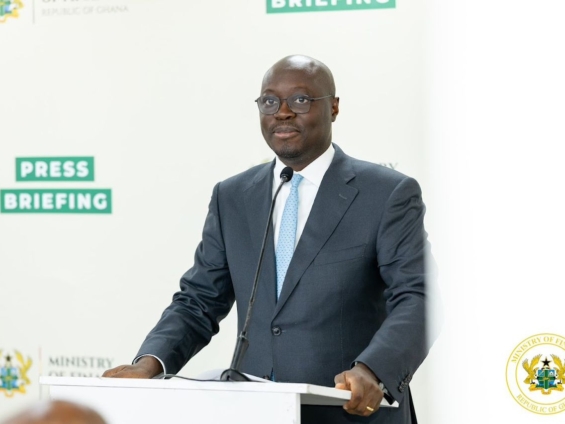
Speaking at a press conference yesterday, the minister outlined a series of Cabinet-approved directives designed to strengthen value addition within the country, create jobs, and reposition Ghana from a predominantly raw cocoa exporter to a leading processor of cocoa products.
Under the new financing model, the Ghana Cocoa Board (COCOBOD) will now have the flexibility to sell cocoa beans of any volume directly to local processing companies.
This move is intended to remove previous supply bottlenecks and empower domestic processors to expand operations and increase production capacity.
Cabinet has further directed that, with immediate effect, the remainder of cocoa beans for the 2025/2026 crop season be allocated primarily for domestic processing.
The decision marks a deliberate policy shift toward retaining more value within the local economy rather than exporting unprocessed beans.
Looking ahead, government has also set a clear medium-term target. Beginning with the 2026/2027 crop season, a minimum of 50 percent of all cocoa beans produced in Ghana is expected to be processed locally.
Officials say this benchmark will serve as a structural anchor to deepen industrialisation within the cocoa value chain and reduce over-reliance on raw exports.
As part of the implementation strategy, the state-owned Cocoa Processing Company (CPC) is to be revived as a priority intervention.
The company is expected to be repositioned to become a leading processor of cocoa beans, thereby strengthening Ghana’s domestic processing capacity and enhancing competitiveness in global cocoa product markets.
The finance minister disclosed that he, together with the Minister for Trade, Agribusiness and Industry, recently engaged domestic cocoa processors who expressed both the willingness and the operational capacity to process more than half of the cocoa produced in the country.
This industry readiness, he noted, provides a strong foundation for the immediate rollout of the policy.
Government further confirmed that an agreement has been reached for the immediate implementation of the new measures, signalling urgency and high-level commitment to transforming the cocoa sector.
The policy is expected to stimulate industrial growth, increase export earnings from finished and semi-finished cocoa products, and generate substantial employment opportunities across processing, logistics, and ancillary services.
Latest Stories
-
NDC threatens sanctions over oversized campaign posters, gives aspirants 5 days to comply
18 minutes -
Star Oil paid GH¢2.7bn in taxes, levies in nine months of 2026
33 minutes -
Samson’s Take: The rule of law is cheaper before the bulldozer
34 minutes -
GRA blames system failure for delay in issuing receipt over passenger’s customs duty
55 minutes -
Livestream: Newsfile discusses World Cup visa scandal, beach demolitions, education strikes, BRICS bid
59 minutes -
NC-PTAs welcomes end of teachers’ strike, urges parents to prepare children for Monday
1 hour -
Government procures over 2,000 transformers as Ghana’s electricity access hits 89.13% – Energy Minister
2 hours -
UTAG-UG threatens strike on October 19 over unpaid allowance
2 hours -
Let The Constitution direct Chieftaincy to deliver “All Development Is Local”
3 hours -
John Jinapor outlines renewable energy, nuclear power priorities for 2027
3 hours -
Ghana explores centre of excellence for hearing, communication and cochlear implant care
4 hours -
Schizophrenia-related disorders lead mental health cases recorded in Ghana
5 hours -
Dutch authorities enlist Ghana in hunt for fugitive drug lord Bolle Jos
5 hours -
Ghana housing finance conference adopts communiqué to improve affordable housing access
9 hours -
Special Initiatives Minister urges Wa Technical Institute to enrol more girls as EU-backed solar training lab opens
10 hours