

Audio By Carbonatix
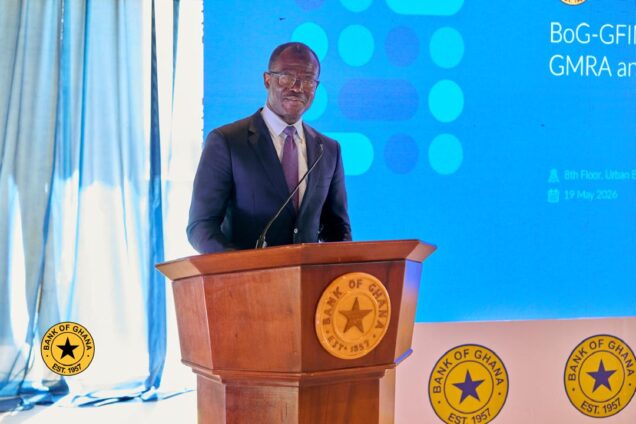
The First Deputy Governor of the Bank of Ghana, Dr. Zakari Mumuni, has stated that the rural banking story can be described as one of Ghana’s greatest innovations to financial inclusion and local financial intermediation.
He, therefore, argued that one cannot celebrate financial inclusion and local financial intermediation without talking about rural banking, now called Community Banking in Ghana.
Dr. Mumuni disclosed this at a programme to commemorate the 50 years of “Rural Banking and The Conversion to Community Banking” at the Bank Square in Accra.
According to the Bank of Ghana, the decision to convert rural banks to community banks is of a broader strategy to improve financial inclusion and aid what the regulator describes as a community level financial intermediation.
It is also in line with the Guidelines on Revised Microfinance Sector Farmwork, 2026, targeted at strengthening the sector as well.
In a regulatory, directive, the Central Bank disclosed that exiting rural banks required to complete all statutory name changes, corporate rebranding, and other regulatory alignments by the end of December 2026.
Speaking at the programme, the first Deputy Governor of the Bank of Ghana pointed out that “Ghana remains home to one of the largest and most vibrant Community Banking sectors on the African continent”.
“At 50, we can confidently say that this sector has come of age and there couldn’t have been an appropriate moment to undertake the transition from rural banking to community banking”, Dr. Mumuni added.
He also stated that “This is more than a change of name, but rather a renewal of purpose”.
The first Deputy Governor highlighted that through these reforms, “The Bank of Ghana seeks to strengthen institutions, improve business models, and expand opportunities for communities across Ghana”.
He praised the country’s development partners, like the IMF , World Bank and the German Development Corporation for their role and contribution to the development of these community banks.
“They walked this journey with us; through financial support, technical assistance, institutional capacity building, and policy development”, he added.
Dr. Mumuni concluded, saying, their contributions have been instrumental to the growth and transformation of this sector, “and as we look forward to an even stronger partnership in the years ahead”.
Latest Stories
-
Conflicts among care providers linked to maternal, neonatal deaths – Expert
36 minutes -
GIS marks 10th TIME conference, champions improved teaching practices
43 minutes -
BRICS Or Balance? What Ghana’s bid really means
1 hour -
GPRTU wants full TRAFFITECH-GH implementation to start in 2027
1 hour -
Mahama announces plans to import electric wheelchairs for PWDs
2 hours -
KGL U17 Colts 2026: Western beat Prempeh Elite Academy to set up final final with Greater Accra Region
2 hours -
Late Solanke strike salvages 10-man Spurs draw at Man United
2 hours -
Gender Ministry to monitor welfare of Nana Akua Addo’s children amid domestic violence case
2 hours -
Benedict Okyere Yeboah: Ghana’s football problem goes beyond sacking a coach
2 hours -
GPL 2026/27: Darkwah Wiafe’s winner sees All Blacks beat Kotoko
2 hours -
ITF World Tour : Patel Wins Boys’ Singles Final at J100 Accra
3 hours -
Ghana must pursue BRICS partnership if it brings economic benefits – Kpebu
3 hours -
Success and Wright Claims J100 Accra Girls’ Doubles Championship
3 hours -
ITF J100: America’s Wright wins J100 Accra Girls’ Singles Title
3 hours -
Expedition hopes to find aviator Amelia Earhart’s plane on remote island
3 hours