

Audio By Carbonatix
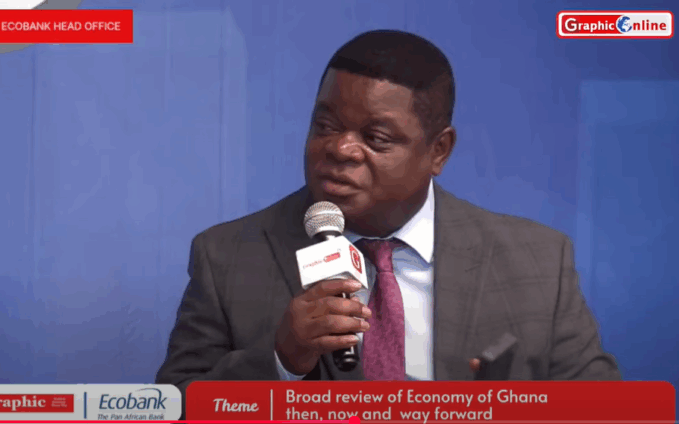
The Director of the Institute for Statistical, Social and Economic Research (ISSER), Prof. Peter Quartey says Ghana’s current tax system encourages evasion to enrich a few people.
He blamed the situation on the imposition of high taxes on businesses and individuals in an attempt to achieve targets.
Speaking at the Graphic Ecobank Economic Forum, Prof. Quartey cautioned that tax handles must not only be seen as means of achieving target, but must be a tool for behavioral correction and effective revenue collection.
Citing Ghana’s VAT system as an example, he pointed out that the computation of the consumption levy has compounded the tax burdening of businesses and consumers.
“Our tax levels are too high, in my view. Our VAT is 21% plus. Some are even straight levies that you cannot claim input tax, and what have you. But look at our competitors. On average, some are paying 15%, 18%, and we are charging over 21%. So what you are doing is that you are encouraging people to evade”, he cautioned.
Prof. Quartey observed that the situation has created an environment that fuels conspiracy and corruption between state officials responsible for tax collections, and businesses required to pay taxes.
“When your tax is too high, it calls for tax evasion. So you are enriching customs officials, you are enriching businessmen, and the government is struggling for money”, he stressed.
According to him, the development is made worse due to the fact that Ghana’s economy is largely informal, making it difficult to trace and punish tax evaders.
“We have an informal economy. Over 80% of our economy is informal. We have not devised a proper mechanism for taxing the informal sector”.
This, he said has resulted in a situation where a few workers in the formal economy are targeted and overburdened with taxes.
“All we do is the 20%. Why should we focus so much on the 20% and over tax them and leave the 80%?, he quizzed.
Proffering some solutions, Prof. Quartey called f or a serious examination of the VAT system and engage broadly to bring the informal sector into the tax bracket.
“We need to look at this critically. Otherwise, we would not be making a lot of inroads in terms of tax revenue mobilisation, and that is why we keep borrowing. Because we are not raising enough revenue”.
He cautioned that increasing taxes will not necessarily lead to a corresponding increase in tax to GDP ratio.
“Tax to GDP at best, 14%, when some are doing 18, 20, 23% within Africa. So it tells you there is a lot of risk inherent to risk”.
He added that one way to get the public to voluntarily pay taxes is to judiciously use revenue collection in the wellbeing of the public.
“Maybe later we'll talk about even how efficiently we even use the revenue, because it's not just about raising the revenue, but how well you use the revenue to advance your cause”.
The forum, held at the Ecobank Head Office under the theme “A broad review of the economy of Ghana: Then, now, and the way forward,” also featured remarks from Presidential Advisor on the Economy, Seth Terkper, and PwC Ghana’s Tax Partner, Abeku Gyan-Quansah. Participants explored issues of monetary policy, taxation and fiscal discipline, with a focus on repositioning Ghana’s economy for long-term growth.
Latest Stories
-
Ablakwa receives Presidential Special Envoy on Reparations to advance global agenda
8 minutes -
Christina Koch becomes first woman to travel around the moon on Artemis II
18 minutes -
Epstein survivors’ calls to meet King Charles and Queen harder to ignore as US visit approaches
24 minutes -
UN Secretary-General names Ghana’s Anita Kiki Gbeho as South Sudan envoy
26 minutes -
Mali withdraws recognition of Sahrawi Republic, backs Morocco’s autonomy plan
30 minutes -
Gov’t distributes over 8,500 laptops to One Million Coders project
31 minutes -
Julius Debrah, ‘man to beat’ as NDC’s James Agbey dismisses Musah Dankwah’s polls
37 minutes -
GPRTU in Savannah Region to protest alleged eviction in Damongo
1 hour -
Re: Reinsurance does not replace process — A response to the SIGA–SIC defence
1 hour -
Gender Ministry supports Harriet Amuzu in ongoing abuse case
2 hours -
AG joins plaintiff to scrap OSP ?: We should be mindful of the mischief in this – Bobby Banson
2 hours -
Samson Lardy Anyenini questions willingness of Attorneys-General to prosecute political colleagues
2 hours -
It is only fair the OSP is heard in Supreme Court case – Bobby Banson
2 hours -
Asiedu Nketia resumes Ashanti tour, second leg kicks off on Sunday
2 hours -
NLA denies salary cut claims, threatens legal action over reports
2 hours