

Audio By Carbonatix
The Ghana Health Service (GHS) has developed a new policy aimed at attracting and retaining health professionals in deprived areas of the Country.
Consequently, Regional Health Directors have been tasked to ensure that the policy worked effectively in their respective Regions to achieve its intended objective.
The immediate Past Chairman of the GHS Council, Dr Yao Yeboah, who made this known underscored the need to ensure equitable distribution of health professionals as Ghana sought to achieve universal health coverage.
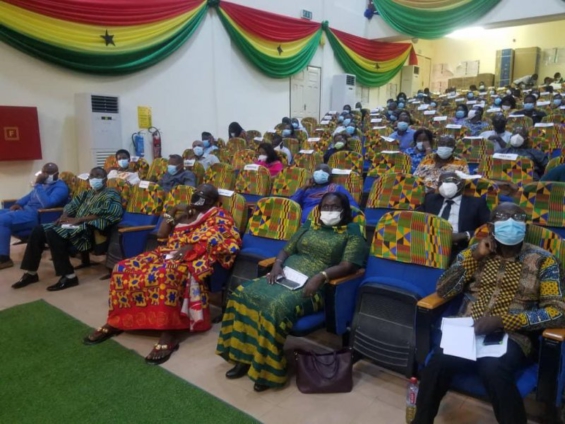
He was speaking at the opening of a two-day Central Regional health sector 2020 annual performance review in Cape Coast.
The performance review was on the theme: “Achieving universal health coverage, containing the Covid-19 pandemic, improving good governance and services; the role of stakeholders”.
“The issues of having very few professionals in deprived areas has been on the drawing table of the GHS for some time now. Accra alone has got 30 percent of all doctors in Ghana but does not have 30 percent of the population of Ghana”.
“One hospital in Greater Accra has more doctors than in the Upper West Region. That is unfair”, he added.
Under it, health professionals who opted to serve in deprived areas of the country would among other things have quicker promotion and opportunities for further training compared to their colleagues in the cities.
They would also be automatically transferred to the city after three years of service in a deprived community.
“If a staff is sent to a deprived area, the staff will not be condemned to life term imprisonment there, maximum three years, the staff should not request for transfer but automatically be brought to the city and be replaced.
“ ...this has worked in some institutions and could work in the GHS too”, Dr Yeboah assured.
Deputy Director-General, Dr Anthony Adofo Ofosu, of the GHS said the Service was finalizing plans to set up and strengthen systems to help address staff needs like compensation, benefits and training packages.
This, he emphasised would ensure that staff were more skillful, efficient, motivated, equitably distributed and well protected during the delivery of services, especially in this Covid-19 pandemic era.
Going forward, he said the Service would focus on promoting opportunities for health research which was paramount in the provision of evidence-based health policies and practices.
“One other area that the pandemic has brought to the fore is the importance of health research. There is strong evidence that a research-informed health system with a research-aware workforce ultimately results in better outcomes for patients”, he said.
Latest Stories
-
Iran war lands ‘triple blow’ to flood-ravaged Sri Lankans
5 minutes -
Gunmen kill at least 11 people at Afghanistan picnic spot
19 minutes -
Woman, 25, in court for stealing baby at Bogoso
20 minutes -
Trump unveils giant gold-accented victory arch design for US capital
23 minutes -
We spoke to the man making viral Lego-style AI videos for Iran. Experts say it’s powerful propaganda
28 minutes -
Hungarians vote in big numbers on whether to end Orbán rule and elect rival
28 minutes -
At least 30 feared dead in crush at Haitian tourist site
29 minutes -
Boxing: Abdul Ahmed wins WBA Africa Cruiserwight title after dispatching Nigeria’s Eradeye
42 minutes -
Nearly 2,000 displaced, schools damaged as windstorm wreaks havoc in Gushegu
1 hour -
Ghana’s Derrick Kohn to work under Marie-Louise Eta as she becomes first woman to coach men’s Bundesliga team
1 hour -
Accra Open Championships conclude with strong performances ahead of African Championships
1 hour -
Ghana to begin camping with 12 athletes after Accra Open Championships – Bawa Fuseni
2 hours -
Anthony Joshua declines showdown with Tyson Fury but admits they ‘probably’ clash next
2 hours -
Tyson Fury dominates Makhmudov, calls out Joshua next
2 hours -
I have supported highway authority financially to fix roads in my constituency – A Plus
3 hours