

Audio By Carbonatix
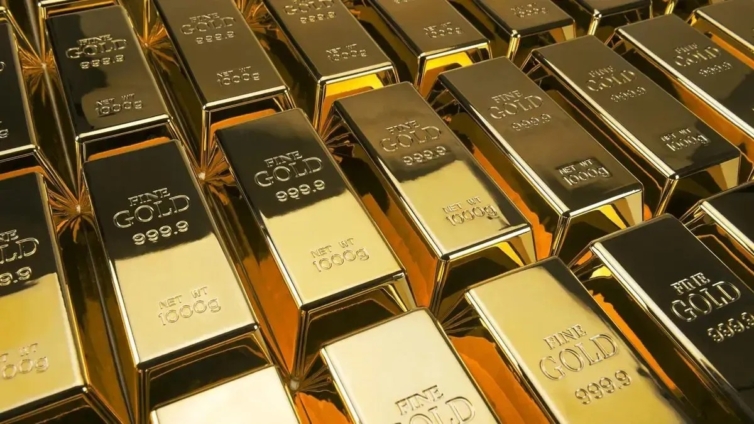
The price of gold has risen above $5,000 (£3,659) an ounce for the first time ever, extending a historic rally that saw the precious metal jump by more than 60% in 2025.
It comes as tensions between the US and NATO over Greenland have added to growing concerns about financial and geopolitical uncertainty.
US President Donald Trump's trade policies have also worried markets. On Saturday, he threatened to impose a 100% tariff on Canada if it strikes a trade deal with China.
Gold and other precious metals are seen as so-called safe-haven assets that investors buy in times of uncertainty. On Friday, silver topped $100 an ounce for the first time, building on its almost 150% rise last year.
Demand for precious metals has also been driven by a range of other factors, including higher-than-usual inflation, the weak US dollar, buying by central banks around the world and the expectation that the US Federal Reserve will cut interest rates again this year.
Wars in Ukraine and Gaza, as well as Washington's seizure of Venezuelan President Nicolás Maduro, have also helped push up the price of gold.
One of the biggest appeals of gold is its relative scarcity. Only around 216,265 tonnes of the metal have ever been mined, according to the World Gold Council trade association.
That's enough to fill between three and four Olympic-sized swimming pools. The majority of that was only extracted from the earth since 1950, as mining technology advanced and new deposits were discovered.
The US Geological Survey estimates that another 64,000 tonnes of gold can still be mined from underground reserves, although the metal's supply is expected to plateau in the coming years.
"When you own gold, it's not attached to the debt of somebody else like a bond is or an equity where the performance of a company will drive performance," said Nicholas Frappell, global head of institutional markets at ABC Refinery.
"It's a really good diversifier in a very uncertain world," he added.
'People go to gold'
Gold saw a blockbuster year in 2025, with its biggest annual gain since 1979 as investors flocked to precious metals.
With financial markets spooked by concerns including Trump's tariffs and fears that artificial intelligence-related stocks are overpriced, gold repeatedly hit new record highs.
"I think a large part of that is the extreme uncertainty we have around US policy," said Nikos Kavlis from research consultancy Metals Focus.
While economic concerns can help to push up the price of gold, it also tends to rise when investors expect interest rates to be cut.
Lower rates typically mean smaller returns for investments such as bonds, so investors look to assets like gold and silver.
The US Federal Reserve is widely expected to cut its main interest rate twice this year.
"It's inversely correlated because the opportunity cost of keeping the money in a [government bond] is really not worth it anymore, so people go to gold," said Ahmad Assiri, Research Strategist at Pepperstone.

It's not just investors who have been buying up gold.
Last year, central banks added hundreds of tons of bullion to their reserves, according to the World Gold Council.
"There's a very clear shift away from the US dollar, which is benefiting gold immensely," said Kavalis.
The start of this year has seen gold continue to rally, but Frappell warns the "news-driven" market could also result in a fall in its price.
"There's got to be scope for unexpected news that actually might be positive for the world and not necessarily positive for gold," he said.
But not everybody is buying gold for purely investment reasons.
In many cultures, the metal is purchased during festivals or given as gifts at celebrations such as weddings.
In India, the annual Diwali festival is believed to be an auspicious occasion to buy precious metals in order to bring on wealth and luck.
According to the US investment bank Morgan Stanley, Indian households held $3.8tn of gold, equivalent to 88.8% of the country's gross domestic product (GDP).
Neighbouring China is the world's largest single consumer market for gold, with many believing that buying it brings good fortune.
"We often see a seasonal uptick in demand around Chinese New Year, which we are seeing at the moment to an extent," said Kavalis, referencing the upcoming Year of the Horse, which begins in February.
Latest Stories
-
Berekum Chelsea edge Aduana FC in Bono derby to boost survival hopes
3 hours -
‘They can’t control the team’ – Ernest Thompson doubts local coaches for Black Stars role
4 hours -
Ghana-born midfielder Seidu realises ‘dream’ with Atlético Madrid debut
4 hours -
GPL 2025/26: Bubakari strikes late to hand All Blacks vital win over Dreams FC
4 hours -
Fatal crash on Kintampo–Tamale highway claims four lives
4 hours -
2025–26 FA Cup Semifinal Draw: Chelsea, Man City Learn Wembley Opponents
5 hours -
GPL 25/26: Gold Stars back on top after beating Nations FC
5 hours -
GPL 2025/26: Heart of Lions roar back with victory over Vision FC in Kpando
6 hours -
Solomon Agbasi: Hearts keeper in stable condition after concussion
6 hours -
GPL 2025/26: Late Salim Adams penalty earns Medeama draw at Bechem
6 hours -
Hearts pip Young Apostles 1-0 to end 5-game winless run
7 hours -
Boakye Agyarko marks Easter Sunday with a call for Godly leadership ahead of nationwide campaign tour
8 hours -
Pepsi withdraws as UK festival sponsor after Kanye West backlash
8 hours -
Pope Leo calls for global leaders to choose peace in his first Easter Mass
8 hours -
Kpando MP highlights progress on road projects
8 hours