

Audio By Carbonatix
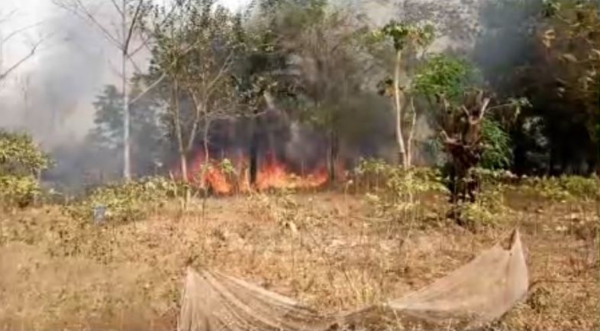
The Ghana National Fire Service (GNFS) has launched a National Bush-fire Prevention campaign with the assurance by the government to protect the country's natural landscape from the destructive forces of bush-fires.
The Director of Finance and Administration at the Interior Ministry, Doreen Payin Annan who read a speech on behalf of the Interior Minister, Ambrose Dery called for collaborative efforts to continuously reduce bush-fires while calling for the enforcement of the Control and Prevention of Bush-fires Act – 1990 (PNDCL 229).
"The government, on its part, is not sparing any effort to protect our natural landscape from the destructive forces of bush-fires. The protection of our environment, our communities, and the safety of our citizens is our solemn duty.”
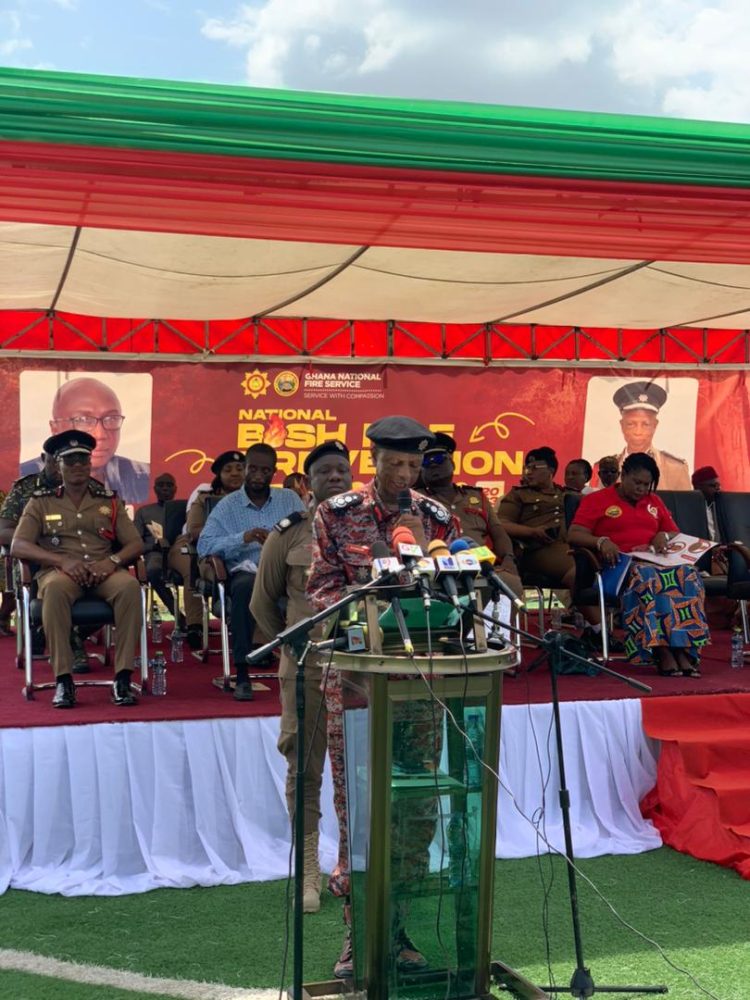
"I will further urge the Ghana National Fire Service to give life to the Control and Prevention of Bush-fires Act-1990 (PNDCL 229). Defaulters of this law do not have any more excuses after 33 years of sensitisation and education for which they cannot be held responsible for their actions if they go contrary to the law,'' she said.
The Chief Fire Officer, Julius Aalebkure Kuunuor said the service recorded a reduction of bush-fires by 27.5 per cent for the 10-month period of the year 2023.
In spite of this progress, according to him, over 75,000 hectares of vegetation and forest cover across the country were destroyed through bush-fires annually.

"The loss of vegetation according to the Service contributes to a three percent loss to the country's gross domestic product.
However, this year, a significant reduction of 218 representing 27.5 percent has been recorded for the first three quarters.
From January to October 2023, 583 bush-fires were recorded as against 791 for the same 10-month period in 2022," he revealed.
He explained that 60 percent of the country's population relied on agriculture, adding that disruption to the sector can have severe implications for the economy.

“Bush-fires pose a significant threat to our environment, destroying vast areas of vegetation, wildlife habitats, and farmlands. The consequences of these are far-reaching, affecting not only natural resources but also our food security.
"Ghana relies heavily on agriculture, as 60 percent of the population is involved in it. Any disruption has severe implications on the economy and well-being of our people,” he stated.
Latest Stories
-
Monetise Idiocy In Ghana
2 minutes -
The Ghanaian prophet and the mysterious death of his scottish wife Charmain Speirs
47 minutes -
Nearly 400 sentenced in Nigeria for links to militant Islamists
1 hour -
Ghana’s recovery supported by gold strength despite global oil price pressures – Standard Bank Research
1 hour -
‘Excellence is our inheritance’ – Nana Sam Brew-Butler hails Mfantsipim’s 150-year reign in leadership
2 hours -
Kwaku Azar writes: A-G vs OSP
2 hours -
Mfantsipim–Adisadel rivalry built excellence, not division – Sam Jonah
2 hours -
Vice President launches Mfantsipim’s 150 years of shaping Ghana’s greatest mind
3 hours -
I assure Otumfuo, Mahama will join him to commission KNUST Teaching Hospital by end of this year – Haruna Iddrisu
3 hours -
Barcelona dominate derby to extend La Liga lead
3 hours -
Gov’t to roll out free special education for persons with disabilities from July 1 – Education Minister
4 hours -
Importers and Exporters Association declares full support for Publican AI port system
4 hours -
“We used it to test our officiating officials’ readiness” – Bawah Fuseini after CAA Athletics event
4 hours -
Volleyball emerges as Ghana’s fastest rising sport
4 hours -
National Sports Fund needs strong leadership from the top – Administrator David Wuaku
4 hours