
Audio By Carbonatix
As part of efforts to bridge the gap in the telecommunication network connectivity, Government through the Ministry of Communications and Digitalisation, has committed about €155 million to supplement universal service funds to boost broadband services in rural areas and narrow the digital divide.
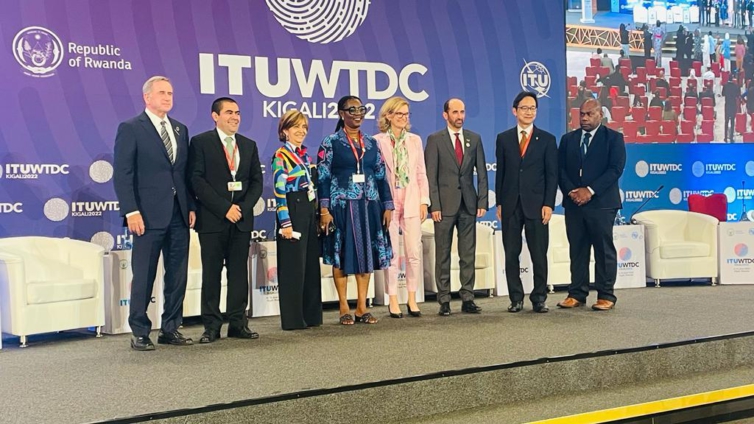
The Minister for Communications and Digitalisation, Ursula Owusu-Ekuful, made the disclosure during the 2022 World Telecommunications Development Conference (WTDC) roundtable discussion in Rwanda.
According to her, 2,016 project cell sites are being built across the country to connect about three million Ghanaians by 2023.
She also revealed that a similar amount will be committed to the second phase, once the current phase of the Rural Telephony and Digital Inclusion Project is completed.
The Minister said government has pledged an open spectrum policy to facilitate the usage of any technology to connect more than 6,000 villages across the country.
Under the programme, three million Ghanaians will be connected by 2023, in addition to building the shared infrastructure for rural connectivity.
“We have mandated and are implementing a national roaming policy for any user to access broadband and emergency call services in our rural, unserved and underserved communities, regardless of their service provider,” she said.
Mrs. Owusu-Ekuful further reiterated Ghana’s commitment to enhance digital skills to empower the citizens to develop and utilise digital solutions to address social and economic challenges.
She recounted how government has committed about $2.6 million to add two innovation centres for the training of at least 3,000 people by 2024.

The Girls in ICT programme, the Minister noted, which was initially targeted at 1,000 female students from selected basic schools has been up-scaled to 5,000 girls who have begun training in five regions.
It is expected that an equal number of young women will be trained at the tertiary level.
She disclosed that Ghana has an agreement with SMART Africa Alliance, “working through the Smart Africa digital Academy, to train up to 22,000 persons by 2023.”
According to the Minister, Ghana’s Universal Access and Service Fund Administration operates over 220 Community ICT Centres (CICs) across rural communities with a programme to build capacity, offer skills training as well as advisory services.
Ghana is collaborating with the ITU and NORAD to train more than 14,000 individuals by 2023, utilising the network of CICs.
A total of 220 CICs have been put in place to train 105,600 persons annually, with government seeking collaboration with partners and financiers to expand the space to deliver digital skills to at least 200,000 persons by 2024.
Latest Stories
-
Jinijini–Sampa road to be completed by 2027 — Mahama
6 hours -
Afroman wins legal battle over songs mocking US police
6 hours -
MTN Ghana deepens role in national growth with record tax contributions and expanded investments
6 hours -
Kevin Spacey and accusers settle before civil trial
6 hours -
Premier League extends £30 cap on away tickets
6 hours -
Oyarifa Police arrest pastor over alleged sexual abuse of 9-year-old stepdaughter
6 hours -
Haaland invests in new global chess tour
6 hours -
Denounce ‘abject’ Afcon decision – senior CAF member
6 hours -
Ashanti Police arrest 12 suspects in robbery, link 3 to Kusasi Chief murder at Asawase
7 hours -
Uefa calls leagues to summit over ‘microscopic’ VAR
7 hours -
Ghana’s Ambassador to US meets White House Task Force over 2026 World Cup
7 hours -
Fifa rules women’s teams must have female coaches
7 hours -
Mahama engages Bono residents, outlines key projects under Resetting Ghana tour
7 hours -
Cattle prices hit GH₵ 25000 at Techiman ahead of Eid-Al-Fitr festivities
7 hours -
Former CDS General Thomas Oppong‑Peprah honoured by France
7 hours