

Audio By Carbonatix
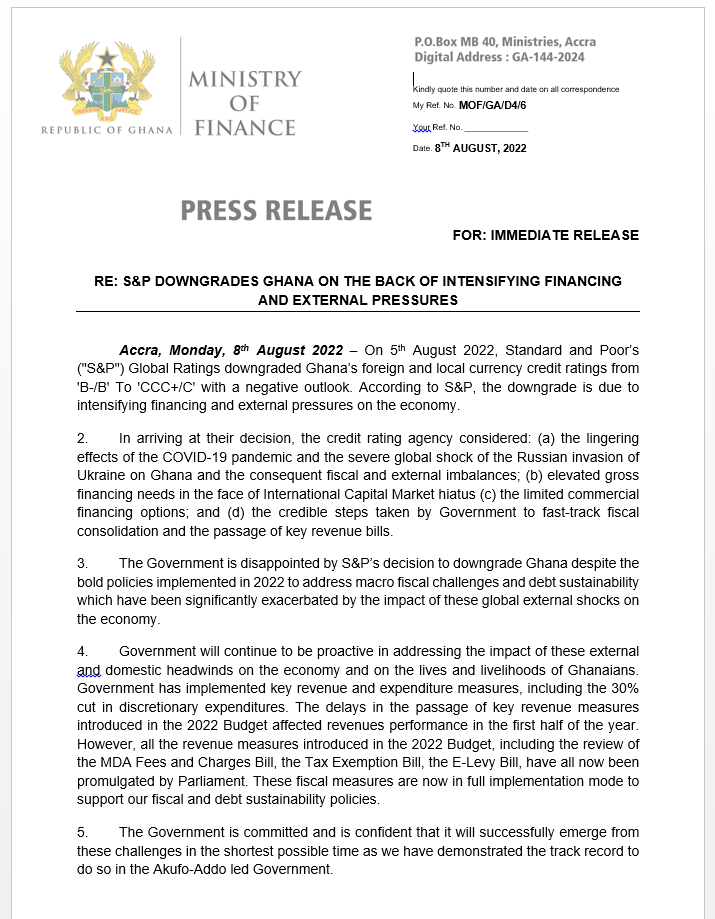
The government has expressed disappointment by rating agency, S&P’s, decision to downgrade Ghana despite the bold policies implemented in the 2022 to address macro fiscal challenges and debt sustainability which have been significantly exacerbated by the impact of these global external shocks on the economy.
In a statement from the Finance Ministry, it said government will continue to be proactive in addressing the impact of these external and domestic headwinds on the economy and on the lives and livelihoods of Ghanaians.
“Government has implemented key revenue and expenditure measures, including the 30% cut in discretionary expenditures. The delays in the passage of key revenue measures introduced in the 2022 Budget affected revenues performance in the first half of the year. However, all the revenue measures introduced in the 2022 Budget, including the review of the MDA Fees and Charges Bill, the Tax Exemption Bill, the E-Levy Bill, have all now been promulgated by Parliament”.
“These fiscal measures are now in full implementation mode to support our fiscal and debt sustainability policies”, the statement explained.
Furthermore, it said the government is committed and is confident that it will successfully emerge from these challenges in the shortest possible time as “we have demonstrated the track record to do so in the Akufo-Addo led government”.
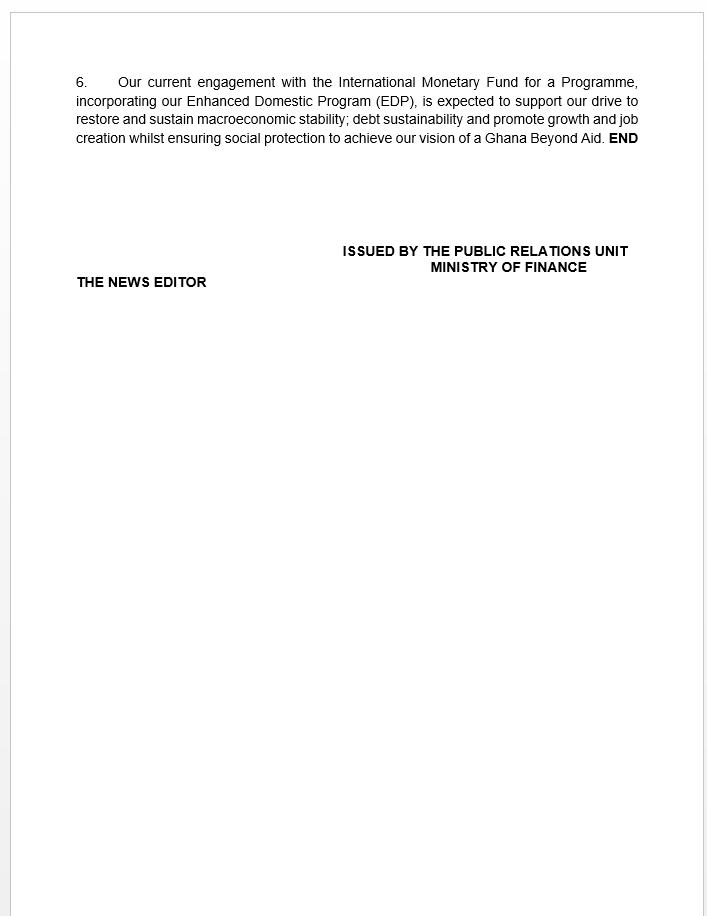
“Our current engagement with the International Monetary Fund for a programme, incorporating our Enhanced Domestic Program (EDP), is expected to support our drive to restore and sustain macroeconomic stability; debt sustainability and promote growth and job creation whilst ensuring social protection to achieve our vision of a Ghana Beyond Aid”, it concluded.
Standard and Poor’s ("S&P") Global Ratings on Friday August 5th, 2022 downgraded Ghana’s foreign and local currency credit ratings from 'B-/B' To 'CCC+/C' with a negative outlook.
According to S&P, the downgrade is due to intensifying financing and external pressures on the economy.
In arriving at its decision, the credit rating agency considered the lingering effects of the COVID-19 pandemic and the severe global shock of the Russian invasion of Ukraine on Ghana and the consequent fiscal and external imbalances; elevated gross financing needs in the face of International Capital Market hiatus; the limited commercial financing options and the credible steps taken by government to fast-track fiscal consolidation and the passage of key revenue bills.
Latest Stories
-
AG joins plaintiff to scrap OSP ?: We should be mindful of the mischief in this – Bobby Banson
5 minutes -
Samson Lardy Anyenini questions willingness of Attorneys-General to prosecute political colleagues
7 minutes -
It is only fair the OSP is heard in Supreme Court case – Bobby Banson
13 minutes -
Asiedu Nketia resumes Ashanti tour, second leg kicks off on Sunday
21 minutes -
NLA denies salary cut claims, threatens legal action over reports
25 minutes -
BoG Governor honoured for stabilising cedi, improve inflation
28 minutes -
Trade Minister applauds GUTA as a pillar of economic growth; Prez Mahama honoured
1 hour -
President’s brother’s takeover of Damang Mines is ‘untidy’ – Alhassan Tampuli
2 hours -
It’s not true that gov’t decided not to renew the lease for Gold Fields – Bobby Banson
2 hours -
Ghana to boost tomato production with 60-hectare irrigated farms and processing initiatives
2 hours -
E&P’s takeover process of Damang Mines was very clean – Inusah Fuseini
2 hours -
Damang takeover: There is not going to be any job loss; it is a lease change – Bobby Banson
2 hours -
Gold Fields didn’t stop mining at Damang mines; such claims are untrue – Bobby Banson
3 hours -
Engineers and Planners currently operate only in Ghana – Bright Simons
3 hours -
Lands Minister has no legal basis to restrict lease to Ghanaian firms – Bright Simons
3 hours