

Audio By Carbonatix
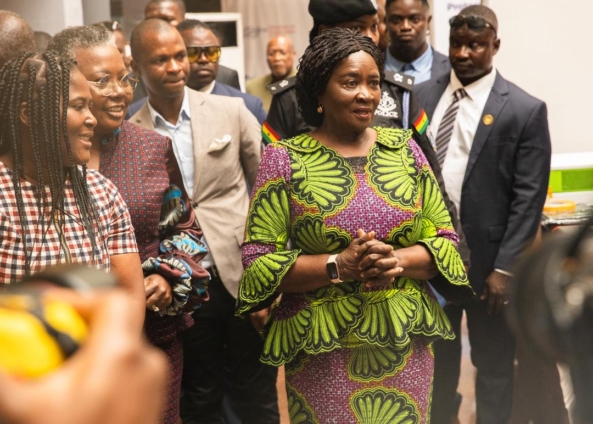
Vice President Professor Jane Naana Opoku-Agyemang says the government remains committed to strengthening Ghana’s aquaculture sector through increased investment, innovation, and stronger public-private partnerships.
Speaking at the launch of the 3rd edition of Aquaculture Ghana 2025 at the World Trade Center in Accra, Prof. Opoku-Agyemang said the goal is to position Ghana as a regional leader in sustainable aquaculture and create opportunities for young people and women entrepreneurs.
“Government will continue to prioritise agriculture, especially aquaculture, to ensure there’s adequate investment, incentives, and fiscal support,” she said.
“These measures are intended to unlock private investment, drive innovation, and position Ghana as a regional leader in sustainable aquaculture.”
The Vice President noted that the Fisheries Commission is already implementing measures to improve the sector’s resilience, including enhanced farm-level biosecurity, stronger laboratory diagnostics, and better disease surveillance and early warning systems.
She emphasised that the future of aquaculture depends on collaboration between the government and the private sector, particularly in adopting technology and sustainable practices.
“The future of aquaculture depends on public-private partnerships, as well as on innovation — including remote water quality monitoring to protect the environment,” she added.
According to Prof. Opoku-Agyemang, such partnerships will help scale up fish production, processing, and exports while promoting local consumption. She also highlighted the government’s commitment to supporting women and youth through skills training, mentorship, and access to finance.
“These partnerships will create an enabling environment for youth innovators and women entrepreneurs through skills development, mentorship, and access to finance. I’m sure the women and the youth are happy to hear this,” she said.
Describing aquaculture as a “development agenda and a social contract,” the Vice President urged stakeholders to use the two-day forum to deliberate on practical measures that can translate discussions into tangible outcomes.
“As we deliberate over the next two days, I invite you to reflect on how to optimise productivity through efficient and sustainable practices, strengthen collaboration among government, academia, industry, and communities, and take concrete actions that move the sector forward,” she said.
Latest Stories
-
Port crises loom as 11,000 drivers threaten four-day strike
1 hour -
A source of excellence across generations – Vice President Opoku-Agyemang lauds Mfantsipim
2 hours -
(Photos) Mfantsipim School launches historic 150th anniversary
2 hours -
Knights and Ladies of Marshall group backs Catholic Bishops’ stance on anti-LGBTQ+
3 hours -
Bright Simons writes: All the Filla in the Ibrahim Mahama/E&P – Gold Fields Saga
4 hours -
Monetise Idiocy In Ghana
4 hours -
ECG kicks off Phase Two of transformer upgrades at Lashibi; brief outages expected
5 hours -
The Ghanaian prophet and the mysterious death of his scottish wife Charmain Speirs
5 hours -
Nearly 400 sentenced in Nigeria for links to militant Islamists
5 hours -
Ghana’s recovery supported by gold strength despite global oil price pressures – Standard Bank Research
5 hours -
Methodist Church hails Mfantsipim@150; calls for “fresh consecration” to excellence
5 hours -
‘Excellence is our inheritance’ – Nana Sam Brew-Butler hails Mfantsipim’s 150-year reign in leadership
6 hours -
Kwaku Azar writes: A-G vs OSP
6 hours -
Mfantsipim–Adisadel rivalry built excellence, not division – Sam Jonah
6 hours -
Vice President launches Mfantsipim’s 150 years of shaping Ghana’s greatest mind
6 hours