

Audio By Carbonatix
School violence in Ghana is no longer an occasional headline — it is becoming a troubling national pattern. A recent viral video showing a senior high school student under attack by colleagues has reignited public concern about safety, discipline, and emotional control within our educational institutions.
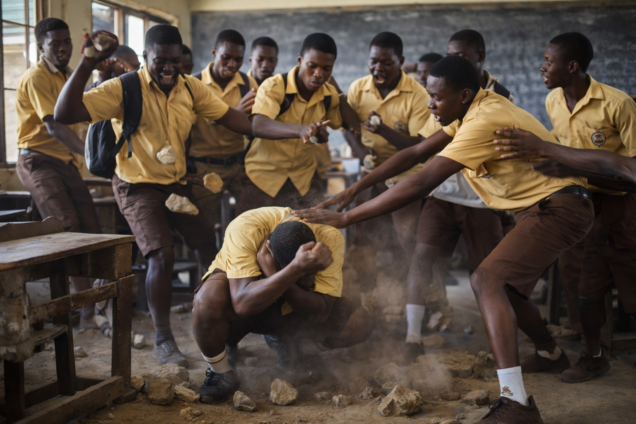
The footage is disturbing. A student crouches under a barrage of stones and blows while a few attempt to shield him. It is painful not simply because of the assault, but because of what it represents — a slow erosion of restraint, authority, and responsibility.
“A classroom that tolerates chaos today will graduate confusion tomorrow.”
This is not an isolated episode. Ghana has witnessed repeated reports of student clashes, attacks on teachers, and destruction of school property. According to UNESCO’s research on school violence and bullying, school aggression often reflects deeper social, emotional, and systemic pressures beyond the classroom walls.
Causes of School Violence in Ghana
1. The Home Environment: Discipline as Shared Responsibility
Schools are extensions of our homes. When discipline at home becomes negotiable, school discipline becomes fragile. In some cases, parents challenge sanctions before seeking full understanding. When students perceive consequences can be reversed externally, deterrence weakens.
“When authority is constantly negotiated, accountability becomes optional.”
2. Digital Influence and the Normalisation of Aggression
Today’s students inhabit both physical and digital spaces. Social media amplifies confrontation. Altercations are recorded, shared, sometimes celebrated. Adolescents — still developing emotionally — may internalise viral aggression as validation.
Digital literacy must move from optional conversation to structured engagement.
3. Inconsistent Enforcement
Institutional authority depends on predictable consequences. If disciplinary measures appear uncertain or lenient, credibility erodes. The Ghana Education Service must ensure clarity, fairness, and uniform enforcement — balanced with counselling and rehabilitation.
4. Overcrowding and Emotional Pressure
The Free SHS policy expanded access — a commendable national achievement. Yet overcrowded dormitories, stretched supervision, and academic pressure heighten adolescent tension. Without adequate counselling structures, minor conflicts escalate rapidly.
5. Broader Societal Signals
Students mirror society. When public discourse models hostility, classrooms absorb it. A nation cannot shout daily and expect whispers in its classrooms.
“The classroom is a mirror — and the nation must examine its reflection.”
Why School Violence in Ghana Matters
- Psychological trauma for victims and witnesses
- Normalisation of mob culture
- Erosion of teacher authority
- Decline in academic performance
- Long-term civic instability
If violence becomes normalised within school walls, its consequences will extend far beyond school gates.
The Way Forward: A National Reset
Parents
Reinforce boundaries at home and partner constructively with educators.
Schools & Ghana Education Service
Strengthen enforcement of codes of conduct and expand counselling and emotional development programmes.
Law Enforcement
Where behaviour crosses into criminality, decisive action must follow.
Students
Peer leadership must replace mob psychology. Silence in the face of wrongdoing is complicity.
5 Urgent Causes of School Violence in Ghana
- Weak home-school discipline alignment
- Social media glorification of aggression
- Inconsistent disciplinary enforcement
- Overcrowding and academic stress
- Hostile civic rhetoric
What Ghana Must Decide Now
School violence in Ghana forces us to confront an uncomfortable national question: are we raising disciplined citizens — or merely graduating emotionally reactive adults?
Adolescence is not an excuse for cruelty. It is a stage that demands guidance. Identity, pride, peer approval, insecurity, and frustration collide in the teenage mind. Without deliberate mentorship, emotional literacy, and consistent boundaries, youthful energy does not disappear — it hardens. It organises itself. And sometimes, it gathers into a mob.
We must stop treating each viral assault as an isolated embarrassment. It is not. It is a signal. And signals ignored eventually become culture.
If students learn early that collective aggression carries little consequence, they internalise a dangerous lesson: that power lies in numbers, not in character. Today’s schoolyard mob can become tomorrow’s workplace intimidation, political thuggery, or civic disorder.
The Ghana Education Service must treat counselling units not as decorative departments but as strategic national assets. Conflict resolution training, peer mediation structures, and digital responsibility education must be institutional, measurable, and mandatory.
Equally, school leaders require visible backing. A headmaster who enforces discipline must not stand alone. Authority that is publicly undermined quickly becomes privately irrelevant.
If discipline becomes optional in adolescence, enforcement becomes inevitable in adulthood.
This conversation is not about harshness. It is about structure. It is about forming citizens who can disagree without violence, compete without cruelty, and lead without intimidation.
The real question is simple: what kind of nation are we rehearsing inside our classrooms?
A Final Word from the Republic
The school bell must ring for learning — not for chaos.
This moment must not pass as another viral headline. It must serve as a national wake-up call.
Latest Stories
-
COMAC says Uniform Fuel Pricing Fund should not be confused with fuel subsidy
3 minutes -
Mercy Ships targets over 2,000 surgeries, 3,500 dental treatments during Ghana mission
5 minutes -
NITA appoints ShaQ Express founder Anthony Owusu-Ansah as Acting Deputy DG
11 minutes -
Government moves to compel public institutions to buy food from Ghanaian farmers
17 minutes -
‘Baffour Awuah won’t die in EOCO’s detention, even if he dies there, that’s okay for us’ – John Boadu
21 minutes -
OccupyGhana calls for parliamentary scrutiny of EOCO, BNI powers
27 minutes -
Mahama calls for continued care for Mercy Ships patients after surgeries
32 minutes -
NDPC DG calls for stronger financing, accountability to improve nutrition outcomes
38 minutes -
Over 130 courts are without magistrates – JUSAG
47 minutes -
SWAG calls on GFA leadership to fix Ghana football or step aside
54 minutes -
Gender Ministry launches breast cancer campaign, pushes support over stigma
60 minutes -
Feed Ghana Programme cuts food import dependence
1 hour -
Mahama welcomes Global Mercy Hospital Ships back to Ghana
1 hour -
Tourism Minster calls for improved maintenance, consistent storytelling at tourist sites
1 hour -
Katamanso Police Station appears complete outside but unfinished inside – Aidoo
1 hour