

Audio By Carbonatix
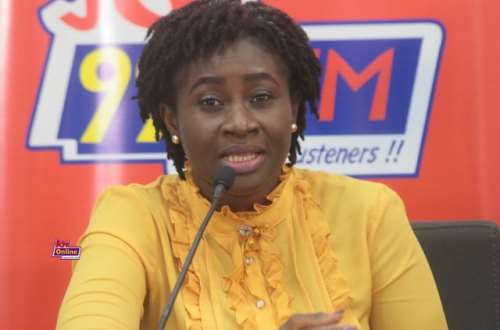
Senior Lecturer at the University of Ghana’s Department of Economics, Dr. Priscilla Twumasi Baffour says the economic hardship of the Covid-19 pandemic has been exacerbated by the government’s ambitious spending prior to the pandemic.
According to her, the Akufo-Addo government which had fortunately inherited a lot of resources had gone ahead to roll out a massive social expenditure scheme in the form of the Free Senior High School Policy which had taken a huge chunk of the available resources.
She says this, coupled with the unexpected Covid-19 pandemic had thus left the government with a dwindling resource pool to work with, occasioning the hardship the country currently suffers.
Speaking on JoyNews’ Newsfile Saturday, she explains that “on that scale, you see that yes, government was quite ambitious on the estimation of revenue that was to come in and based on that there has also been the argument of the free SHS.
“Because when you look at the data you see that capital expenditure in recent times have been dwindling and as a developing country we need that capital expenditure, so the argument has been should we include expenditure on free shs as a capital expenditure element because we’re investing in human capital that is something we can debate about.”
She added that “But the reality is that yes government was a bit ambitious in terms of the expectations of revenue and for that matter rolled out expenditures that are also quite ambitious. And based on all this without anticipating any significant negative shock that explains quite the position we’re in.”
Dr. Twumasi Baffour further stated that the blow the pandemic dealt the private sector has further exacerbated the economic hardship in the country.
She explained that the private sector which is still recuperating from the Covid-19 pandemic is unable to hire new employees and in some instance have laid off some workers thus contributing to unemployment in the country.
“And when you look at the unemployment situation we see that yes, our government is struggling because the private sector that is supposed to drive that agenda based on prudent economic management is also struggling to find its feet because of some of the negative effects that the pandemic has had on them,” she said.
Latest Stories
-
Greater Accra becomes first region to secure full certification of district dev’t plans
3 minutes -
Align ambition with faith, KNUST professor urges Muslim law students
6 minutes -
NAP presents industrial machines to 36 young women in Wenchi Municipality
20 minutes -
24-Hour Economy Authority, GNCCI to sign MoU to strengthen SME support structures
24 minutes -
National Peace Council urges Ghanaians to embrace diversity
28 minutes -
Parliament hosts inaugural meeting of network of parliamentary training institutes with global partners
31 minutes -
OnlyFans owner Leonid Radvinsky dies at 43
6 hours -
Nigerian police arrest 15 after viral videos of alleged sexual assault at festival
6 hours -
Ethnic, political exclusion, not theology alone drives Muslim sectarian violence in Ghana, KNUST study finds
6 hours -
Semenyo reports to Black Stars camp after Carabao Cup win
7 hours -
Colombian military plane with 125 people crashes
8 hours -
Journalism out loud: Defending truth in a divided world
11 hours -
Heath Goldfields partners local firm, receives new mining fleet to revive Bogoso-Prestea mine
11 hours -
Korle-Bu overcrowding driven by broken referral system, not just bed shortage – Doctors
12 hours -
MC Portfolio named red carpet host for 2026 Ghana Music Awards USA
12 hours