


Audio By Carbonatix
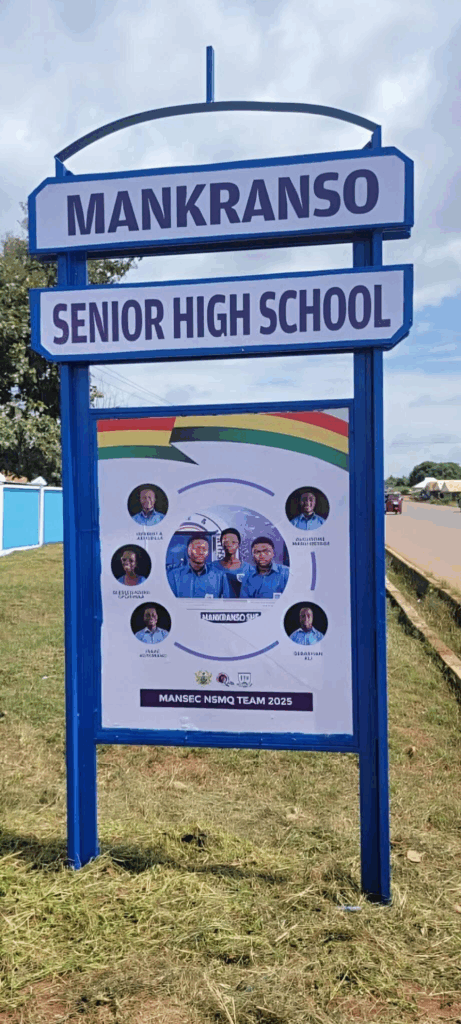
Education Minister Haruna Iddrisu has announced that Mankranso Senior High School will be upgraded following its exceptional performance in the 2025 National Science and Maths Quiz (NSMQ).
Speaking at a media briefing on Wednesday, November 19, the Minister said the school’s achievement deserves national recognition. “We will expand the number of Category A schools, and on my way here, I have added Mankranso Senior High School based on their performance at the 2025 National Math and Science Quiz,” he stated.
He praised the students for excelling despite limited resources. “My heart is warmed to reach out to them to know that the country appreciates that, given the deprivation, they have demonstrated excellence in academic pursuit,” he added.
Mankranso SHS, a Category C school in the Ahafo Ano Southwest District of the Ashanti Region, defied all odds to reach the semifinals of the 2025 NSMQ for the first time. Their achievement has drawn national attention, especially given the school’s long-standing infrastructural challenges. Some teachers have described the school as an “advanced JHS” due to its poor facilities.
From worn-out classrooms to the bright national stage, Mankranso SHS proved that brilliance can emerge from difficult conditions—and that with the right support, even more can be achieved.
Mr Iddrisu said the upgrade forms part of a broader government plan to restructure the school categorisation system. He revealed that the government intends to upgrade 10 Category B schools to Category A and 10 Category C schools to Category B, while providing additional support to schools showing exceptional promise.
He highlighted similar cases, such as a school in Kade in the Eastern Region, where a student recently won the Best Science Student award despite the absence of a science laboratory. “I’ll reward them with a laboratory into next year,” he promised.
The Minister also reflected on wider challenges in the secondary education sector, pointing to the impact of the former double-track system. He argued that the arrangement affected quality because students had fewer contact hours with teachers. “You remember double track?” he asked. “It necessarily and avoidably contributed to the low quality of education because the number of hours spent by students and teachers was affected. Many of the girls and boys spent more time at home and less time in school.”
To help close these gaps, he announced a new flagship initiative—the Ghana Secondary Learning Improvement Programme—supported by the World Bank with a US$180 million investment. “The World Bank team is in town,” he said, explaining that they are assessing facilities nationwide and will help complete some of the abandoned E-block schools.
Latest Stories
-
We can tackle multiple priorities – Sam George defends Anti-LGBTQ Bill push
14 seconds -
Statement: Ghana Chamber of Mines’ Response to Claims in Joe Jackson’s “Ananse Stories about the Economy of Ghana”
2 minutes -
GES opens 2026 teacher recruitment for licensed B.Ed graduates
4 minutes -
Ghana must value skilled trades, build resilient learners — Ibn Chambas
12 minutes -
Ghana must rethink education around relevance, resilience and responsibility — Ibn Chambas
15 minutes -
Prince Harry faces defamation lawsuit from charity he co-founded
17 minutes -
South Korea deploys thermal cameras to track escaped zoo wolf
18 minutes -
Calls for royal meeting with Epstein survivors grow ahead of US visit
22 minutes -
Ibn Chambas advocates blend of technology and human values in education
23 minutes -
UMA improves healthcare access in Asutifi North with GH₵700k ‘Kim Taylor Legacy’ Walkway
28 minutes -
Scholarships Authority and Fanaka University offer sponsorship for procurement and supply chain studies
31 minutes -
Bisa Kdei drops new single ‘Go N Look’ featuring Medikal
38 minutes -
Benin facing rising terrorism in north as French military presence faces growing criticism
39 minutes -
UEW Public Lecture Series 2026: Education debate ‘about the soul of Ghana’s future’ — Dr Ibn Chambas
40 minutes -
EU fingerprint and photo travel rules come into force from today
1 hour