

Audio By Carbonatix
Monday morning came with news of Ernest Nuamah’s anterior cruciate ligament rupture. Get French Football News, who first reported the story on X, added that the Olympique Lyonnais winger would be ruled out for four months.
Nuamah suffered the injury in the fifth minute after a duel with Lille defender Gabriel Gudmundsson. Two minutes later, he was forced off.
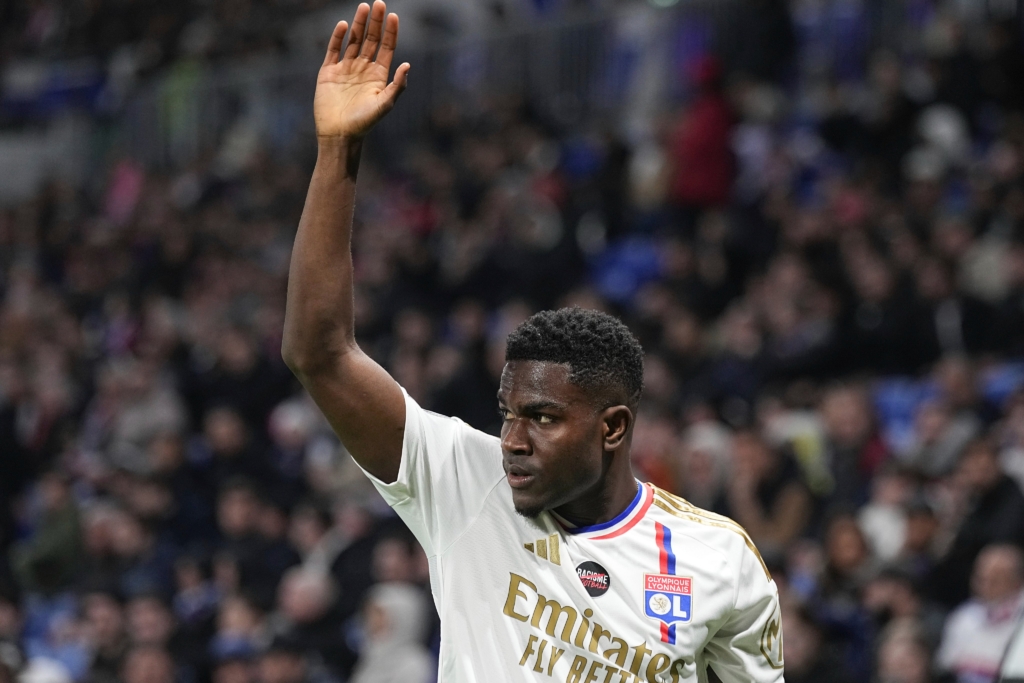
Nuamah will be out for four months, effectively ruling him out for the rest of the season
Nuamah has been an integral part of Lyon's season, scoring three goals and setting up another one in the league. He also has the same numbers in nine appearances in the UEFA Europa League.
Abdul Fatawu Issahaku was the first to be diagnosed with the dreaded injury after he came off in Ghana’s 1-1 draw with Angola in November 2024.
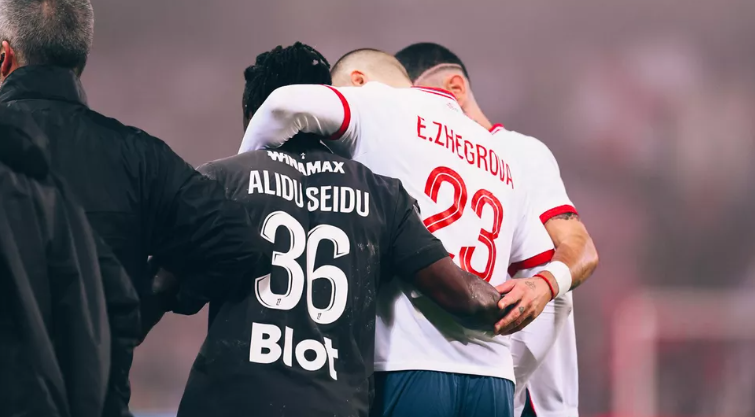
In the same month, Stade Rennes right back Alidu Seidu ruptured his ACL when he sustained the injury against LOSC Lille. The injury occurred at the worst possible time, just after Alidu was named Renne’s Player of the Month in September.
In March this year, Abdul Mumin became the third Black Star to suffer an ACL injury and was ruled out for the rest of the season.
Mumin sustained the injury while featuring for Rayo Vallecano against Sevilla, forcing him off in the 35th minute.
Before the injury, Mumin had made 24 appearances out of 26.
Nuamah has, unfortunately, joined the list of Black Stars players who have sustained the injury.
So why are Ghanaian players rupturing ACL's at never-seen-before frequency (4 ACL's in the last four months)?
Something spiritual? Ill-luck? What leaves our players frequently susceptible to ACL injuries?
Pitches.
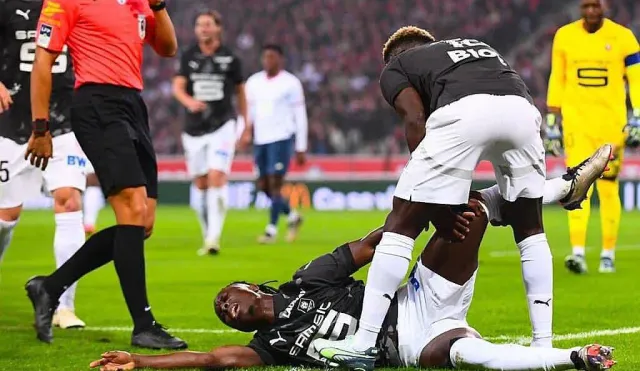
Alidu Seidu's injury occurred on the comfortable pitch ofthe magnificent Decathlon Arena – Stade Pierre-Mauroy
The truth is, you will have better luck finding a needle in a haystack than arriving at a verifiable, medically proven reason for these ligament injuries.
The circumstance for each injury is markedly different from the other.
Of the four, Fatawu’s injury is the only one that occurred while he was on Ghana duty. The other three occurred on presumably well-maintained, lush green pitches of Europe’s major leagues; twice in Ligue 1 (France), and once in La Liga. So it may not necessarily be the quality of the pitches.
Fixture overload.
That narrative is lazy at best, and malicious at worst.
Lazy because, it lifts the very meaningful case of Europe’s elite clubs who play anywhere between 45 to 50 matches per season, and still require their players to feature in competitive games during international matches.
That is not the Ghanaian players in question.
Last season, Abdul Mumin featured only 22 times across all competitions – 20 La Liga games and 2 Copa Del Rey matches.
If the argument is that during the international break, Mumin suffers from tight scheduling, that would be disingenuous because in the whole of last season, Mumin did not play for Ghana. This season, Mumin featured for Ghana against Angola on September 5, 2024, and four days later, Niger.
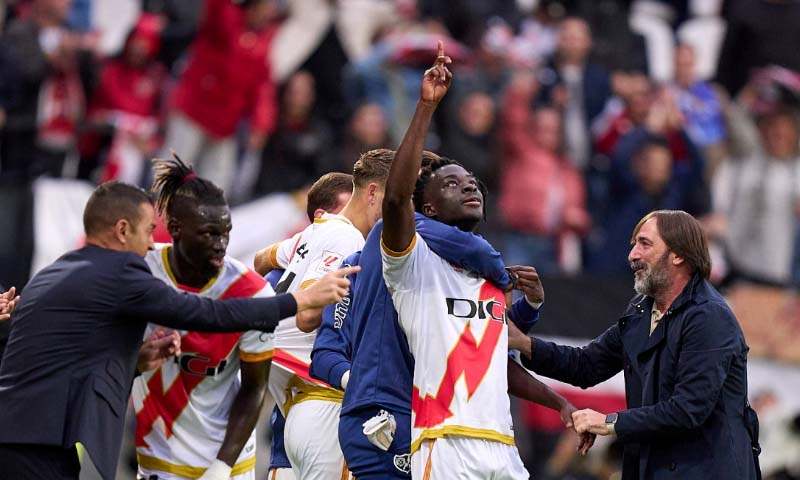
Abdul Mumin is joined by teammates to celebrate his goal in September for Rayo against CA Osasuna
The four-day interval is the maximum for international breaks.
What’s more, Mumin’s injury occurred on March 1, three clear weeks before Ghana played Chad and Madagascar.
Similarly, Ernest Nuamah’s injury occurred two clear weeks after the international break. Last season, he made 39 appearances in total. For a player in the French league, that is not irregular. His peers who hold down regular starting positions at bigger clubs with continental responsibilities will make a minimum of ten more appearances - if you add the six group stage matches in the days of the old UEFA inter-club competitions format and at least four cup games, or in the current iteration, eight matches in the league phase.
In fact, in the current season, 9 of his 33 appearances have come in the Europa League.
Issahaku (43 appearances last season and 11 in the current one) and Seidu (29 appearances in all competitions last season and 11 this term).
So the Ghana Football Association, CAF, FIFA, and the organizations that run the competitions these four participate in, cannot be held responsible for burdening them with too many games (within a short period).
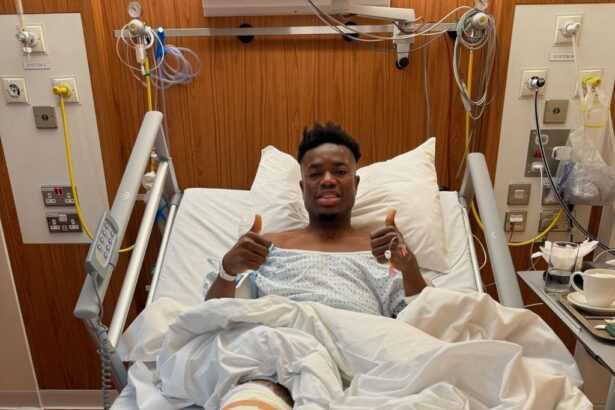
Flashback: Fatawu Issahaku is all smiles after a successful surgery to correct the ligament tear
What causes an ACL injury?
In 2023, former Manchester United physiotherapist Dr. Tom Hughes suggested that ACLs may be ‘‘just an occupational hazard, to a degree.”
His assertion references a 2020 study that assessed 134 ACL cases across 10 seasons of Italian football.
The study established that up to 56 percent of them involved a degree of contact but were mostly indirect. What’s more, the contacts were mostly to the shoulder, with just a fraction of them being direct contact with the knee.
The remaining 44 percent of ACL cases assessed by the study were confirmed to be non-contact injuries.
Studies have shown that midfielders and defenders have recorded the majority of European football's ACL cases. Their positions are not the reasons for the injuries, sudden change in direction, exposure to excessive force (up to 2000 Newtons), or landing awkwardly after jumping or twisting the foot, ankle, or knee.
So it is not as if any of Nuamah, Seidu, Issahaku, and Mumin played too many games, were exposed to bad pitches, or had any extracurricular activities that left them susceptible to these injuries.
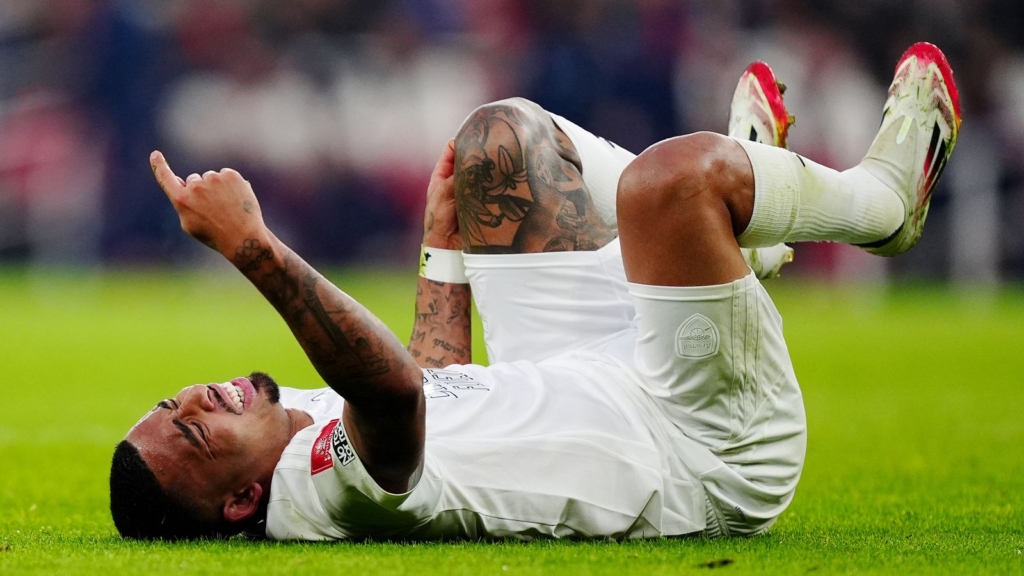
Arsenal striker Gabriel Jesus tore his ACL in January during an FA Cup match against Manchester United
Prevention.
Last year, Dr. Tom Hughes teamed up with Professor Nick London and the Yorkshire Knee Clinic to produce a paper on knee injury prevention studies.
Dr. Hughes's research was in two parts; preventive and corrective.
The preventive part advocates ‘‘for a multi-sport program that focuses on diverse movements, building various muscles and ligaments. This counters the current trend of specialization, where single-sport focus leads to imbalances and heightened injury rates.’’
The second part, according to Top Doctors UK, ‘‘addresses existing barriers to implementing injury prevention programs in schools and clubs. Tom's research recommends shorter programs, easily incorporated into standard PE lessons. Emphasizing the involvement of PE teachers ensures ownership and active participation in the program, overcoming resistance.’’
But these modules, together with a million others out there, are yet to be implemented by any African country for us to see how African players respond to them in relation to ACL occurrence rate.
Until then, it would remain, to borrow the words of Dr. Tom Hughes once more, ‘‘just an occupational hazard.’’
Latest Stories
-
Haruna Iddrisu calls for limits on annual university accommodation fee increases
36 minutes -
Today’s front pages: Tuesday, October 13, 2026
1 hour -
Wealth Over Water: How Galamsey Is Threatening Ghana’s Water Security
2 hours -
LA 2028: Black Queens pumped up for second leg of Mauritius tie
2 hours -
LA 2028: Black Queens hold final training session ahead of second leg against Mauritius
3 hours -
Standards are not Seasonal: What the EC appointments teach both sides
3 hours -
King Mohammed VI urges private sector to create youth jobs and spread benefits of growth
3 hours -
KGL U17 Colts 2026: Greater Accra win title after penalties win over Western Region
3 hours -
UK Investment Roadshow opens in London to advance UK-Ghana growth partnership
3 hours -
Assemblies of God requires pastors to resign before entering partisan politics – Rev. Wengam
3 hours -
Ghana targets 20% annual reduction in maternal deaths – Health Minister
3 hours -
Cyber attacks in Africa grow faster than global rate, report finds
3 hours -
Ghana signs UAE deal to create 5,000 overseas jobs
3 hours -
One Million Coders Programme targets 100,000 digital jobs in two years – Sam George
4 hours -
John Jinapor, Italian Ambassador explore opportunities for energy sector investment
4 hours