

Audio By Carbonatix
In Lisbon’s bairro das novas nações, the neighbourhood of new nations, each street is named after a former Portuguese colony: Rua de Angola, Rua de Moçambique, Rua da Guiné, Rua de Cabo Verde.
“Ah, Cabo Verde,” I say to my guide, Djuzé Neves, “your homeland.”
Though that’s not entirely accurate—Neves was born and raised in Lisbon—his parents hail from Santiago Island, the largest in the Cape Verdean archipelago.
Climate refugees fleeing drought found solace in Lisbon’s embrace.
For Neves, this neighbourhood embodies more than just geography; it’s a beacon of community-driven resilience. As a board member of Batoto Yetu, an organisation nurturing African heritage among underprivileged youth, Neves invests his time in cultivating cultural pride.
I’ve come to Lisbon exactly for neighbourhoods like novas nações, a liberating space to escape the rising tide of racial and political stress I’ve been experiencing in the United States. I’m not alone.
On social media, countless Black travellers share tales of feeling marginalized and impotent in the face of systemic racism and police brutality, prompting a surge in overseas travel in search of historical significance, cultural diversity, and a relaxed atmosphere.
I’ve come to Lisbon exactly for neighbourhoods like novas nações, a liberating space to escape the rising tide of racial and political stress I’ve been experiencing in the United States. I’m not alone.
On social media, countless Black travellers share tales of feeling marginalized and impotent in the face of systemic racism and police brutality, prompting a surge in overseas travel in search of historical significance, cultural diversity, and a relaxed atmosphere.
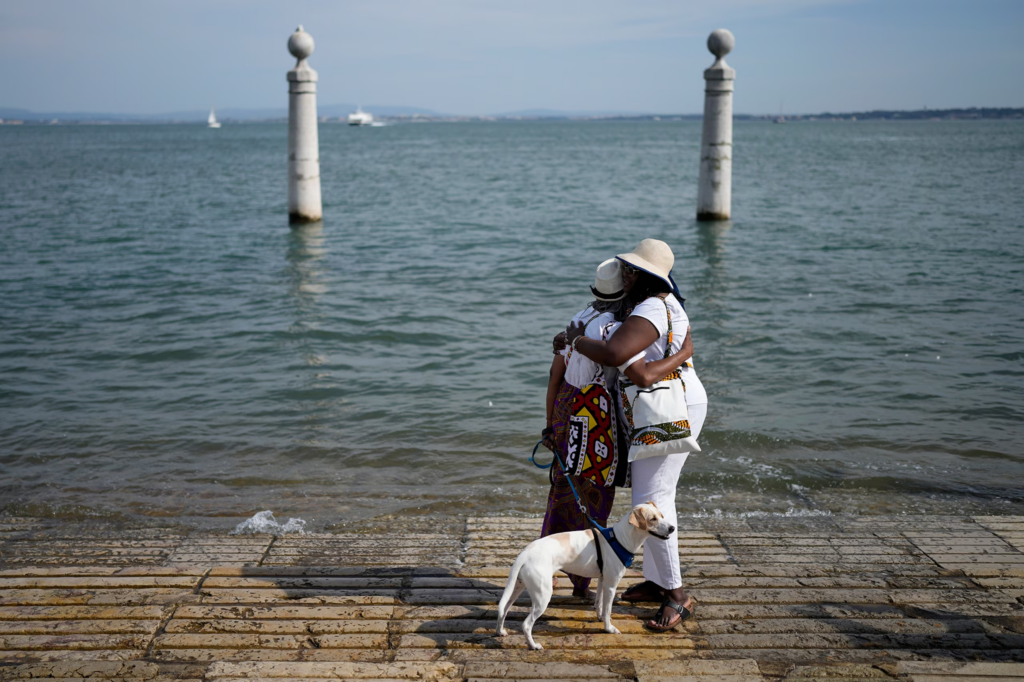
It’s not new, this practice of African Americans traveling to foreign lands for a respite from the challenges and frustrations that come with being Black in America. In the 1920s and ’30s, the Soviet Union became an attractive place to visit and explore because it promised a raceless, classless society. In Lisbon and other cities such as Paris, Dubai, and Amsterdam, travelers find memorials and tours that acknowledge the trauma of the slave trade and programs that explore cultural heritage.
Where the slave trade started
I meet Madisyn Brown, a Black 22-year-old video essayist, on the flight from New York to Lisbon. She tells me that her great-great-grandmother was from Portugal. “But no one in my family has been to Portugal despite that connection,” she says.
On the final day of her trip, I reconnect with Brown for a drink on Avenida da Liberdade, a sun-drenched, tree-lined street with wide sidewalks featuring black, white, and sometimes gray limestones mosaics, called calçada Portuguesa. Avenida da Liberdade is Lisbon’s version of Paris’ Champs-Élysées, London’s Regent’s Street, and Beverly Hills’ Rodeo Drive.
Brown says her time in Lisbon has been magical. “I felt like a normal person walking through the world,” she says. “I never felt like I didn’t belong. I’m going to miss the positive energy here. America can be a really tough place to live.”
The irony isn’t lost on me—seeking solace in a city with ties to the very institution of slavery that shaped our history. We’ve learned to associate many European nations with colonialism, but Americans are not as familiar with Lusophone culture and history.
Many of us were unaware that Portugal was not just a participant in colonialism; it pioneered the trade in chattel slavery. In 1444, the small nation began transporting sub-Saharan Africans to Europe. In 1526, Portugal transported its first shipment of enslaved people to Brazil, effectively launching the transatlantic slave trade.
Yet, perhaps our modern “return” to Portugal signifies a crucial step in healing, a reclaiming of collective joy and freedom.
Toby Thompkins, a recent ex-pat from New York, sees Lisbon as a place of reconciliation. “I think that’s what a lot of Black Americans are tapping into,” he says, adding there’s an openness to dialogue and a sense of infinite possibilities, reminiscent of America in the 1970s—a time of acknowledging and confronting racism.
How to experience Lisbon
To address its role in the slave trade, Lisbon’s government, in association with Batoto Yetu, has erected more than 20 historical street markers to honor the contributions of Africans and their descendants in 2024.
Travelers can find the plaques near the riverside Terreiro do Paço, where enslaved people disembarked from the ships that carried them there from Africa, or in places such as Rossio Square, which, for centuries, has been a traditional gathering place for Black people in Lisbon. It is also the location of Igreja de São Domingos, the church where enslaved Africans were taken for their requisite baptism.
In the Largo São Domingos neighborhood, which has a sizable African population, a stone bust was unveiled of Paulino Jose da Conceiçao, a formerly enslaved African who emigrated to Portugal from Brazil in 1832. Da Conceiçao, also known as Pai Paulino, was a social justice advocate and worked to improve the working and living conditions of Africans in Lisbon. Also in the works is a memorial to the victims of slavery, the first of its sort there.
In the coastal city of Lagos, in the Algarve region of southern Portugal, about three hours by train from Lisbon, visitors can explore a small museum dedicated to the history of slavery in the town. The museum, Mercado de Escravos, Market of Slaves, is situated on the site where the very first group of enslaved Africans was sold.
Latest Stories
-
Let The Constitution direct Chieftaincy to deliver “All Development Is Local”
55 minutes -
John Jinapor outlines renewable energy, nuclear power priorities for 2027
1 hour -
Ghana explores centre of excellence for hearing, communication and cochlear implant care
2 hours -
Schizophrenia-related disorders lead mental health cases recorded in Ghana
3 hours -
Dutch authorities enlist Ghana in hunt for fugitive drug lord Bolle Jos
3 hours -
Ghana housing finance conference adopts communiqué to improve affordable housing access
7 hours -
Special Initiatives Minister urges Wa Technical Institute to enrol more girls as EU-backed solar training lab opens
8 hours -
In the matter of my first year at the Bar
8 hours -
ActionAid Ghana calls for an end to child marriage, greater investment in girls’ rights
8 hours -
Newsfile to tackle World Cup visa scandal, beach demolitions, education strikes, BRICS bid
9 hours -
UK-Ghana Trade & Investment Summit: Trade Resource Centre to help businesses maximise UK-Ghana trade opportunities
9 hours -
Embassy of Denmark celebrates World Maritime Day
9 hours -
Linking LEAP to productive inclusion could cut extreme poverty by 2030 – UNICEF
10 hours -
Trade Ministry backs use of creative arts to rehabilitate prison inmates
10 hours -
Negotiations with government to continue despite strike suspension – GNAT
10 hours