

Audio By Carbonatix
The Finance Minister has outlined strategic measures to address the fiscal gap that will arise from its decision to abolish several taxes, including the E-Levy, Betting Tax, and COVID-19 Levy.
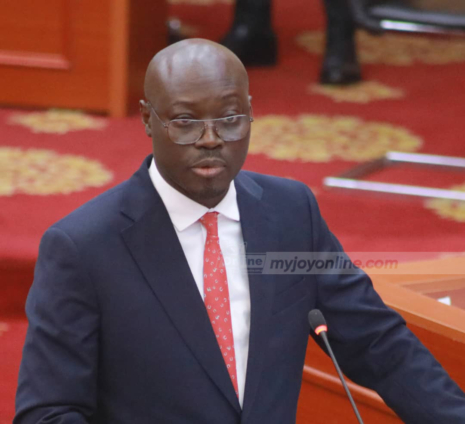
Speaking during the presentation of the 2025 Budget Statement and Economic Policy on March 11, Dr. Cassiel Ato Forson assured that the shortfall will be covered through enhanced revenue mobilisation and expenditure controls.
Dr. Forson stated that the abolition of selected taxes will be offset by reducing the tax refund ceiling.
"The Tax Refund Account has been abused in recent years. A study on the use of the tax refunds in the last eight (8) years revealed that GHS29.11 billion had accrued to the tax refund account with only 12.5 billion, representing 43% of the total accrued amount is used for tax refund purposes," he explained.
The Minister explained that the tax Refund Account has been mismanaged in recent years, with large sums being misapplied.
For him, the government will cut the tax refund ceiling from 6% to 4% of total revenue, saving GH₵3.8 billion.
"Mr. Speaker, by reducing the ceiling on the tax refund from 6% to 4%, we will save GH¢3.8 billion. This
amount is enough to close the revenue shortfall from the removal of the E-Levy amounting GH¢1.9 billion
and the Betty Tax of GH¢180 million. Mr. Speaker, already we have saved GH¢3.8 billion for 2025 alone from only one source and this is enough to close the gap from the taxes that we have removed," the Minister explained.
He also highlighted plans to improve tax compliance and administration.
The Revenue Administration Act will be amended to increase tax efficiency and ensure greater compliance, with the government expecting a 2% improvement in net tax revenue collection.
"Accompanied with this budget, we will amend the Revenue Administration Act, 2016 (Act 915). This
measure will improve the tax revenue, net of tax refunds by 2%, representing 0.3% Of GDP.
"Mr. Speaker, in line with Government policy, the 2025 minimum wage recently negotiated with the
National Tripartite Committee will be zero-rated. This is consistent with our resolve to protect the poor and the vulnerable."
Additionally, a new Non-Tax Revenue Legislation will be introduced to improve the collection and management of revenue from state services and assets.
Property rate collection will also be streamlined and enhanced to boost local government finances.
The government plans to simplify Ghana’s VAT system and eliminate distortions that have led to inefficiencies in tax collection.
The reforms aim to broaden the tax base while reducing the effective VAT rate for businesses and consumers.
To complement revenue measures, the government will implement aggressive spending cuts. The government has cut the number of ministries from 30 to 23 and reduced ministerial appointments from 88 to 60.
This downsizing will result in significant savings on salaries, operational costs, and government logistics.
The government will audit and validate all arrears/payables before making payments, while non-essential programs such as YouStart, One District One Factory, and GhanaCARES will be eliminated.
In the energy sector, he intimated that ECG and NEDCo will implement new strategies to improve revenue collection, while the government will renegotiate Independent Power Producer (IPP) contracts to reduce capacity charges and operational costs.
He further explained that "without increasing the levy, we will also review the Energy Sector Levies Act (ESLA) to consolidate the Energy Debt Recovery Levy, Energy Sector Recovery Levy (Delta Fund), and Sanitation & Pollution Levy into one levy and use the proceeds to cater for the energy sector shortfalls and service the inherited debt service obligation."
Dr. Ato Forson emphasised that these measures will ensure fiscal discipline while supporting economic growth.
“To those asking how we will cover the revenue gap from tax removals, the answer is simple: we have stopped the bleeding,” he stated.
The Minister is confident that by prioritising efficiency, cutting wasteful spending, and improving revenue mobilization, it can maintain fiscal stability while easing the tax burden on Ghanaians.
Latest Stories
-
Tamale Water Project to help address northern Ghana’s water shortages – Ghana Water Limited
19 minutes -
Oil prices fall and stocks rise after Trump says Iran war ‘very complete’
26 minutes -
Ghana-Peru Relations: Foreign Ministry outdoors new book focusing on a Journey of Friendship and Cooperation
29 minutes -
Kufuor advocates strict separation of powers to strengthen Ghana’s democracy
30 minutes -
Well-structured governance institutions improve efficiency and strengthen democracy – Kufuor
34 minutes -
Two Turkish firms to construct water treatment plant for Eastern Accra
37 minutes -
Rising sophistication in science and technology is deepening corruption – Kufuor
51 minutes -
Allegations of product hoarding by OMCs are baseless – CBOD
55 minutes -
Council of State not enough to check executive – Kufuor
56 minutes -
CLOGSAG strike without production: Ghana’s dangerous culture of entitlement
59 minutes -
Achimota School raises infrastructure concerns as surging demand outpaces facilities
60 minutes -
Ghana’s economic challenges fuel corruption, private sector must grow – Kufuor
1 hour -
Five Iranian footballers granted Australian visas after anthem protest
1 hour -
Kufuor calls for higher pay for public servants to curb corruption
1 hour -
Kufuor calls for stronger separation of powers, greater parliamentary control over national budget
1 hour