

Audio By Carbonatix
Former President John Agyekum Kufuor has called for a major overhaul of public sector remuneration in Ghana, arguing that low wages for government officials contribute significantly to corruption.
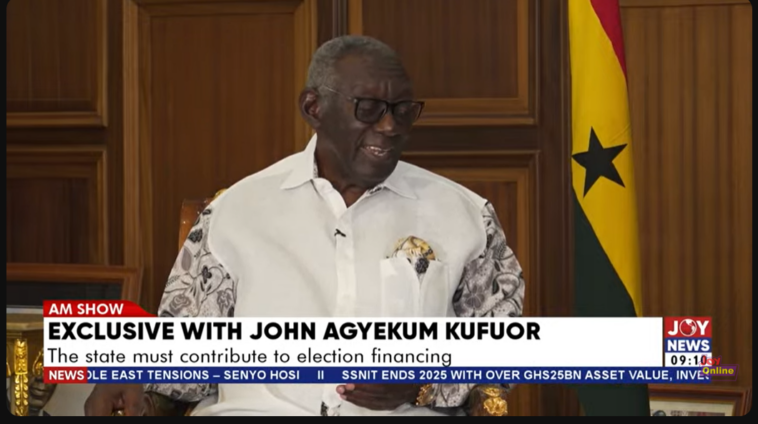
Speaking in an interview on the AM Show, Mr Kufuor said the current salary structure for civil servants and political office holders is unrealistic and creates conditions where corruption can become a coping mechanism rather than an isolated act of misconduct.
According to him, improving governance requires paying public servants competitively while enforcing strict penalties for those who still engage in corrupt practices.
The former president cited the example of Lee Kuan Yew, who famously argued that ministers and senior public officials should be paid salaries comparable to top corporate executives to attract and retain the best talent in government.
“The people I used to fashion these policies are as good as the people in the corporate world getting fat salaries — so they must be paid like the people in the corporate world,” Mr Kufuor quoted Lee Kuan Yew as saying.
He suggested that by that standard, Ghana’s top political offices are significantly underpaid compared to the level of responsibility and expertise required.
Mr Kufuor, however, stressed that better salaries must be matched with strict accountability measures.
“When you choose to be in the public sector, to be well-paid, and you allow yourself to be tempted into red tape and corruption — and they catch you — some of the worst punishments would be visited on you,” he said.
Debate about public sector pay has persisted in Ghana for years, particularly following the introduction of the Single Spine Salary Structure in 2010.
The policy was designed to address wage disparities across the public sector, but critics say it has not fully resolved concerns about fairness and competitiveness in government pay.
Mr Kufuor, who served two terms as president from 2001 to 2009 under the New Patriotic Party, said a comprehensive rethink of how Ghana compensates its public servants is necessary if the country wants to reduce corruption and improve efficiency in public administration.
Latest Stories
-
Cedi was worst African currency in quarter 2, 2026 – World Bank
6 minutes -
AI gains can lift three times as many people out of poverty in Ghana – World Bank
34 minutes -
Police arrest suspect over jewellery theft during fire outbreak
3 hours -
EOCO returns Hanan’s £6,700, GH¢2,750 and devices after defence challenge
3 hours -
Opplift Youth Entrepreneurs Summit 2026 equips entrepreneurs with skills, mentorship and support
3 hours -
Rival clubs want range of punishments for Man City
3 hours -
Tear gas in Paris and Marseille as school protests grow across France
4 hours -
Kane inspires England to win over Czech Republic in UEFA Nations League
4 hours -
Finland orders halt to work on two Google data centres
4 hours -
Substitute Merino scores twice as Spain win in Croatia
4 hours -
Ronaldo wants Portugal ‘punishment’ but not retiring
4 hours -
White House defends Trump comment to let Iran ‘take out’ LA and San Diego
4 hours -
Asos confirms hackers sent ‘unauthorised’ notification to app users
4 hours -
US televangelist Jim Bakker, disgraced from sex scandal and fraud, dies at 86
5 hours -
Congolese-born golfer to represent Ghana at Turkish Airlines World Cup grand final
5 hours