


Audio By Carbonatix
A paralysed man has been able to walk simply by thinking about it thanks to electronic brain implants, a medical first he says has changed his life.
Gert-Jan Oskam, a 40-year-old Dutch man, was paralysed in a cycling accident 12 years ago.
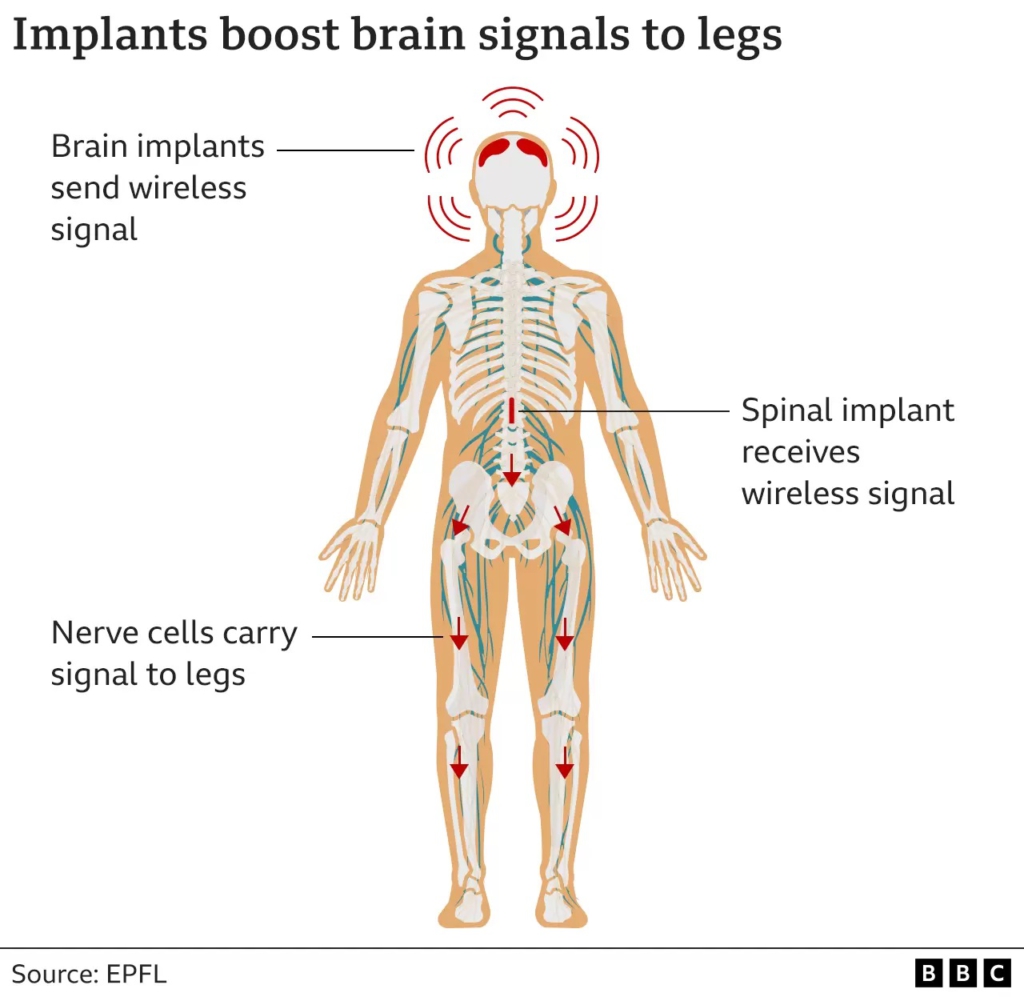
The electronic implants wirelessly transmit his thoughts to his legs and feet via a second implant on his spine.
The system is still at an experimental stage but a leading UK spinal charity called it "very encouraging".
"I feel like a toddler, learning to walk again," Mr Oskam told the BBC. He can also now stand and climb stairs.
"It has been a long journey, but now I can stand up and have a beer with my friend. It's a pleasure that many people don't realise."
The development, published in the journal Nature, was led by Swiss researchers. Prof Jocelyn Bloch, of Lausanne University, who is the neurosurgeon who carried out the delicate surgery to insert the implants, stressed that the system was still at a basic research stage and was many years away from being available to paralysed patients.
But she told BBC News that it was the team's aim to get it out of the lab and into the clinic as soon as possible.
"The important thing for us is not just to have a scientific trial, but eventually to give more access to more people with spinal cord injuries who are used to hearing from doctors that they have to get used to the fact that they will never move again."
Harvey Sihota is chief executive of the UK charity Spinal Research, which was not involved in the research. He said that although there was a long way to go before the technology would be generally available, he described the development as "very encouraging".
"While there is still much to improve with these technologies this is another exciting step on the roadmap for neurotechnology and its role in restoring function and independence to our spinal cord injury community".
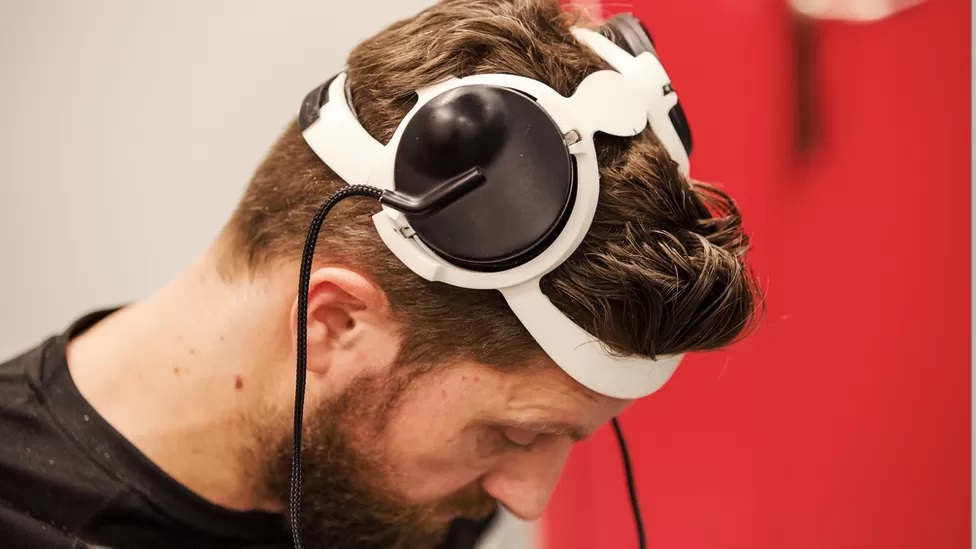
The operation to restore Gert-Jan's movement was carried out in July 2021. Prof Bloch cut two circular holes on each side of his skull, 5cm in diameter, above the regions of the brain involved in controlling movement. She then inserted two disc-shaped implants which wirelessly transmit brain signals - Gert-Jan's intentions - to two sensors attached to a helmet on his head.
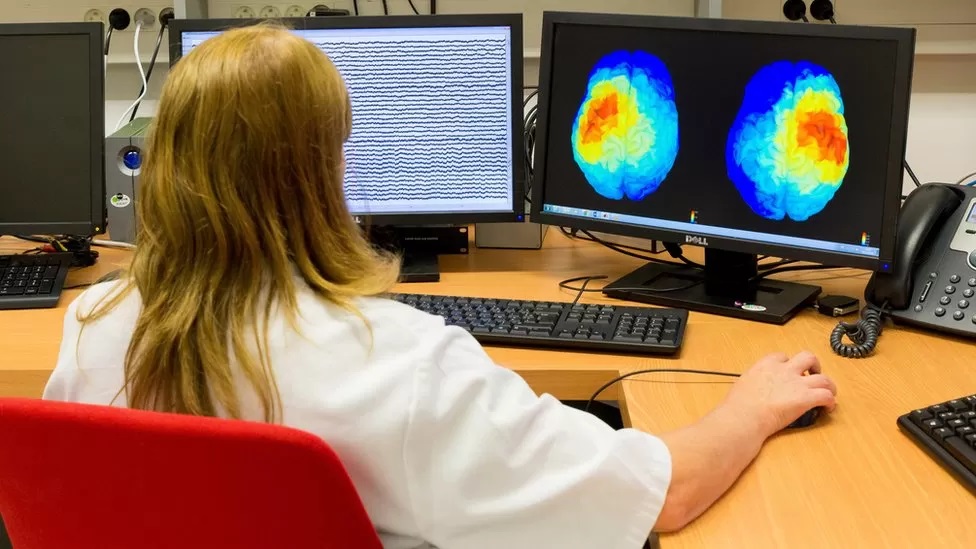
The Swiss team developed an algorithm which translates these signals into instructions to move leg and foot muscles via a second implant inserted around Gert-Jan's spinal cord - which Prof Bloch intricately attached to the nerve endings related to walking.
The researchers found that after a few weeks of training he could stand and walk with the aid of a walker. His movement is slow but smooth, according to Prof Grégoire Courtine of the École Polytechnique Fédérale in Lausanne (EPFL), who led the project.
"Seeing him walk so naturally is so moving," he said. "It is a paradigm shift in what was available before".
The brain implants build on Prof Courtine's earlier work, when only the spinal implant was used to restore movement. The spinal implant amplified weak signals from the brain to the damaged part of the spinal column and was boosted further by pre-programmed signals from a computer.
BBC News reported how David M'zee was the first patient to have benefited from the spinal implant in 2018, so much so that he was able to have a baby with his wife, something that had not been possible previously.
And last year we reported how Michel Roccati became the first person with a completely severed spinal cord to walk as the result of the technology.
Both have benefitted tremendously but their walking motion is pre-programmed and looks robotic. They also have to keep their intended movements in step with the computer and have to stop and reset if they get out of sync.
Gert-Jan had only the spinal implant before he had the brain implants. He says that he now has much greater control.
"I felt before that the system was controlling me, but now I am controlling it".
Neither the previous or new systems can be used constantly. They are bulky and still at an experimental stage.
Instead, patients use them for an hour or so for a few times a week as part of their recuperation. The act of walking trains their muscles and has restored a degree of movement when the system is turned off, suggesting that damaged nerves may be regrowing.
The eventual aim is to miniaturise the technology. Prof Courtine's spin out company Onward Medical, is making improvements to commercialise the technology so it can be used in people's day-to-day lives.
"It's coming," says Prof Courtine,. "Gert-Jan received the implant 10 years after his accident. Imagine when we apply our brain-spine interface a few weeks after the injury. The potential for recovery is tremendous".
Latest Stories
-
Israelis mark three years since October 7 as Palestinians mourn Gaza’s destruction
2 minutes -
Support constitutional amendment to fix voting day on Tuesday – Asiedu Nketiah urges SDA Church
3 minutes -
‘It’s a systemic problem’ – All Black PRO dismisses Kurt’s resignation calls
8 minutes -
Vance says Iran must cut enrichment to end war
9 minutes -
Mahama orders sanctions for officials who fail to enforce building safety rules
11 minutes -
Court grants bail to banker accused of stealing GH¢1 million
15 minutes -
We have a winning team for 2028 – NPP Atwima Nwabiagya South Secretary
17 minutes -
Bono East Minister cracks whip on contractors over delayed 24-Hour Economy Market projects
19 minutes -
Zelensky condemns ‘vile’ large-scale Russian attacks that killed 15
22 minutes -
Trump to speak to Putin about plague lab worker’s death in Russia
23 minutes -
GHIPO makes case for local plant breeders to protect developed varieties for food sovereignty and reinvestment
25 minutes -
Ghana’s bamboo bikes entrepreneur gets a seat at World Economic Forum
26 minutes -
After years under trees, Akatsi children get a permanent school
26 minutes -
Kanton SHS appeals for more teachers, ICT facilities and infrastructure support
29 minutes -
Black Queens Coach maps out preparations ahead of Olympic qualifying games
34 minutes