

Audio By Carbonatix
The International Monetary Fund has openly criticised the UK government over its plan for tax cuts, warning that the measures are likely to fuel the cost-of-living crisis.
In an unusually outspoken statement, the IMF said the proposal would be likely to increase inequality and add to pressures pushing up prices.
Markets have already raised alarm over the plans, sending the pound plunging.
The government says the measures will kickstart economic growth.
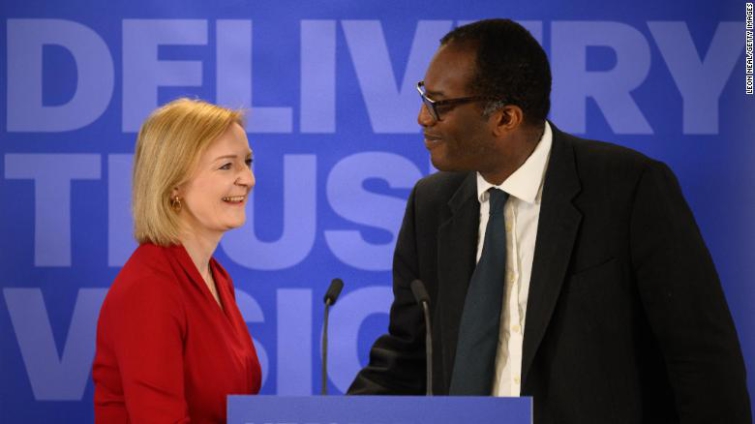
Chancellor Kwasi Kwarteng unveiled the country's biggest tax package in 50 years on Friday. The £45bn cut will be funded by government borrowing.
The IMF works to stabilise the global economy, and one of its roles is to act as an early economic warning system.
It said it understood the package aimed to boost growth via tax cuts, but it warned that the measures could speed up the pace of price rises, which the UK's central bank is trying to bring down.
"Furthermore, the nature of the UK measures will likely increase inequality," it said.
The IMF said that the government publishing a fiscal plan on 23 November gave it an opportunity to "re-evaluate" tax measures, "especially those that benefit high income earners".
The UK government proposals would scrap the top rate of income tax, and end a cap on bankers' bonuses, among other measures.
The announcement on Friday sparked days of financial turmoil, as investors dumped the pound and UK debt. On Monday the pound fell to record lows against the dollar.
Some of the country's biggest lenders suspended mortgage deals amid the uncertainty.
The Treasury said: "We are focused on growing the economy to raise living standards for everyone."
It added that Mr Kwarteng was due to publish his medium-term plan for the economy on 23 November, which would include ensuring that UK debt falls as a share of economic output in the medium term.
Meanwhile, Lord Frost, the former Brexit minister and close ally of Prime Minister Liz Truss, criticised the IMF's statement.
He told the Daily Telegraph: "The IMF has consistently advocated highly conventional economic policies. It is following this approach that has produced years of slow growth and weak productivity.
"The only way forward for Britain is lower taxes, spending restraint, and significant economic reform."
BBC economics editor Faisal Islam says the IMF's "stinging rebuke... reflected similar concerns from the world's major finance ministries that a crisis brewing in the UK could spill over into a global slowdown".
On Tuesday, the Bank of England signalled that it was prepared to ramp up interest rates in response to the slump in the value of the pound.
Its chief economist Huw Pill said the Bank "cannot be indifferent" to the developments of the past days.
He said the Bank would have to deliver a "significant monetary policy response" to protect sterling.
Speaking to BBC Two's Newsnight, former US Treasury Secretary Larry Summers described the situation facing the UK as "very ominous".
"I can't in all honesty remember a time when a set of policy announcements from a G7 country elicited so negative a response both from markets and from economic experts," he said.
"When a country sees its interest rates rise by [as much as they have] in two days at the same time that its currency is falling in a major way, that is a sign that there has been a major loss of market credibility and market confidence.
"The kind of warning that Britain received from the IMF today is a kind of warning that comes much more frequently to emerging markets with new governments than to a country like Britain."
Asked about the UK's plans at an event in Washington, White House economic adviser Brian Deese said he had not been surprised by the negative reaction of the markets and that it was important to focus on "fiscal prudence, fiscal discipline", the Reuters news agency reported.
Moody's credit rating agency said on Wednesday that the UK's plan for "large unfunded tax cuts" was "credit negative" and would lead to higher, persistent deficits "amid rising borrowing costs [and] a weaker growth outlook". Moody's did not change the UK's credit rating.
Labour's shadow chancellor Rachel Reeves said the government must "urgently lay out how it will fix the problems it created through its reckless decisions to waste money in an untargeted cut in the top rate of tax".
"Waiting until November [when the fiscal plan is published] is not an option," she said. Instead, "the government must urgently review the plans made in their fiscal statement last week".
She added: "This statement from the IMF should set alarm bells ringing in government and make it clear that they need to act now."
Latest Stories
-
Standard Chartered Bank delivers strong returns and sustainable shareholder value
1 minute -
Akufo-Addo’s role in the artificial cedi stability is indisputable — Facts do not bend to political convenience
4 minutes -
Breaking Bad actor RJ Mitte dies aged 34
10 minutes -
Wontumi pleads not guilty in GH¢30m Exim Bank loan case
15 minutes -
Beyond the Flyer: Awareness without screening is not enough
22 minutes -
Bekwai MP donates GH¢100,000 to hospital for specialist equipment
29 minutes -
Van Vicker sues Lil Win for defamation, demands GH¢10m
35 minutes -
FIFA/ FIBA agency Pep Sports moves to admit Ghana’s 7-Foot Basketball talent to its Ultra-Modern Sports campus after MyJoyOnline report
37 minutes -
GAUA strike disrupts academic plans at University of Ghana as students, parents express frustration
42 minutes -
Dad’s Army/African Polistas crowned champions of 2026 Accra Polo Club Trustees’ Cup
49 minutes -
Mahama approves Integrated Basic Education Model, with funding expected in 2027 under GETFund formula
51 minutes -
Money-driven elections fuelling corruption – Haruna Iddrisu
56 minutes -
Excessive borrowing ‘cracked’ Ghana’s economy under Akufo-Addo – Haruna Iddrisu
1 hour -
NPP’s silence on economic indicators suggests Mahama is doing better – Haruna Iddrisu
1 hour -
GoldBod must be more accountable to Ghanaians – Haruna Iddrisu
2 hours