

Audio By Carbonatix
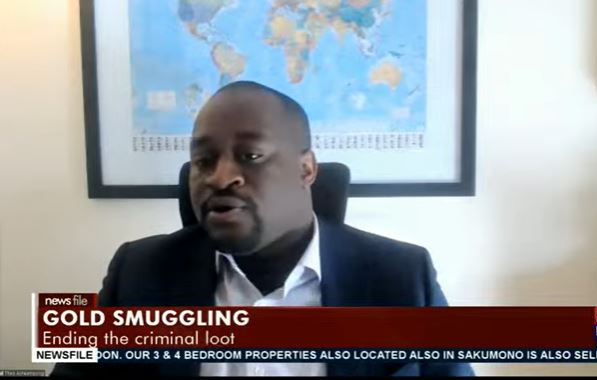
Economist and Political Risk Analyst, Theo Acheampong has said Ghana can employ institutional coordination to help eradicate the problem of gold smuggling.
According to him, there is a need to robe in other stakeholders as most of the solution lies therein, “they just need to be coordinated.”
His comment on Newsfile Saturday comes in the wake of JoyNews exposé, ‘Busted: Gold smugglers’.
The documentary brought to light how some security operatives and politically connected individuals have been aiding a gold smuggling syndicate illegally to export gold through the country’s air and seaports.
Proffering solutions to stop such a development, he said, “The point then comes to institutional coordination going forward, I think it’s absolutely vital but it needs to go beyond just the GRAs, EOCOs, and Financial Intelligence Centre.”
In 2018, President Akufo-Addo noted that the country’s gold of about $5 billion could not be accounted for.
Theo Acheampong told Samson Lardy Anyenini that the situation is not different, as in other instances such as rice importation.
“You tend to see that the declaration as you have and the volumes when you collaborate that with other statistical agency, particularly the like the UN contract stats, you see a big disparity between rice that we claim to have been imported to Ghana and what these other international agencies are reporting as rice that has been exported into Ghana.”
He said the country needs to “focus on the borders and entry points and that’s a question of investment, the solvent system, the technology that will allow us to detect some of these challenges.”
Per his observation, sometimes officials at the port, though educated or understand the issues let their guards down, but other times too, “they just don’t have the tools that allow them to really pick things up.”
The economist further noted that there is also a need for the country to check its revenue inflow and outflows in some of its key sectors.
“For example, in telecoms where traditionally we have seen some of these transfer pricing issues and we need to double up on the auditing requirement.
“In the petroleum sector that I work, there are so many issues there some of which I cannot talk about on national TV.”
He said such “broader working groups that involve the stateside actors but other stakeholders, I think we would find some of the solutions to it.”
Mr Acheampong assured his office is opened for further discourse, noting that “going forward, there’s a big question about taxation of the digital economy and how things are changing as a result.”
Latest Stories
-
“NSA did not tell us of any embassy arrangement” – Kofi Adams
8 minutes -
Glasner suffers loss on Selhurst return as Palace beat Forest
2 hours -
WAFU B U17: ‘We won but I expected more from my boys’ – Kassim Ocansey
2 hours -
Man City cruise to statement win over 10-man Liverpool
2 hours -
Be careful with cross-border lending, foreign currency exposures – BoG to financial institutions
4 hours -
GPL 2026/27: Medeama go three clear as Hearts of Oak recover and Bechem stage stunning comeback
4 hours -
Ntiamoah Foundation launches “BEYOND 20” anniversary campaign
5 hours -
Credit Risk Management Directive: BoG to begin implementation for banks, others from July 1, 2027
5 hours -
Ghana Brands Awards 2026: Leading brands, business trailblazers to shine on November 20
5 hours -
T-bills auction: Demand improves as government exceeds target by about 76%; interest rates soften
5 hours -
Ziope undertakes initiative to build a technologically inclined community, commissions self-help ICT lab
6 hours -
ECG announces power outage in parts of Tema, Central Region due to network fault, maintenance
6 hours -
When the Gospel Becomes a Weapon: The church, blackmail and the abuse of faith
7 hours -
JoyNews’ Jacqueline Ansomah Yeboah selected for UK Media Excellence for Emerging Technologies Fellowship
7 hours -
Mental Health Alliance urges government to operationalise Mental Health Fund
7 hours