

Audio By Carbonatix
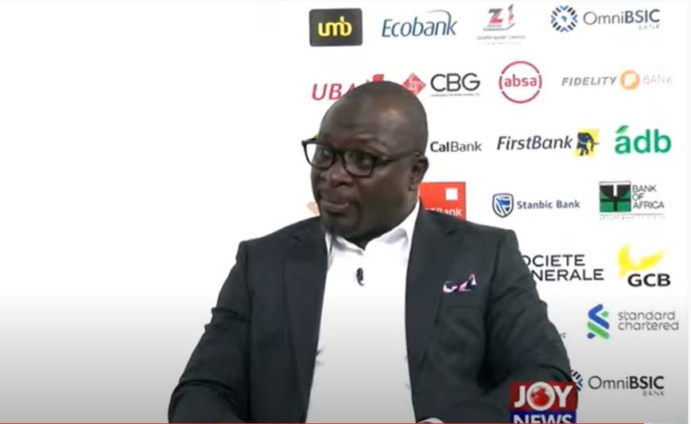
The Chief Executive of the Ghana Association of Banks (GAB), John Awuah, has said that there must a direct link between reduction in interest rates and improved economic environment.
He cautioned that banks cannot be forced to bring interest rates down when the economic fundamentals do not support such moves.
“Instances where the economy had turned around with some variables improving, the banks did moved quickly to review their rates. We should not try and get to that era where interest rates are forced down when it is not backed by the economic fundamentals”, he warned.
Mr. Awauh disclosed this on PM EXPRESS BUSINESS EDITION with host George Wiafe.
He argued that banks have always responded by reducing interest rates any time other macro-economic indicators improve.
“There have been several examples in the past which showed that when all these factors that influence interest rates drop, the banks have gone ahead to revise their rates”, he maintained.
Policy rate reduction and inflation rate
The Monetary Policy Committee at its first meeting on January 23, 2023, cut the policy rate by 100 basis points to 29.0%. The inflation rate since July 2023 witnessed some significant drop until that marginal spike in January 2024.
Recalling some instances where the banks have reduced interest rates, Mr. Awuah pointed out that in times when the indicators have improved, financial institutions have used variable rates on loans.
“You should check with anyone who secured a facility at a variable rate and you realise that commercial banks in question have change their rates”, he added.
High interest rates and impact on commercial banks
The Bank of Ghana pegged average interest rates by the end of December 2023 at around 30.19%, from 25.51% in December 2022.
However, some analysts have described the rate as high posing financial challenges to businesses.
Responding to assertions that banks profit from high interest rates, Mr. Awuah argued that the high interest rates rather lead to high default rates.
“I don’t think it’s fair to link the profits that commercial banks are making purely to the high interest rates”, he stressed.
“For instance every, GH¢100 given out by commercial bank there is a likelihood that GH¢20 will not be paid back”, he added.
Interest rates in Ghana
The interbank weighted average rate remained well-aligned within the policy corridor by the end of 2023.
The weighted average rate increased to 30.19% in December 2023 from 25.51% in December 2022, in line with the monetary policy rate and supported by adjustments made in the cash reserve ratio.
The average lending rates of banks eased marginally to 33.75% in December 2023 from 35.58% a year earlier.
Latest Stories
-
Standard Chartered Bank delivers strong returns and sustainable shareholder value
3 minutes -
Akufo-Addo’s role in the artificial cedi stability is indisputable — Facts do not bend to political convenience
6 minutes -
Breaking Bad actor RJ Mitte dies aged 34
13 minutes -
Wontumi pleads not guilty in GH¢30m Exim Bank loan case
18 minutes -
Beyond the Flyer: Awareness without screening is not enough
24 minutes -
Bekwai MP donates GH¢100,000 to hospital for specialist equipment
32 minutes -
Van Vicker sues Lil Win for defamation, demands GH¢10m
37 minutes -
FIFA/ FIBA agency Pep Sports moves to admit Ghana’s 7-Foot Basketball talent to its Ultra-Modern Sports campus after MyJoyOnline report
39 minutes -
GAUA strike disrupts academic plans at University of Ghana as students, parents express frustration
44 minutes -
Dad’s Army/African Polistas crowned champions of 2026 Accra Polo Club Trustees’ Cup
51 minutes -
Mahama approves Integrated Basic Education Model, with funding expected in 2027 under GETFund formula
54 minutes -
Money-driven elections fuelling corruption – Haruna Iddrisu
58 minutes -
Excessive borrowing ‘cracked’ Ghana’s economy under Akufo-Addo – Haruna Iddrisu
1 hour -
NPP’s silence on economic indicators suggests Mahama is doing better – Haruna Iddrisu
1 hour -
GoldBod must be more accountable to Ghanaians – Haruna Iddrisu
2 hours