

Audio By Carbonatix
A lecturer at Duke University, Professor Felwine Sarr, has called on the governments on the continent to invest in knowledge and innovation production within the education system as a crucial solution to address the social and economic challenges facing Africa.
The Senegalese writer and academician emphasized that many African governments tend to focus more on resolving immediate social and economic issues rather than prioritising long-term investments in knowledge production.

He highlighted the significance of such investment, stating that it would contribute to generating more intellectuals from tertiary institutions who could devise effective measures to tackle economic and social problems.
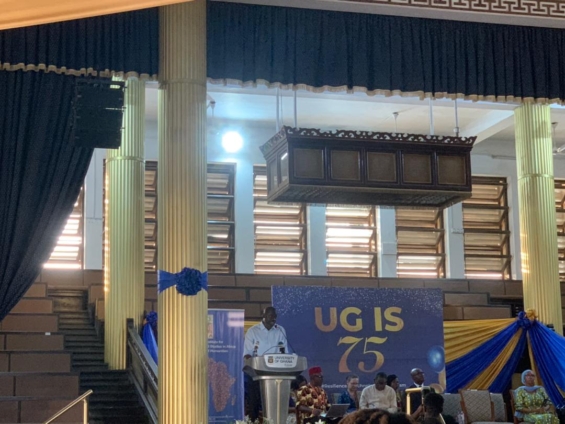
Speaking at the Anton Wilhelm Arno Lecture organised by the Department of Philosophy and Classics at the University of Ghana, Professor Felwine Sarr urged African leaders to recognise the importance of investing in knowledge production.
"The government has an important role to play in the pluralism of African knowledge. Africa has a lot of challenges, including education, health, and others, so most of the time they think that investing in knowledge is not urgent, so they respond to the needs, and knowledge comes later. It's a mistake because the investment in knowledge will allow them to respond to the needs appropriately," he said on Tuesday.

Prof Sarr further stressed that knowledge, particularly in areas such as innovation, technology, and material forms of knowledge, forms the foundation of economies.
He also highlighted the need for a broad understanding of knowledge, extending beyond traditional university and scientific domains.
He said, "They must know that the spheres of knowledge are the most important ones because economies are based on knowledge, innovation, technology, and material forms of knowledge. Also, the knowledge they have to consider should be wider than those in the universities and sciences. For instance, there is an ecological crisis that requires knowledge to adapt and respond to the African farmers and agriculture."
The lecturer also urged stakeholders in the education sector to integrate African knowledge across various domains into the curriculum of educational institutions.
"There is a lot of knowledge in different domains, which is psychological, environmental, and techniques that Africa has produced, and we need to put this knowledge in the curriculum, in courses like Maths, Sciences, humanities, and social science courses."
Latest Stories
-
Ohwimase residents threaten mass demo over deplorable roads
1 minute -
Two dead after another construction crane collapses in Thailand
5 minutes -
Political will key to solving transport crises – Spatial Planning Authority
8 minutes -
V/R: Fuel tanker overturns on Nyangbo–Tafi Mador road
14 minutes -
When Blame Misses The Target: A Sarcastic Football Philosophy on Nigeria vs Morocco
20 minutes -
Importers and Exporters warn Smart Port Note could cost Ghanaian households €382.8m annually
28 minutes -
Solo comic host key to best TGMA experience – Ebenezer Dwomoh
35 minutes -
Health minister spearheads talks to strengthen Agenda 111 implementation
39 minutes -
Serge Ibaka and Afrikicks engage CAF, GFA leadership on African football development
42 minutes -
CSA orders cybersecurity firms, professionals to legalise operations by January 31
43 minutes -
Vice-President expresses concern over rise in drug abuse among young people
54 minutes -
Former Black Queens forward Samira Suleman appointed Hasaacas Ladies Technical Advisor
54 minutes -
Minority demands removal of NaCCA boss, board chair over ‘gender identity’ content in SHS manual
56 minutes -
Bank of Ghana faces questions of misreporting to the IMF on Gold for Reserves losses
57 minutes -
Ghana to admit Burkina Faso students into public universities under capped-fee scheme
1 hour