


Audio By Carbonatix
Sounds good.
How would you feel if you texted a friend to invite them round for dinner and this reply popped up on your phone?
Concerned? Offended? Or would you not give it a second thought?
What about if they replied:
sounds good
or even
Sounds good!
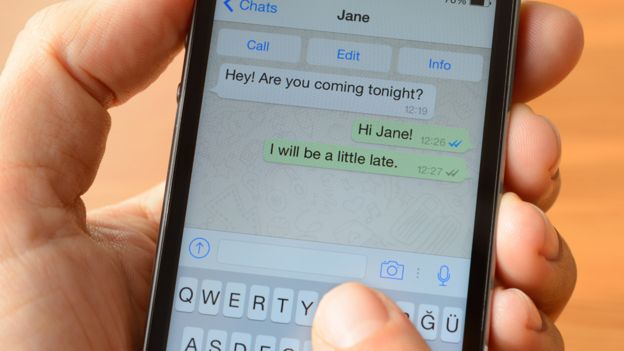
Internet linguist Gretchen McCulloch says more and more people now see ending messages with a full stop as rude because of the way we text and use instant messaging apps like WhatsApp and Facebook Messenger.
"If you're a young person and you're sending a message to someone, the default way to break up your thoughts is to send each thought as a new message," she says.
"Because the minimum thing necessary to send is the message itself, anything additional you include can take on an additional interpretation."
A 2015 study by Binghamton University involving 126 undergraduates found they perceived text messages ending in a full stop as being less sincere than the same message without a full stop.
In speech, the full stop is generally accompanied by lowering the voice to indicate the end of a sentence and carries connotations of formality or seriousness, Ms McCulloch explains.
"This can be fine if your message is already serious," she says.
"The problem comes when you have a positive message with the seriousness of the full stop. It's the juxtaposition of those things which creates that sense of passive aggression."
 Gretchen McCulloch has written about how the digital world is transforming the English language
So how can we tell if someone is actually annoyed or just using a full stop in the traditional sense?
Erika Darics, a lecturer in linguistics at Aston University in Birmingham, says it is all down to context.
"If you and your friends don't normally use full stops in a WhatsApp group and then somebody does, they are probably trying to tell you something about how they feel," says Ms Darics.
She says someone's age and how often they use messaging apps can also affect how they use punctuation.
For example, younger people are more likely to send single-sentence messages without a full stop.
Often these differences are more significant than differences in nationality, Ms McCulloch - who is Canadian - argues. Using a full stop in messages seems to have similar connotations in both North America and the UK, she adds.
However, there can be some cultural differences between countries - Americans and Canadians don't use "x" to denote a kiss at the end of a message, while Brits do, she says.
Gretchen McCulloch has written about how the digital world is transforming the English language
So how can we tell if someone is actually annoyed or just using a full stop in the traditional sense?
Erika Darics, a lecturer in linguistics at Aston University in Birmingham, says it is all down to context.
"If you and your friends don't normally use full stops in a WhatsApp group and then somebody does, they are probably trying to tell you something about how they feel," says Ms Darics.
She says someone's age and how often they use messaging apps can also affect how they use punctuation.
For example, younger people are more likely to send single-sentence messages without a full stop.
Often these differences are more significant than differences in nationality, Ms McCulloch - who is Canadian - argues. Using a full stop in messages seems to have similar connotations in both North America and the UK, she adds.
However, there can be some cultural differences between countries - Americans and Canadians don't use "x" to denote a kiss at the end of a message, while Brits do, she says.
 Online messaging also forces people to develop new ways of conveying emotion and meaning without the use of body language or tone of voice.
"Going back to the 1500s there have been proposals for an irony punctuation mark but none of those caught on," says Ms McCulloch.
"But within a few short decades of being online we've come up with so many ways of conveying irony and other meaning."
For example, the acronym "lol" (laugh out loud) can be used sarcastically, as can the upside-down face emoji.
"Things like emojis raise awareness of language and can help us understand subtleties in other types of communication, like politics or propaganda," says Ms Darics.
"It encourages linguistic creativity."
Online messaging also forces people to develop new ways of conveying emotion and meaning without the use of body language or tone of voice.
"Going back to the 1500s there have been proposals for an irony punctuation mark but none of those caught on," says Ms McCulloch.
"But within a few short decades of being online we've come up with so many ways of conveying irony and other meaning."
For example, the acronym "lol" (laugh out loud) can be used sarcastically, as can the upside-down face emoji.
"Things like emojis raise awareness of language and can help us understand subtleties in other types of communication, like politics or propaganda," says Ms Darics.
"It encourages linguistic creativity."
Gretchen McCulloch has written about how the digital world is transforming the English language
So how can we tell if someone is actually annoyed or just using a full stop in the traditional sense?
Erika Darics, a lecturer in linguistics at Aston University in Birmingham, says it is all down to context.
"If you and your friends don't normally use full stops in a WhatsApp group and then somebody does, they are probably trying to tell you something about how they feel," says Ms Darics.
She says someone's age and how often they use messaging apps can also affect how they use punctuation.
For example, younger people are more likely to send single-sentence messages without a full stop.
Often these differences are more significant than differences in nationality, Ms McCulloch - who is Canadian - argues. Using a full stop in messages seems to have similar connotations in both North America and the UK, she adds.
However, there can be some cultural differences between countries - Americans and Canadians don't use "x" to denote a kiss at the end of a message, while Brits do, she says.
Laziness or linguistic creativity?
Use of informal grammar and text slang in messaging can lead to accusations of dumbing down and making people lazy. But Ms McCulloch points out that using slang or incorrect spellings actually takes more effort in an age of autocorrect and predictive text.
Online messaging also forces people to develop new ways of conveying emotion and meaning without the use of body language or tone of voice.
"Going back to the 1500s there have been proposals for an irony punctuation mark but none of those caught on," says Ms McCulloch.
"But within a few short decades of being online we've come up with so many ways of conveying irony and other meaning."
For example, the acronym "lol" (laugh out loud) can be used sarcastically, as can the upside-down face emoji.
"Things like emojis raise awareness of language and can help us understand subtleties in other types of communication, like politics or propaganda," says Ms Darics.
"It encourages linguistic creativity."DISCLAIMER: The Views, Comments, Opinions, Contributions and Statements made by Readers and Contributors on this platform do not necessarily represent the views or policy of Multimedia Group Limited.
Tags:
DISCLAIMER: The Views, Comments, Opinions, Contributions and Statements made by Readers and Contributors on this platform do not necessarily represent the views or policy of Multimedia Group Limited.
Latest Stories
-
S&P affirms Ghana’s “B-/B” credit ratings with stable outlook
1 minute -
Alan Kyerematen urges Ghanaians to make a ‘strategic choice’ in 2028
3 minutes -
Akwasi Opong-Fosu proposes ‘3Vs’ plan for NDC grassroots empowerment and economic viability
5 minutes -
Government races to end teachers’ strike as Education Minister holds crunch talks with unions
6 minutes -
LA 2028: Black Queens to face Mauritius in Round Two of African qualifiers
16 minutes -
Three dead, including child, in Channel crossing attempt
20 minutes -
Woman charged with stealing from patients and staff at hospitals across Ontario
20 minutes -
Foreign tourists stay longer as domestic guests dominate Ghana’s accommodation market – GSS
22 minutes -
Ghana’s tourism accommodation market shows sharp regional disparities – GSS
26 minutes -
Ayalolo BRT to get contra-flow lanes on three major Accra corridors
31 minutes -
GH¢111bn DDEP maturity wall in 2027/2028 – Insights from Charles Adu Boahen
33 minutes -
Danlad Ibrahim on crutches after suffering injury against Aduana FC
34 minutes -
Aayalolo to operate contra-flow on three major Accra corridors
39 minutes -
Northern Region pupils left unsupervised as teacher unions begin strike
40 minutes -
Limited time forced me to contest 2024 election as independent candidate — Alan Kyerematen
41 minutes