

Audio By Carbonatix
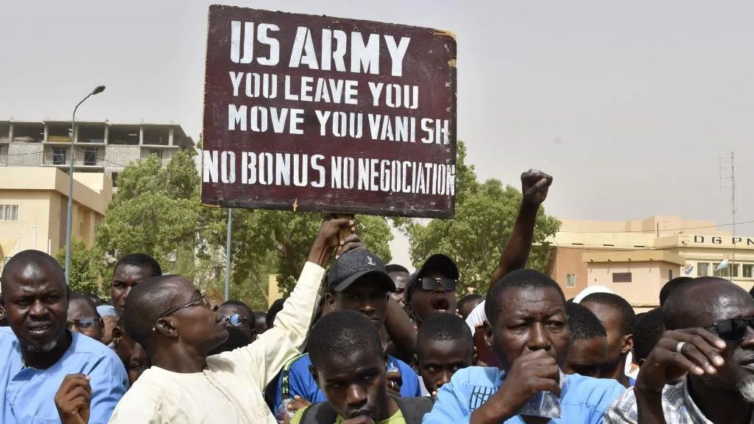
The US and Niger have agreed that American troops will leave the country "no later" than 15 September, they announced in a joint statement on Sunday.
They said the two countries had "reached a disengagement agreement to effect the withdrawal of U.S. forces, which has already begun".
The US has relied on Niger as its primary base for monitoring regional jihadist activity.
The statement commended the "joint sacrifices of Nigerien and U.S. forces in the fight against terrorism".
The statement said the withdrawal would not affect the continuation of US-Niger relations.
"The United States and Niger are committed to ongoing diplomatic dialogue to define the future of their bilateral relations," it read.
The deal was reached after marathon talks between the two countries in Niamey.
In March, Niger announced the end of its military agreement with the US. Military spokesperson Col Amadou Abdramane accused the US of raising objections about the allies that Niger had chosen.
Col Abdramane condemned the US for its "condescending attitude" and "threat of reprisals".
Tensions spiked between the US and Niger after elected president, Mohamed Bazoum, was overthrown last year.
Niger is in Africa's Sahel region, considered the new global epicentre of the Islamic State group.
American forces have used two military bases in Niger to monitor Islamist militant groups in the Sahel.
The US built a $100m (£80m) military base there six years ago in the central city of Agadez, 750km (460 miles) north-east of Niamey.
It has played a key role in the US strategy to combat jihadists in West Africa.
The US has more than 1,000 troops stationed at the base.
It is the second Western power to withdraw from Niger.
Last year, Niger expelled former colonial power France's troops, who had also been deployed to fight jihadists.
As Niger has distanced itself from the West, it has drawn closer to Russia.
Last month, Russian military instructors arrived in Niger as part of a new agreement with its military leaders.
Niger has also broken away itself from local democracies and sought stronger regional alliances with fellow junta-led nations Burkina Faso and Mali.
The trio have quit Ecowas - the West African regional body which opposed their military takeovers.
They have also quit the French-backed G5 Sahel force, saying it was ineffectual and undermined African sovereignty, and launched their own defence pact called the Alliance of Sahel States.
Latest Stories
-
Anthropic seeks rehearing of case over Pentagon’s security risk branding
44 seconds -
NDC Deputy National Organizer Aspirant Hamza Umar targets grassroots mobilisation
45 minutes -
Villarreal fight back to beat Napoli and end losing run
3 hours -
Tresoldi nets hat-trick as Club Brugge win Inter thriller
3 hours -
PSG’s Luis Enrique hopes Man City avoid sanctions
3 hours -
Lisandro Martinez issues scathing attack on Man Utd board – has he made things worse?
3 hours -
Saka responds to Arteta’s challenge with ‘huge impact’
3 hours -
Viking hold Bayern in thriller as Kane breaks Messi record
4 hours -
Gordon scores as Barcelona beats Galatasaray
4 hours -
Bumble bought for $1.3bn in ‘bet on the future of humanity’
4 hours -
Imagination Africa, Mentors Chess Academy to host second African Genius Chess Championship at Ghud Park
4 hours -
Paradigm Initiative steps up calls over digital rights, internet freedom in Africa
4 hours -
Saudi man charged with planting ‘sophisticated’ recording device in OpenAI office
4 hours -
Ghana wins UN Human Rights Council seat as calls grow for action against atrocities
4 hours -
Royal Mail losing 400 postal workers a week, says union
5 hours