

Audio By Carbonatix
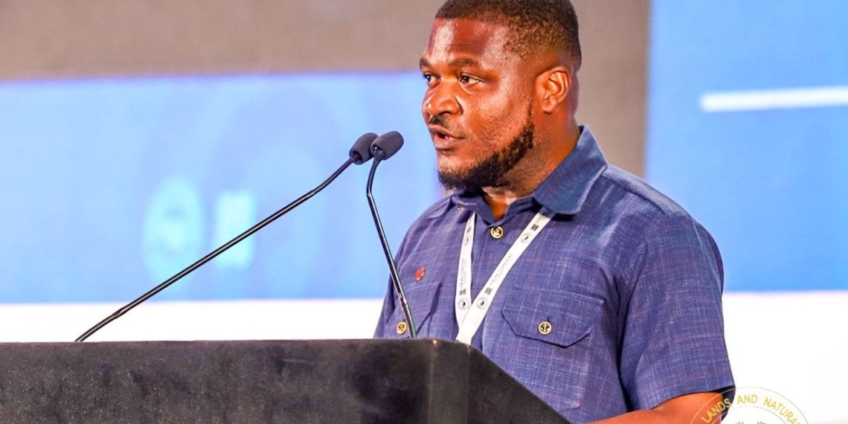
Chief Executive Officer of the Minerals Commission, Isaac Tandoh, has announced a sweeping set of reforms aimed at restoring Ghanaian ownership and control of the country’s mining industry, including the revocation of more than 300 fraudulently acquired or dormant small-scale mining licences.
Speaking at the maiden Mining Local Content Summit 2026 in Takoradi, Mr Tandoh questioned whether Ghana had fully taken charge of its mineral resources more than 70 years after independence.
The Mining Local Content Summit 2026 is the first major technical forum dedicated to promoting Ghanaian participation across the mining value chain.
For decades, Ghana’s mining industry has largely operated on an extraction-based model, with most technical services and profits flowing abroad.
The new reforms mark a shift toward value retention, aimed at ensuring that billions of cedis spent annually on equipment, engineering, and services remain within the local economy.
Observers say the success of the reforms will depend on sustained enforcement and political commitment, as the government seeks to build a mining sector that creates lasting wealth beyond mineral extraction.
“While we have made gains in local employment, there is a difference between providing labour and exercising control,” he said.
A major focus of his address was the practice of “fronting”, where foreign operators hide behind Ghanaian names to secure mining licences while retaining ownership and profits.
Mr Tandoh described the practice as unethical and directly linked it to illegal mining, known locally as galamsey.
“Some Ghanaians are being used to disempower their own people,” he warned, urging citizens to stop facilitating such arrangements.
He said under the policy direction of the Minister for Lands and Natural Resources, Emmanuel Armah-Kofi Buah, the Commission has shifted from paperwork to active enforcement over the past year.
As part of this approach, more than 300 inactive and improperly acquired licences have been withdrawn, while District Mining Committees have been activated to ensure that no licence is processed without input from local authorities.
According to him, the reforms are intended to improve transparency and reduce political and foreign influence in the licensing process.
Mr Tandoh also announced a comprehensive review of the Minerals and Mining Act (Act 703), including the revocation of LI 2462, which previously allowed mining in forest reserves.
He said the government is also introducing a new medium-scale mining category to support responsible Ghanaian operators who fall between small and large-scale mining.
In a move expected to affect multinational companies, the Commission is phasing out long-term “Development Agreements”, which he said had often been abused.
“Some companies use revenue from Ghana to develop mines elsewhere while failing to meet basic obligations to our districts,” he noted.
To replace the agreements, the government is proposing a more flexible royalty system that will allow Ghanaians to benefit directly from high global gold prices.
Mr Tandoh said the reforms are aligned with President John Dramani Mahama’s “Reset Agenda”, which seeks to strengthen local participation across key sectors of the economy.
He stressed that local content would no longer be treated as a mere regulatory requirement.
“Local content is no longer a compliance checkbox. It is now a strategic priority in every mining agreement,” he stated.
The Minerals Commission CEO assured “genuine investors” of the government’s readiness to work with partners committed to Ghana’s development, while pledging to confront those exploiting regulatory loopholes.
Latest Stories
-
Ghana’s security exposed by Defence Ministry vacancy – Nitiwul
34 seconds -
MOBA commences historic 150th anniversary celebration rooted in faith and national service
7 minutes -
MiDA calls on chiefs to free land for President Mahama’s project
9 minutes -
Timing Trouble: Why Mexico friendly threatens Ghana’s World Cup readiness
15 minutes -
GHS issues new security, patient care directives after Mamprobi baby theft
24 minutes -
Gov’t urged to provide psychological support for victims following foreign national scandal
38 minutes -
Forty Under 40 Africa Summit declares ‘End of African Apology’ at Accra gathering
52 minutes -
Ghana remains 4th in Africa with highest debt to IMF
1 hour -
Minerals Commission revokes over 300 licences in push to reclaim Ghanaian control of mining sector
1 hour -
2026 UG Corporate Games: Ghana Civil Aviation Authority secures big win
1 hour -
No extradition treaty makes justice for Russian suspect difficult – Criminologist
1 hour -
Speaker faults NDC, NPP over absence of female candidates in Ayawaso East by-election
1 hour -
“We are not creating a parallel financial system”-BoG Governor on Virtual Asset regulation
1 hour -
Pan-African Youth Union General Secretary pays courtesy call on NYA CEO Osman Ayariga
1 hour -
NYA explores collaboration with Pan-African Youth Union to empower African youth
2 hours