

Audio By Carbonatix
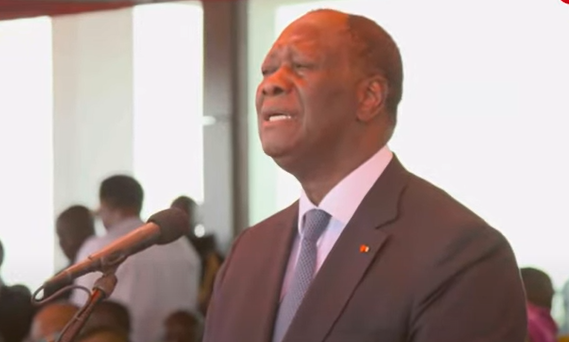
Ivory Coast President Alassane Ouattara's decision to seek re-election in October means the world's top cocoa-producing nation will again have to wait on his promise to pass the baton to a new generation of political leaders.
But the 83-year-old former international banker is hoping a strong economy and a weak field of challengers will propel him to a fourth term, extending a period of relative stability after the civil war that brought him to power in 2011.
Ouattara made his announcement on Tuesday, saying his health was not an issue. With the country's most high-profile opposition politicians ruled ineligible, he is the clear front-runner.
A U.S.-trained economist whose resume includes stints as governor of the West African central bank (BCEAO) and deputy managing director of the International Monetary Fund (IMF), Ouattara has long pitched himself as a savvy technocrat capable of delivering steady growth.
The numbers back him up, with the IMF projecting GDP to increase to 6.3% this year, in line with the average over the past decade.
He has also proved himself to be a deft political operator, striking deals that have eased his two previous re-election bids and avoided a repeat of the widespread violence that followed his election win over predecessor Laurent Gbagbo in late 2010.
Gbagbo's refusal to accept defeat in that contest triggered a brief civil war that killed more than 3,000 people and only ended with his arrest in a bunker at his Abidjan residence.
Ouattara's "primary success has been on the macroeconomic side" and restoring Ivory Coast's "international influence," said political analyst Arthur Banga.
But "there are still democratic challenges to overcome," he added, citing lingering fears of election-related violence. "This means there is work to be done to achieve normalcy."
POLITICAL VIOLENCE
Born in Dimbokro in central Ivory Coast on January 1, 1942, Ouattara received a doctorate in economics from the University of Pennsylvania.
He earned a reputation for competent economic management as prime minister under founding President Felix Houphouet-Boigny, whose name evokes decades of agricultural export-led prosperity that built palm-lined boulevards and skyscrapers.
Houphouet-Boigny's death in 1993, combined with economic challenges related to structural adjustment and the devaluation of the regional currency, gave rise to a more toxic period in Ivorian politics.
Following a coup in 1999, Ouattara was excluded from running for president the following year on the grounds that one of his parents was from Burkina Faso. Gbagbo, who won that election, called Ouattara "a candidate for the foreigners".
A 2002 rebellion against Gbagbo split the country in two, leaving its northern half in the hands of rebels, many of them from Ouattara's Dioula ethnic group.
The war was largely a result of xenophobic policies by successive Ivorian governments against migrant farmers from Burkina Faso and Mali that also targeted northern Ivorians with cultural ties to them.
For the 2010 election, Ouattara formed a pact with former President Henri Konan Bedie that helped secure his victory in the runoff against Gbagbo.
Five years later, with Gbagbo awaiting trial at the International Criminal Court in The Hague, Ouattara reaffirmed his alliance with Bedie, opens new tab and coasted to re-election with 83% of votes cast.
In 2020, Ouattara initially vowed not to run again, but he went back on that after his preferred successor, then-Prime Minister Amadou Gon Coulibaly, died several months later.
Ouattara argued that a new constitution approved in 2016 reset his two-term limit, though his opponents disagreed and boycotted.
Clashes between rival supporters before and after the 2020 vote killed 85 people, opens new tab, officials later said.
This time around, the most viable opposition candidates, including Gbagbo and former Credit Suisse chief executive Tidjane Thiam, have been excluded from the ballot, meaning Ouattara could again win by a comfortable margin.
This could give him more time to ensure the economic gains of his tenure so far are more evenly shared, said political scientist Geoffroy Julien Kouao.
Ouattara has "succeeded in establishing peace after a decade of crisis," he said. "However, much remains to be done in terms of wealth distribution to reduce social inequalities."
Latest Stories
-
Only 14% of the world’s cities breathed safe air in 2025, new global report finds
23 minutes -
Ghana’s air quality improves for the first time since 2021; country places 11th in Africa – IQAir 2025 report
29 minutes -
Chad, DR Congo have dirtiest air in Africa; Réunion, Canary Islands cleanest, IQAir 2025 report
37 minutes -
Divine Mission Academy advances to finals of 2026 Luv FM VitaMilk Primary Schools Quiz
1 hour -
University of Ghana beat UENR to reach 2026 Honda Football Championship final
2 hours -
President Mahama urges international partners to respect Ghana’s position on LGBTQ issues
2 hours -
UDS edge UBIDS to reach 2026 Honda Football Championship final
2 hours -
Gender Minister holds first quarter ministerial advisory board meeting
2 hours -
Yirenkyi, Adjetey score lowest as Ayew tops ratings in Austria annihilation
2 hours -
Mahama courts diaspora support, highlights $7.8bn contribution to Ghana’s economy
2 hours -
President Mahama honoured with International Statesperson Award in US
3 hours -
Biggest winners from Ghana’s defeat to Austria
3 hours -
Gov’t working to address salary arrears of 2024 teachers – Education Minister assures
3 hours -
‘Democracy Is Not for Sale’ forum ends with strong calls to tackle vote buying, reform political financing
3 hours -
Parliament rejects Minority motion to investigate GoldBod losses
4 hours