

Audio By Carbonatix
Journalists have been called upon to play a critical role in promoting decent work and standing against forced labour as part of national development efforts.
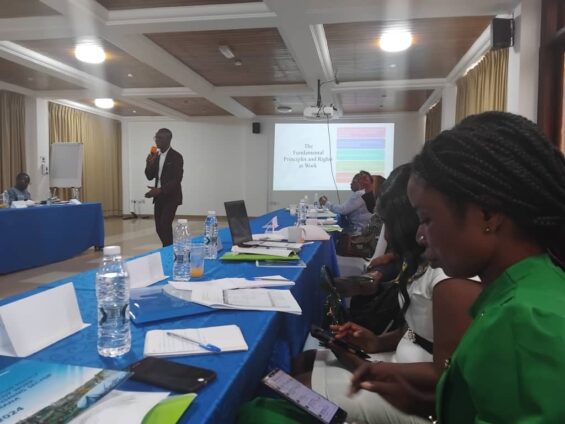
This appeal was made by Emmanuel Kwame Mensah, the National Project Coordinator for the 8.7 Accelerator Lab Project, during a media training session organized by the International Labour Organization (ILO) on Fundamental Principles and Rights at Work (FPRW).
Speaking at the training, Mensah emphasized that journalists, as influencers of public opinion, are uniquely positioned to raise awareness about labour rights violations and advocate for policies that protect workers.

He urged media professionals to become champions of decent work by shedding light on exploitative labour practices, particularly in sectors where forced labour, child labour, and other abuses are prevalent.
"The media must not only inform but also engage in the fight against forced labour, promoting decent working conditions that foster national development," said Mensah.
Pressing Global Labour Challenges
The global labour landscape is facing profound challenges, with the COVID-19 pandemic and other crises exacerbating pre-existing issues. Rising levels of extreme poverty, child labour, forced labour, and informal employment have highlighted the urgent need to address inequalities in the labour market.
Vulnerable groups, especially in sectors such as agriculture and fishing, are disproportionately affected by exploitative labour conditions.
In Ghana’s fishing industry alone, over 128,000 fishers work under severely compromised conditions.
Reports of forced labour, debt bondage, wage withholding, and abusive practices are widespread. This form of exploitation not only violates fundamental labour rights but also poses a threat to food security for millions of people worldwide who rely on the fishing industry.
Ghana’s Commitment to Labour Rights: Ratifying the ILO Work in Fishing Convention
Ghana has taken a bold step towards addressing labour exploitation by ratifying the ILO’s Work in Fishing Convention (C188).
This important convention sets a global standard for decent work in the fishing sector. The ratification ensures that Ghana commits to upholding labour rights that guarantee fair recruitment practices, safe and healthy working conditions, and social security provisions for fishers.
Under the framework of the convention, fishing workers in Ghana are entitled to acceptable working conditions, including proper accommodation, and access to food, water, and medical care while at sea. By ratifying this convention, Ghana has also established an accountability system to ensure these standards are met.
The ILO's Work in Fishing Convention seeks to transform the often-overlooked labour conditions in the industry, ensuring the protection and well-being of workers who are essential to the country’s food supply and broader economic development. This move reinforces Ghana’s commitment to advancing labour rights and achieving decent work for all, in alignment with Sustainable Development Goal 8.
The Role of Media in Advancing Decent Work
Emmanuel Kwame Mensah's call to journalists aligns with the broader goal of promoting sustainable development through labour rights advocacy. Journalists are encouraged to hold institutions accountable, spotlight cases of labour exploitation, and push for the enforcement of legal protections for workers. The media has a critical role in raising public awareness, shaping policy discourse, and fostering societal change in the fight against forced labour.
As Ghana strives to improve labour conditions across various sectors, he noted that the role of journalists in reporting on labour rights violations and advocating for decent work will be instrumental in driving national development. With the ILO’s support, media professionals can amplify the voices of vulnerable workers, helping to bring about meaningful reform in the labour market.
By engaging in this advocacy, according to Mr Mensah journalists contribute to a future where decent work is the norm, forced labour is eradicated, and the workforce is empowered to contribute to sustainable economic growth.
Latest Stories
-
Ghana must value skilled trades, build resilient learners — Ibn Chambas
2 seconds -
Ghana must rethink education around relevance, resilience and responsibility — Ibn Chambas
3 minutes -
Prince Harry faces defamation lawsuit from charity he co-founded
5 minutes -
South Korea deploys thermal cameras to track escaped zoo wolf
6 minutes -
Calls for royal meeting with Epstein survivors grow ahead of US visit
10 minutes -
Ibn Chambas advocates blend of technology and human values in education
11 minutes -
UMA improves healthcare access in Asutifi North with GH₵700k ‘Kim Taylor Legacy’ Walkway
16 minutes -
Scholarships Authority and Fanaka University offer sponsorship for procurement and supply chain studies
19 minutes -
Bisa Kdei drops new single ‘Go N Look’ featuring Medikal
26 minutes -
Benin facing rising terrorism in north as French military presence faces growing criticism
27 minutes -
UEW Public Lecture Series 2026: Education debate ‘about the soul of Ghana’s future’ — Dr Ibn Chambas
28 minutes -
EU fingerprint and photo travel rules come into force from today
55 minutes -
Anti-LGBTQ+ Bill: Ghanaians demand expedited passage, not dialogue – Ntim Fordjour to Mahama
1 hour -
EU airline industry warns of fuel shortages if Strait of Hormuz stays closed
1 hour -
White House staff told not to place bets on prediction markets
1 hour