

Audio By Carbonatix
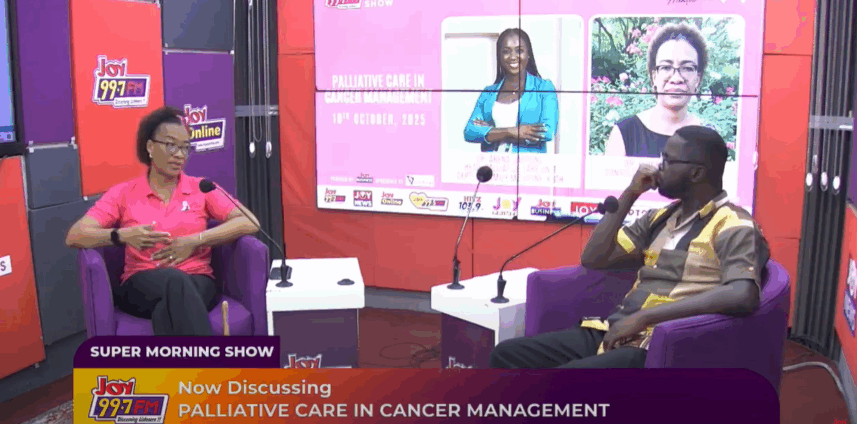
Health experts are urging government and health institutions to prioritise palliative care and early cancer management across Ghana, stressing that effective support systems can greatly improve patients’ quality of life and recovery outcomes.
Speaking on the Joy FM Super Morning Show as part of Joy Cancer Awareness Month, Dr Abena Sarpong, Head of the Palliative Care Unit at the Department of Family Medicine at the Korle Bu Teaching Hospital, said palliative care should not be seen as a service reserved only for the dying, but as an essential part of holistic cancer treatment.
“Palliative care provides comfort and support to patients and their families, helping them cope physically, emotionally, and spiritually through the disease process,” she explained. “Unfortunately, many people associate it with end-of-life care, and that’s not the case.”
Dr Sarpong said most patients are referred for palliative care at late stages due to misinformation, stigma, and inadequate understanding of what the service entails. She added that the lack of a national policy and limited coverage under the National Health Insurance Scheme (NHIS) have also hindered access to care.
“We need a national policy for palliative care and for services to be covered by health insurance. If we can integrate palliative care at the point of diagnosis, patients can receive better symptom control, pain relief, and psychological support.”
She said that palliative care plays a critical role not just for patients with terminal illness, but also for those undergoing treatment such as chemotherapy, radiotherapy, or surgery.
Consultant General Surgeon at Korle Bu Teaching Hospital, Dr Florence Dede, who is also a breast cancer survivor, said early detection and multidisciplinary care are key to improving survival rates.
“One good thing about my own experience was that it was picked early,” she shared.
“When cancer is detected early and treated promptly, the outcomes are very good. That really encouraged me.”
Dr Dede underwent surgery and radiotherapy but did not require chemotherapy due to the nature of her cancer. She said her experience made her deeply appreciate the need for emotional and palliative support for patients.
“Going through cancer treatment is not easy; apart from the physical side effects, there are emotional struggles,” she said.
“That’s why palliative care and family support are so important. Patients shouldn’t have to walk that journey alone.”
She also highlighted how early palliative interventions can improve adherence to treatment and recovery.
“Sometimes, patients abandon treatment because of fear or misinformation. When palliative care is integrated, professionals help address those concerns; it makes a huge difference,” Dr Dede said.
The two specialists urged the public to take advantage of screening services and seek medical attention early, noting that many cancers, including breast and cervical cancers, can be treated effectively if diagnosed on time.
Dr Sarpong further called for increased training of healthcare providers in palliative medicine and the establishment of more care units across the country.
“Palliative care must not be centralised in teaching hospitals alone. We need to decentralise it so that patients in regional and district facilities can also benefit,” she said.
The experts stated that improving cancer management in Ghana requires collaboration between the government, healthcare professionals, civil society, and the media to raise awareness and combat stigma.
“We all have a role to play. Cancer is not a death sentence. With early detection, proper treatment, and the right support, people can and do survive.”
Latest Stories
-
Interior Minister receives Gbenyiri Mediation report to resolve Lobi-Gonja conflict
21 minutes -
GTA, UNESCO deepen ties to leverage culture and AI for tourism growth
35 minutes -
ECG completes construction of 8 high-tension towers following pylon theft in 2024
58 minutes -
Newsfile to discuss 2026 SONA and present reality this Saturday
1 hour -
Dr Hilla Limann Technical University records 17% admission surge
1 hour -
Meetings Africa 2026 closes on a high, Celebrating 20 years of purposeful African connections
1 hour -
Fuel prices to increase marginally from March 1, driven by crude price surge
2 hours -
Drum artiste Aduberks holds maiden concert in Ghana
2 hours -
UCC to honour Vice President with distinguished fellow award
2 hours -
Full text: Mahama’s State of the Nation Address
2 hours -
Accra Mayor halts Makola No. 2 rent increment pending negotiations with facility managers
2 hours -
SoulGroup Spirit Sound drops Ghana medley to honour gospel legends
3 hours -
ECG reinforces ‘Operation Keep Light On’ in Ashanti Region
3 hours -
UK remains preferred study destination for Ghanaians – British Council
3 hours -
Ghana Medical Trust Fund: Maame Samma Peprah ignites chain of giving through ‘Kyerɛ Wo Dɔ Drive’
3 hours