

Audio By Carbonatix
A US federal judge has temporarily blocked the Trump administration from deploying National Guard troops from Texas and California to Portland, Oregon.
The decision late on Sunday comes after the same court denied Trump's attempt to deploy Oregon's own National Guard members to Portland.
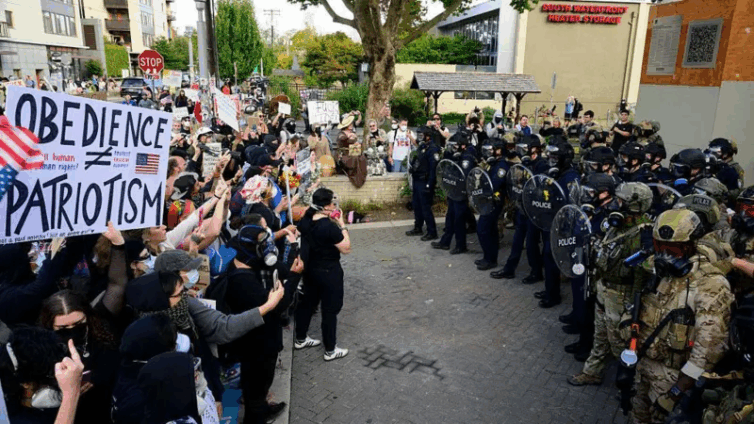
Portland is the latest Democrat-led city targeted as part of the president's attempt to address what he says is out-of-control crime, amid protests over his administration's immigration enforcement.
Trump has also authorised the deployment of National Guard troops from other states to Chicago in Illinois, to address what he says is out-of-control crime.
The ruling on Sunday from US District Judge Karin Immergut came shortly after the Pentagon confirmed 200 members of the California National Guard had been reassigned to Portland to "support US Immigration and Customs Enforcement and other federal personnel performing official duties".
California and Oregon had sought a temporary restraining order against the deployment.
Judge Immergut, who was appointed by Trump, said there was no evidence that recent protests in the city made the presence of federalised National Guard troops necessary.
During Sunday's emergency hearing, she pressed lawyers from the federal government on how the deployment of troops from other states was not simply a way to circumvent her earlier decision denying the deployment of Oregon's National Guard.
In that decision, she said the use of the military to quell unrest without Oregon's consent risked the sovereignty of that state and others, and inflamed tensions in the city of Portland.
Sunday's ruling will remain in effect until at least 19 October. The White House is yet to respond.
In previous remarks, the Trump administration had said the president was exercising his "lawful authority to protect federal assets and personnel in Portland following violent riots and attacks on law enforcement".
Meanwhile, Illinois Governor JB Pritzker said late on Sunday night that Trump was "ordering 400 members of the Texas National Guard for deployments to Illinois, Oregon, and other locations within the United States".
In a statement, the governor called the proposed deployment "Trump's invasion", and said there was "no reason" to send troops into any state without the "knowledge, consent, or cooperation" of local officials.
He told CNN that the authorisation of troops there would incite protests and accused the administration of creating a "warzone" to rationalise the response.
Pritzker also called on Texas Governor Greg Abbott to "immediately withdraw any support for this decision and refuse to co-ordinate".
In response, Abbott said he "fully authorized" Trump's decision to call up the Texas National Guard "to ensure safety for federal officials".
"You can either fully enforce protection for federal employees or get out of the way and let Texas Guard do it," he said in a statement on X.
Like Portland, Chicago has seen protests over increased immigration enforcement. On Saturday, protests became violent, with immigration authorities saying they opened fire on an armed woman after she and others allegedly rammed their cars into law enforcement vehicles.
The woman's condition is unclear, but officials said she drove herself to hospital.
Protests have been ongoing in Portland and other cities over the Trump administration's increased immigration enforcement.
Portland, in particular, has long drawn Trump's ire over its alleged concentration of people his supporters describe as Antifa, short for "anti-fascist". The president recently signed an executive order designating the group, which is a loosely organised movement of far-left activists, as a domestic terrorist organisation.
The Portland deployment came one day after Trump authorised the deployment of 300 National Guard troops to Chicago under a similar pretext.
The National Guard is the primary combat reserve of the Army and Air Force. The state-based military force can be called up by either a state governor or the US president. It is often deployed to provide disaster relief after floods and hurricanes but can also support military operations overseas.
Over the summer, Trump directed National Guard troops to be deployed in Washington, DC, and Los Angeles, saying they were needed to quell crime or protests. These were significant decisions, as deployments are typically left to a state's governor.
Trump has sought to use National Guard troops in a number of US cities to crack down on crime and support immigration enforcement - including in Washington, DC, and Los Angeles, California.
In September, a federal judge in California ruled Trump's deployment of the National Guard to Los Angeles was illegal because it violated an act that limits the power of the federal government to use military force for domestic matters.
The administration is appealing that decision.
Latest Stories
-
Philanthropist Alhaji FuZak donates Da’wah bus to Ambariya Sunni community
3 minutes -
GUTA calls for suspension of Publican AI system over trade disruptions, demands temporary halt in import activities
6 minutes -
TTAG raises alarm over proposed recruitment of 7,000 teachers, demands national posting roadmap
39 minutes -
Civilians feared killed after reports of air strike on Nigerian market
49 minutes -
Bishop Simon Kofi Appiah installed as new Jasikan Diocese Bishop
50 minutes -
Trump’s Strait of Hormuz blockade threat raises risks and leaves predicaments unchanged
52 minutes -
US Court backs extradiction of former MASLOC CEO Sedina Tamakloe-Attionu’s to Ghana
1 hour -
Seven arrested as NAIMOS dismantles illegal mining camp, seizes firearms at Boin River
1 hour -
Fire erupts at Madina Ritz Junction, destroys multiple wooden structures and containers
1 hour -
Daniel-Kofi Kyereh returns from long-term injury, registers assist for Freiburg U23
2 hours -
Knifeman calling himself ‘Lucifer’ slashes three at NYC’s Grand Central
2 hours -
Brands are built from within to without
2 hours -
Matriculants urged to pursue excellence as gov’t reaffirms support for Maritime education
2 hours -
See the areas that will be affected by ECG’s planned maintenance on Monday, April 13, 2026
2 hours -
GPL 2025/26: Salim Adams double fires Medeama back to summit after Kotoko rout
2 hours