

Audio By Carbonatix
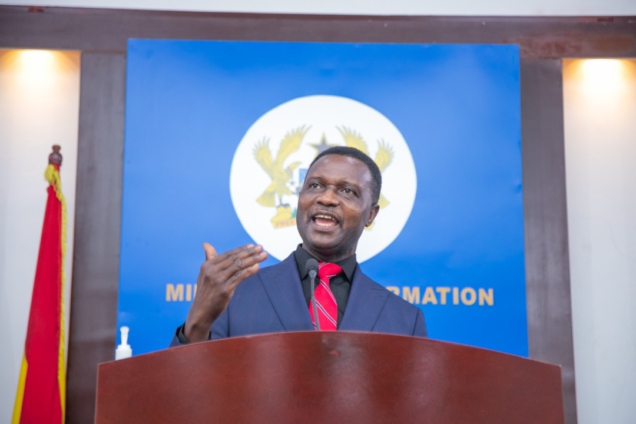
The Education Minister, Dr Yaw Osei Adutwum, says the junior high school (JHS) system lacks the desired quality to produce competitive students and graduates for the country.
He noted that the current JHS system does not favour ‘weak’ or underprivileged students, adding that there are no advanced facilities that build students for their career paths.
Speaking at a press briefing on Sunday, the Bosomtwe MP recounted that the current JHS education is not robust enough to prepare students for higher education, unlike the former middle system.
According to him, the country created “a monster [when] we removed what used to be middle school, which gave people from disadvantaged backgrounds opportunities to catch up with the rest” in 1987.
“I think the weakest link in the education system is the junior high school because others will go the junior high school and do the quality secondary work; if you meet those students at Wesley Girls, they are ahead of the curve, and they are going to do much better than you.”
“We borrowed a concept from the United States…three plus three but we decided that the first three [JHS] is not something that we’re going to be very concerned about. Something needs to be done about the week middle which happens to be the junior high school,” he said.
Ghana passed a new legislation in 1987 which scrapped the then middle school system and replaced it with the JHS system, making the duration of basic school education nine years instead of the previous 10 years.
Prior to that, the Education Act of 1961 had introduced the Free and Compulsory Basic Education (FCUBE) for all school-age children.
Currently, students who complete the three-year Junior High School take a national test in order to qualify to the senior high school.
Successful Basic Education Certificate Examination (BECE) candidates are then able to continue their education at the secondary level under the flagship Free SHS policy.
The Bosomtwe Member of Parliament hinted at plans being put in place to review and revamp the junior high school.
“We have junior high schools that under construction now and the facilities in there will be just like high schools; everything that is in the high school will be there.”
“It’s a pilot programme, and students who go through it would have had three years of quality junior high school, move on to the high school to do another three years, giving me six years making them competitive and making us compete with the rest of the world,” he assured.
Latest Stories
-
Prudential Life settles GH¢100,000 medical bills under its PRUCares Valentine Experience Initiative
6 hours -
Wa West Picnic: Peter Lanchene Toobu champions peace, health and unity in landmark celebration
6 hours -
Dr Mensah Market flooded after downpour in Kumasi
6 hours -
Armed men reportedly storm Adjen Kotoku Onion Market amid tensions
7 hours -
Tecco Mensah writes: Why football fans must look beyond statistics
8 hours -
Police recover stolen Honda CR-V in Kumasi within 48 hours
8 hours -
Apetorku Gbodzi 2026 Festival opens in Dagbamete with development focus
9 hours -
President Mahama arrives in Lyon to co-chair One Health Summit
9 hours -
Beverly View Plus Hotel draws crowds amid coastal Easter rush in Volta
9 hours -
Maiden Zongo Festival held in Wa amid calls to tackle drug abuse among the youth
9 hours -
FDA warns of fake HIV test kits on Ghanaian market
10 hours -
Africa urged to build resilient health systems as donor support tightens
10 hours -
Easter gesture: Ablakwa settles medical bills for 85 North Tongu constituents
11 hours -
Africa must harness its population strength—Titus-Glover
11 hours -
Visa-free access doesn’t mean unlimited stay – Lom Ahlijah
12 hours