

Audio By Carbonatix
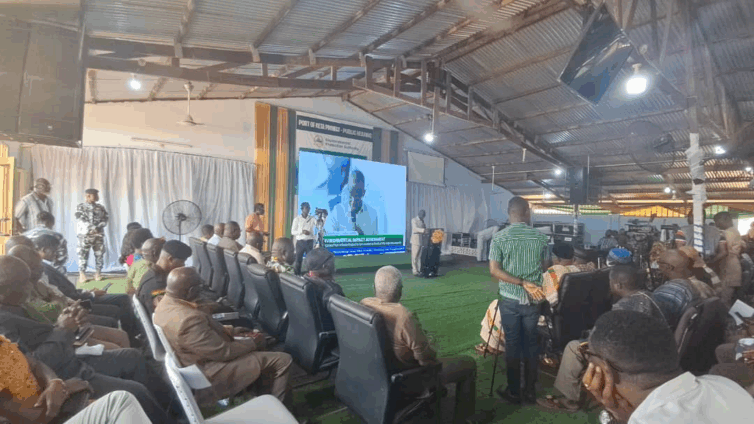
Ghana’s commitment to responsible environmental governance and sustainable infrastructure came into sharp focus as stakeholders converged at Dzelukope in the Volta Region for a crucial public hearing on the proposed Keta Port Development Project.
The event, held at the Global Evangelical Church, Bethel Chapel, brought together state authorities, traditional leaders, Members of Parliament, engineers, environmental experts, and community representatives in a landmark dialogue that underscored the balance between national development and environmental stewardship.
EPA Champions Accountability in Environmental Decision-Making
Delivering the purpose of the gathering, Prof. Nana Ama Browne-Klutse of the Environmental Protection Agency (EPA) said the exercise represented a vital step in strengthening transparency and public participation in Ghana’s environmental decision-making process.
She explained that under the Environmental Protection Act, 2025 (Act 1124), the EPA is mandated to regulate, coordinate, and oversee all matters related to the protection of the environment and climate resilience — and that the hearing was in fulfillment of Regulation 24 of LI 2504, which requires public engagement for projects with potentially far-reaching environmental and social implications.
“Our duty is not only to protect the environment but also to promote development that is sustainable, accountable, and informed by science and stakeholder perspectives,” she said.
She stressed that the feedback gathered from the engagement would be critical in determining the final decision on the Keta Port Project, describing the process as “a cornerstone of environmental democracy.”
“Public hearings such as this one affirm our collective right to participate in decisions that shape our environment and future,” Prof. Browne-Klutse emphasised.
A Model for National and Regional Integration
In a separate address, Mr. Johnson Asiedu Nketiah, Board Chairman of the Ghana Ports and Harbours Authority (GPHA), described the Keta Port as a strategic infrastructure poised to transform trade and logistics across the sub-region.
He noted that the project, when completed, will create new maritime trade corridors linking Ghana to Togo, Benin, and Nigeria and enhance the country’s competitiveness in global shipping and logistics.
“This is not just a port for Ghana—it is a gateway for regional commerce, a hub for investment, and a foundation for future industrial expansion,” he said.
Latest Stories
-
Ghana’s economy now resilient enough to withstand external shocks – Mahama
3 minutes -
Cocoa price adjustment painful but necessary to sustain sector – COCOBOD CEO
10 minutes -
No single African country will be treated in a manner that is preferential or advantageous – Patrice Motsepe
28 minutes -
Removal of GH₵1 levy won’t automatically lower pump prices – Arko Nokoe
41 minutes -
Decision to strip Senegal of AFCON title reflects independence of institutions – CAF President
46 minutes -
Energy Committee Vice Chair assures Ghanaians on stability amid fuel prices
1 hour -
Mahama hails 48 Engineer Regiment after successful disaster recovery mission in Jamaica
1 hour -
Rising crude prices expose flaws in ‘One Ghana Cedi’ levy – NPP MP
1 hour -
TechServe Employability Programme launched to deploy females in ICT into startups
2 hours -
Parliament passes Security and Intelligence Agencies Bill, renames NIB to BNI
2 hours -
Ghana’s fuel supply secure, but prices remain uncertain – Bulk Oil Distributors
2 hours -
Adu Boahene’s case: I’m not aware of theft or missing GH¢49m – Prosecution witness tells court
2 hours -
Ghana Deposit Protection Amendment Bill 2025 passed
3 hours -
Minority Leader warns of neglect in agriculture amid focus on gold for reserves
3 hours -
Minority alleges ‘state capture’ in mining sector, points to Ibrahim Mahama’s influence
3 hours