

Audio By Carbonatix
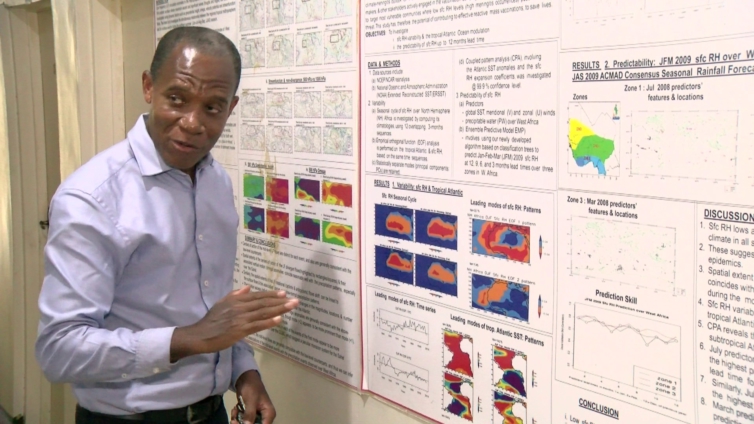
A climate scientist at the Kwame Nkrumah University of Science and Technology (KNUST) has developed a model to predict meningitis outbreaks nice months before they actually occur.
Professor Isaac Tetteh of the Environmental Science Department says absence of data inspired him and his team to embark on a search for ways to foresee occurrence, at least, nine months in advance.
He says the model will enhance government’s effort to fight the perennial disease which has already killed more than 40 people in the Northern sector of the country this year.
Meningitis is a bacterial infection associated with several environmental factors such as dusty harmattan winds and low humidity.
Over the years, the disease has killed many people especially in Northern Ghana.
"The constraints we have on meningitis data analysis is that we don’t have much data across the country and even globally,” Professor Tetteh says.
According to him, in the absence of readily available data, the scientists looked at environmental variables that can be used to make the predictions.
As an environmental variable, relative humidity and meningitis have an inverse relationship which means wherever there is high relative humidity, it could be expected that there would be low meningitis, and vice versa.
“In this situation, we are using relative Humidity as a proxy for meningitis so that once we don’t have data on meningitis we can use relative humidity variability in the atmosphere to predict the onset of meningitis and where the disease is likely to occur,” Prof. Tetteh explains.
"Meningitis is a seasonal yearly disease, so what research can do to augment whatever government is doing is to make predictions a season ahead of time because you need time to organize yourself in terms of logistics and others."
Prof. Tetteh says the model is essential for planning purposes because it can predict meningitis occurrence nine months in advance.
Government and its partners engaged in vaccination outreach can fully utilize the model to target communities with high risk of meningitis.
“We are currently in 2020, so we want to see the climate outlook in 2021," Prof. Tetteh says. "Nobody is there but we can use this modelling approach to make the predictions on the state of relative humidity in 2021. If we are able to spot areas that are having low relative humidity, it is anticipated that these are the regions that will be vulnerable to the disease.”
For the scientist, once such a decision is made ahead of time, then the Ministry of Health in consultation with other stakeholders will start planning for the episode ahead of time, “instead of waiting last minute where it will take everyone by surprise.”
Meanwhile, Dr Tetteh says more resources are needed to support research such as this to address environmental challenges.
The scientist says the department is ready to collaborate with relevant state agencies to adopt and apply the model to put health authorities ahead of the disease.
Latest Stories
-
Conflicts among care providers linked to maternal, neonatal deaths – Expert
1 hour -
GIS marks 10th TIME conference, champions improved teaching practices
2 hours -
BRICS Or Balance? What Ghana’s bid really means
2 hours -
GPRTU wants full TRAFFITECH-GH implementation to start in 2027
2 hours -
Mahama announces plans to import electric wheelchairs for PWDs
2 hours -
KGL U17 Colts 2026: Western beat Prempeh Elite Academy to set up final final with Greater Accra Region
3 hours -
Late Solanke strike salvages 10-man Spurs draw at Man United
3 hours -
Gender Ministry to monitor welfare of Nana Akua Addo’s children amid domestic violence case
3 hours -
Benedict Okyere Yeboah: Ghana’s football problem goes beyond sacking a coach
3 hours -
GPL 2026/27: Darkwah Wiafe’s winner sees All Blacks beat Kotoko
3 hours -
ITF World Tour : Patel Wins Boys’ Singles Final at J100 Accra
3 hours -
Ghana must pursue BRICS partnership if it brings economic benefits – Kpebu
3 hours -
Success and Wright Claims J100 Accra Girls’ Doubles Championship
3 hours -
ITF J100: America’s Wright wins J100 Accra Girls’ Singles Title
4 hours -
Expedition hopes to find aviator Amelia Earhart’s plane on remote island
4 hours