

Audio By Carbonatix
Most hospitals in Ghana do not have support for hearing-impaired and speech-impaired people.
In most cases, there are no sign language translators on stand-by to aid the hearing-impaired and speech-impaired patients in accessing healthcare.
This has prevented many from visiting health facilities because they cannot effectively communicate their ailments to doctors, and health professionals also cannot communicate their expert directions to them.
Stigmatization of the hearing and speech-impaired community in Ghana has led to their isolation.
A significant contributor to this is the communication gap between them and society.
These people communicate in sign language, while the rest of us in society communicate with speech.
Because of this isolation, most people do not feel the need to learn sign language because, more likely than not, they do not know anyone who is hearing-impaired or speech-impaired.
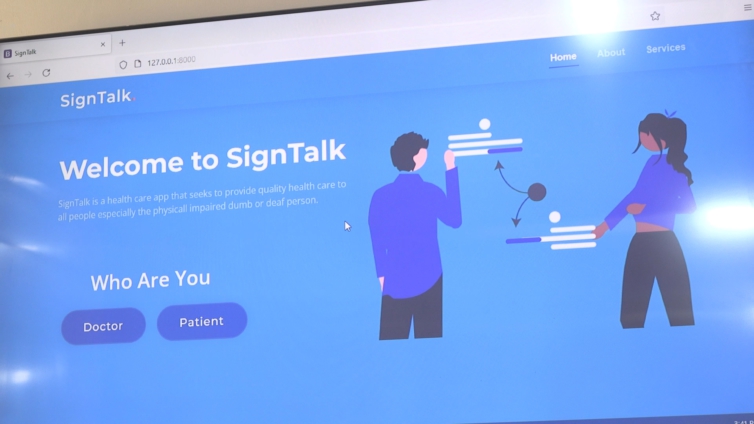
To resolve this challenge, some students at KNUST have developed an app called SignTalk to help the hearing and speech-impaired access healthcare.
SignTalk seeks to solve this problem by being a first-step initiative to bring the hearing and speech-impaired community back into society by bridging the deeply-rooted communication gap.
According to the developers, Dankwah Kwabena Darko Manu and Nana Agyemang Duah. the app does this by providing features that allow speech-to-sign-language translation and sign-language-to-speech translation.
For the speech-to-sign-language translation, SignTalk allows a doctor to speak into their device’s microphone and translate the speech into Sign language by showing the hearing-impaired and speech-impaired patient videos of sign language that represent exactly what the doctor said.
For the sign-language-to-speech translation, SignTalk achieves it by leveraging the power of computer vision and deep learning.
SignTalk allows the hearing and speech-impaired to perform sign language in front of their device’s camera and subsequently translate the sign language into speech played audibly by the doctor.
By doing this, SignTalk effectively acts as a communication facilitator and translator between the hearing-impaired or speech-impaired patient and their doctor.
This, in effect, will restore the confidence in the speech-impaired and hearing-impaired community to access health care since they can effectively communicate their ailments and receive medical directions from their doctors conveniently.
To learn more about the App and join the waitlist for its release, partners, stakeholders, or investors can visit https://csapps.knust.edu.gh.
Latest Stories
-
Let The Constitution direct Chieftaincy to deliver “All Development Is Local”
13 minutes -
Ghana explores centre of excellence for hearing, communication and cochlear implant care
2 hours -
Schizophrenia-related disorders lead mental health cases recorded in Ghana
2 hours -
Dutch authorities enlist Ghana in hunt for fugitive drug lord Bolle Jos
2 hours -
Ghana housing finance conference adopts communiqué to improve affordable housing access
7 hours -
Special Initiatives Minister urges Wa Technical Institute to enrol more girls as EU-backed solar training lab opens
7 hours -
In the matter of my first year at the Bar
7 hours -
ActionAid Ghana calls for an end to child marriage, greater investment in girls’ rights
8 hours -
Newsfile to tackle World Cup visa scandal, beach demolitions, education strikes, BRICS bid
8 hours -
UK-Ghana Trade & Investment Summit: Trade Resource Centre to help businesses maximise UK-Ghana trade opportunities
8 hours -
Embassy of Denmark celebrates World Maritime Day
8 hours -
Linking LEAP to productive inclusion could cut extreme poverty by 2030 – UNICEF
9 hours -
Trade Ministry backs use of creative arts to rehabilitate prison inmates
9 hours -
Negotiations with government to continue despite strike suspension – GNAT
9 hours -
‘Ghana cannot afford to waste public resources; every cedi has a job’ – Ato Forson
10 hours