

Audio By Carbonatix
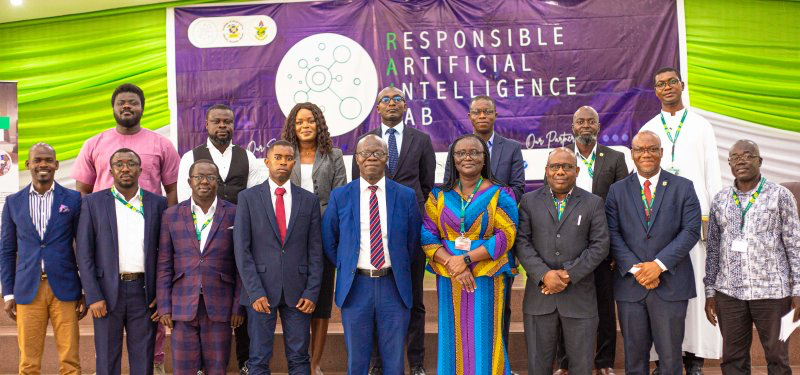
Authorities at the Kwame Nkrumah University of Science and Technology (KNUST) are rolling out a scientific project to strengthen capacities in the responsible utilization of artificial intelligence (AI).
The project aims at developing and applying AI tools for the advancement of computer, social, biomedical, and agricultural and ecological sciences.
It also seeks to provide innovation and technology and the socio-ethical application of inventions.
The project is dubbed “Responsible Artificial Intelligence Lab (RAIL)”.
Vice-Chancellor of the KNUST, Professor Mrs. Rita Akosua Dickson said the novelty would provide an approach to sustainably groom local talents to engage in multidisciplinary and responsible AI for development research.
Addressing an inception workshop, she said that: “RAIL is one of the several technology-driven scientific projects that researchers from the KNUST are leading,” the Vice-Chancellor said, explaining that the agenda was to realise the Sustainable Development Goal (SDG) 17 Target 6. The Goal prioritises knowledge sharing and cooperation for access to science, technology and innovation. In the case of Ghana, the KNUST, through the RAIL project, would be working with its partners at the Université Alioune Diop de Bambey, Senegal, University of Cape Verde, and the Gambia Technical Training Institute to advance the vision of the initiative”.
Prof Dickson added that: “the stakeholders would share knowledge to prepare the country and the sub-region to make a significant contribution towards the projected 42.2 per cent growth in global AI market share from 2020 to 2027. At the heart of this project is inclusion, diversity, gender mainstreaming, innovation and responsible use of technology and socio-ethical application of inventions”.
The project aims at supporting the most vulnerable communities in Ghana, Senegal, Cape Verde, and the Gambia among others in the Sub-region.
Principal Investigator and Scientific Director of RAIL, Prof. Jerry John Kponyo revealed the Fourth Industrial Revolution was an AI-powered revolution and would require the use of digital technologies to improve key sectors of the economy.
“Africa, and for that matter the sub-Region, must strategically position itself to lead the revolution,” he said.
Provost of the College of Engineering-KNUST, Professor Mark Adom-Asamoah indicated the college through hard work had become the driver of innovative solutions for national development.
“At a time when the use of AI had become contentious, with the prospects of its use looking unpredictable, what remains significant is the need to prepare scientists to be ethical and responsible with their use and application of AI,” he said.
The key sponsors of the project include the Deutsche Gesellschaft fur Internationale Zusammenarbeit (GIZ), International Development Research Centre -Canada, and SIDA, a development organisation.
Latest Stories
-
World Bank maintains Ghana’s growth rate forecast at 4.8% in 2026
57 minutes -
Cedi was worst African currency in quarter 2, 2026 – World Bank
1 hour -
AI gains can lift three times as many people out of poverty in Ghana – World Bank
2 hours -
Police arrest suspect over jewellery theft during fire outbreak
4 hours -
EOCO returns Hanan’s £6,700, GH¢2,750 and devices after defence challenge
4 hours -
Opplift Youth Entrepreneurs Summit 2026 equips entrepreneurs with skills, mentorship and support
4 hours -
Rival clubs want range of punishments for Man City
5 hours -
Tear gas in Paris and Marseille as school protests grow across France
5 hours -
Kane inspires England to win over Czech Republic in UEFA Nations League
5 hours -
Finland orders halt to work on two Google data centres
5 hours -
Substitute Merino scores twice as Spain win in Croatia
5 hours -
Ronaldo wants Portugal ‘punishment’ but not retiring
5 hours -
White House defends Trump comment to let Iran ‘take out’ LA and San Diego
5 hours -
Asos confirms hackers sent ‘unauthorised’ notification to app users
5 hours -
US televangelist Jim Bakker, disgraced from sex scandal and fraud, dies at 86
6 hours