

Audio By Carbonatix
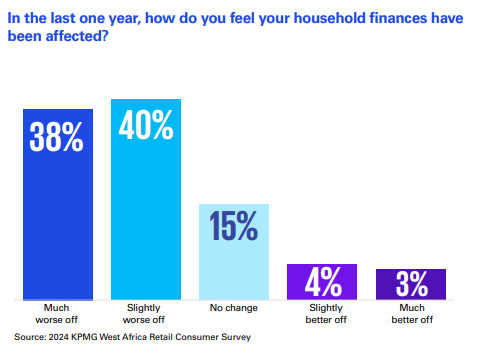
Thirty eight percent of Ghanaian retail consumers feel their finances have worsened in the last one year.
According to the 2024 West Africa Banking Industry Customer Experience Survey by KPMG, the rising costs of fuel and essential goods have further squeezed budgets, leaving little room for discretionary spending or long-term financial planning.
In response to these challenges, the report said many Ghanaians are adopting cost-saving strategies, such as seeking cheaper alternatives for food and clothing.
The financial pressure has also influenced personal decisions, with half of respondents in the retail consumer survey considering emigration to escape lasting economic hardship.
When respondents were asked respondents how they intend to adapt to the economic hardships, 36% indicated that they intend to increase their workload to cope with financial pressures while 29% remain hopeful about starting businesses, despite the economic climate.
However, 6% of respondents expressed reluctance to venture into entrepreneurship due to the uncertainties of the current environment.
While aggregate level of savings remained largely the same compared to last year, the survey observed that respondents who do not save increased from 8% to 12% this year.
“We observed that savings and investments which was the fourth largest expense area last year for Millennials shifted to sixth place”, the report added.
6% Millennials Do Not Save
There were also fewer millennials who indicated that they do not save – a drop from 11% to 6% this year.
Contrary to the Nigerian situation, Baby Boomers had the largest proportion of people who do not save – 41%.
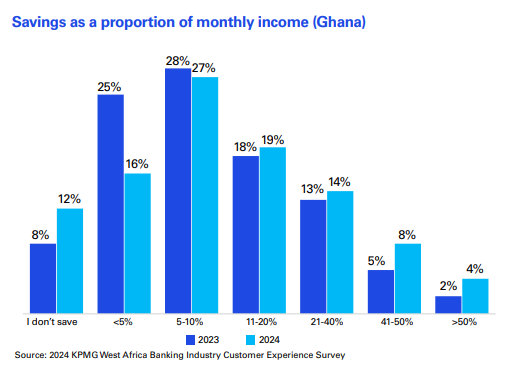
A review of their expenditure showed a focus on their health as well as fitness and catering to their family obligations. For Gen Zs, who are most likely students and early career starters, an impressive 13% indicated that they were able to save 21% to 40% of their monthly income.
The survey findings reveal that the top two expense areas for Ghanaians were food and dining (66%) and transportation (44%), same as in 2023.
Whereas savings and investments was considered a top five spending category last year, we observed a displacement by airtime and data expenses (35%) this year.
Latest Stories
-
Friends of Bridget Bonnie Marks her 35th birthday with donation to Kasseh Model Health Centre
28 minutes -
Landfilling waste management creates no value, it’s an economic waste
55 minutes -
Photos: Speaker Bagbin Commissions MPs constituency office under parliamentary decentralisation programme
1 hour -
Black Stars technical advisor Winfried Schäfer sacked as GFA shakes up backroom staff
1 hour -
Wenchi water project almost complete, critical to gov’t agenda – GWL MD
2 hours -
Anti-LGBTQ+ bill not part of government’s legislative agenda – Inusah Fuseini
2 hours -
Anti-LGBTQ Bill: Forget the rumour mongers, I’m a man of action, and will pass the bill – Speaker
2 hours -
Women and children among those killed in Sudanese army shelling of wedding celebration
2 hours -
President Mahama is not sincere with Ghanaians on LGBTQ bill matter – Hassan Tampuli
3 hours -
Gov’t to establish Prison Industrial Hub to equip inmates with income-generating skills – Prison Service boss
3 hours -
Alhassan Tampuli donates cement, roofing sheets to support storm victims in Gushegu
3 hours -
Alhassan Tampuli appeals for urgent support for storm victims in Gushegu
3 hours -
The hypocrisy must stop; pass Anti-LGBTQ+ Bill now – Alhassan Tampuli to Mahama
3 hours -
Imprisonment should be rehabilitative, not punitive – Ghana Prisons boss at UNGA
3 hours -
Ga Adangbe traditional priests petition Mahama over McDan aviation licence revocation
4 hours