

Audio By Carbonatix
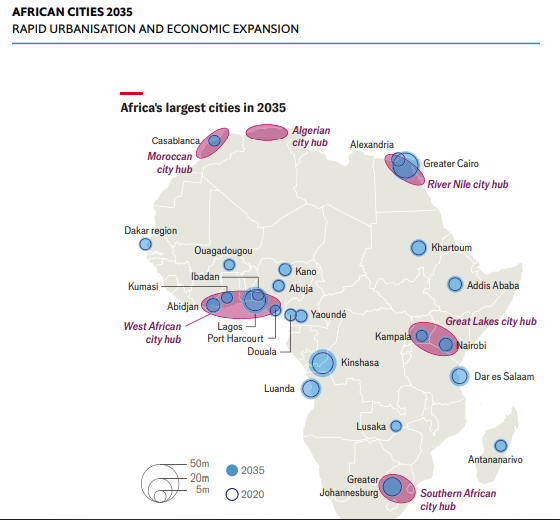
Kumasi and six other African cities are expected to grow at a much faster pace, supported by infrastructure development, urbanisation and the emergence of megacities.
According to the Economist Intelligence Unit, the continent’s established urban heavyweights and megacities including Cairo, Lagos and Johannesburg will still sit at the head of the Africa100 city economies in 2035.
The other six African cities that would grow quickly are Kinshasa, Dar es Salaam, Addis Ababa, Abidjan, Kampala and Dakar.
In a report, the London based firm said it expect rapid urbanisation across Africa to help to create more dynamic and wealthier consumer markets, better connected and more sophisticated commercial and distribution hubs, and larger bases for industrial production and import-export operations.
However, overcrowding, informal settlements, high unemployment, poor public services, stretched utility services and exposure to climate change are just some of the major challenges that city planners will have to grapple with in their drive for sustainable urban economic growth in the next decade
It continued that Africa has and will continue to have the fastest rate of urbanisation of the world’s major regions through to 2035.
Africa’s urban population to hit 1.0bn in 2035
It projected that Africa’s urban population will rise from about 650 million in 2023 to almost one billion in 2035, which represents a compound annual growth rate (CAGR) of about 3.5% and will take the proportion of Africans living in towns and cities to over 50% in 2035.
“Africa’s urban population will continue to grow rapidly in the 2030s, in contrast to other major regions; urban population growth in Asia is expected to decelerate, and the rate in the Americas and Europe will level off during the 2030s. In Africa, the East, Central and West African subregions will record the fastest rate of urban population growth in 2023-35”, it added.
Emergence of megacities to be a major feature of Africa’s demographics
The report stated that the emergence of new urban heavyweights and megacities, the rapid expansion of city clusters and the rising importance of megalopolises will be a major feature of Africa’s demographic and economic future.
It said the continent is projected to have six megacities by 2035—Luanda and Dar es Salaam will join the current giants of Greater Cairo, Kinshasa, Lagos and Greater Johannesburg with a population of more than 10 million resident.
A further 17 cities will have a population that exceeds 5.0 million residents and another 100 or so cities will have populations in excess of one million inhabitants.
Latest Stories
-
US, Iran fail to reach peace agreement after marathon talks in Pakistan
4 minutes -
ECG kicks off Phase Two of transformer upgrades at Lashibi; brief outages expected
38 minutes -
Port crises loom as 11,000 drivers threaten four-day strike
1 hour -
A source of excellence across generations – Vice President Opoku-Agyemang lauds Mfantsipim
2 hours -
(Photos) Mfantsipim School launches historic 150th anniversary
3 hours -
Knights and Ladies of Marshall group backs Catholic Bishops’ stance on anti-LGBTQ+
4 hours -
Bright Simons writes: All the Filla in the Ibrahim Mahama/E&P – Gold Fields Saga
4 hours -
Monetise Idiocy In Ghana
4 hours -
The Ghanaian prophet and the mysterious death of his scottish wife Charmain Speirs
5 hours -
Nearly 400 sentenced in Nigeria for links to militant Islamists
5 hours -
Ghana’s recovery supported by gold strength despite global oil price pressures – Standard Bank Research
5 hours -
Methodist Church hails Mfantsipim@150; calls for “fresh consecration” to excellence
6 hours -
‘Excellence is our inheritance’ – Nana Sam Brew-Butler hails Mfantsipim’s 150-year reign in leadership
6 hours -
Kwaku Azar writes: A-G vs OSP
6 hours -
Mfantsipim–Adisadel rivalry built excellence, not division – Sam Jonah
6 hours