

Audio By Carbonatix
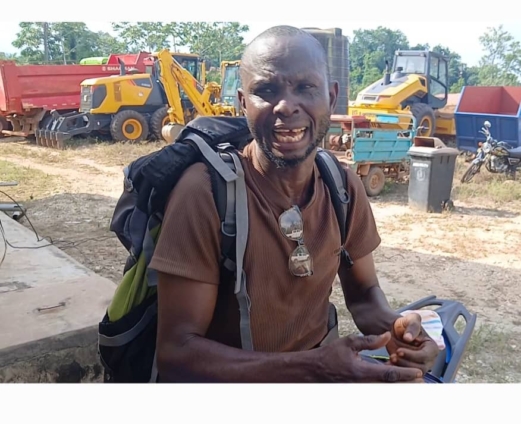
An indigenous mining industry player, Daniel Appiah, has observed that Ghana's economy currently depends heavily on the extraction of mineral resources, and therefore cannot survive without the mining and trading of these mineral resources.
"Without mining, there is no Ghana, and without Ghana, there is no mining. So we need improved or advanced technology to make the mining industry attractive to local people, so that they can venture into the industry, but stopping it is not possible," he said.
Ghana's mining industry, he noted, has been the backbone of the country's economy.
According to Daniel Appiah, known for his exploits in the local mining industry in Amenfi Central of Western Region, the unfettered access offered to foreigners in Ghana's mining industry has caused the invasion of mining communities and concessions over the last two decades.
The 53-year-old who has dedicated 30 years of his adult life to mining says, any attempt by the government to drive away local miners, unsteady of the foreigners, will not just affect livelihoods, but will ground the national economy following the immeasurable contribution and impact of local miners.
He said the locals constitute the majority in the mining industry in terms of job creation, revenue generation, as against large scale miners who are minority and largely foreigners.
Speaking in an interview, Daniel Appiah condemned illegal mining activities in forest areas and water bodies while appealing to the government to streamline activities and reform the mining industry to create jobs and improve the general welfare and well-being of Ghanaian citizens.
Aside South Africa, as the leading producer of gold, Ghana, currently is the second highest producer of gold in Africa, first in West Africa. This is largely due to the abundance of natural mineral deposits in the country.
Consequently, Ghana's mining industry for many years has remained buoyant and continues to attract foreign investors.
Virtually, all large-scale mining companies operating in the country currently are foreigners, therefore, they dictate the commanding heights of the country's mining industry.
This practice, Daniel Appiah observed, cannot be allowed to continue. He believes the over-reliance on foreigners to dictate the performance of the industry, how much revenue mining must offer the country, and, for that matter government, remains challenging when, indeed, small-scale mining activities, when supported adequately, could do more under the circumstances.
"The work that we do, I am an expert, and therefore I understand the importance of managing the resource development, including reclamation. There is no way we will mine an area without reclaiming it," he remarked.
He says, since no government can stop the ancient business which predates all governments, the only thing is to regulate the industry to serve the national interest, devoid of the influence of foreigners.
"As we speak, I have more than 60 workers, and I pay them well. The highest-paid workers receive 6,000 Ghana cedis a week, and the lowest-paid workers receive 1,500 Ghana cedis a week. So, how can you tell these people to go home and go and eat what?" he questioned.
Daniel Appiah explained that the competition in the mining industry is between large-scale mining companies, mostly foreigners, a few small-scale mining companies, largely Ghanaians, and the majority being illegal mining operators whose activities continue to threaten farmland and general livelihoods.
"We just need to protect the industry and follow due process as directed by the president. That is the only way to safeguard the industry," he assured.
The three categories of miners, he noted, currently determine how much gold leaves the shores of Ghana through sales, marketing and other forms of trading of the precious mineral.
"The reason why mining cannot be stopped is because even foreigners come into the country to mine and take away the proceeds, so how can you stop locals from mining?" he asked.
Daniel Appiah observed that in the past, foreigners were known to participate in only large-scale mining activities and contributed significantly to the country's economy.
Unfortunately, lately, foreigners, particularly Chinese, Indians, and other notable West African nationals, he expressed regret, have joined the bandwagon of invading mining communities uninvited with all forms of illegal mining activities.
"Before President John Dramani Mahama assumed office, the order of the day was mining in the forest and water bodies, and we must all share the blame. But, if the industry is streamlined, all miners will follow due process and do the right thing, and the environment will be safe".
"So, we are happy that they [Government and security forces] are arresting those operating in forest areas and in the water bodies to sanitise the industry. We believe that any form of extraction of gold beneath the soil is mining, and so people should stop tagging local mining as an illegal exercise because of the activities of those polluting the environment. Allowing local participation is in the interest of the country".
"What is important is for the government to introduce reforms and regulate the sector because mining cannot be stopped", he said.
According to Daniel Appiah, right from the time of the late former President Jerry John Rawlings, the mining sector has always been fronted and led by locals on the quiet, but, now it is loud because, foreigners are invading mining communities and creating problems for the country through the connivance of Ghanaians, he underscored.
Latest Stories
-
Cryptocurrency regulation: BoG, SEC must collaborate closely to align risk assessments – IMF
2 hours -
Shatta Wale performs Stonebwoy’s ‘Putuu ’, preaches unity among artistes and fans
2 hours -
Congo’s Ebola outbreak has killed more than 4,000, government data shows
2 hours -
Ethiopian rebel forces withdraw from Tigray regional capital
2 hours -
All set for 7th Ghana Credit Excellence Awards 2026 on October 10
2 hours -
Why pastors may not be seen – or heard – preaching on buses for much longer
2 hours -
Oil slips as Middle East crude exports rise, G7 to release stocks
2 hours -
France to step up Ebola funding in Congo amid resurgence fears, minister says
2 hours -
Djokovic beats Zverev to reach China Open semis
3 hours -
Brazil election goes to run-off as right-wing Flávio Bolsonaro wins first round
3 hours -
Modric ‘ashamed’ of Croatia’s ‘catastrophic night’
3 hours -
Klopp’s mixed start continues as Germany held
3 hours -
The job interview question you don’t have to answer
3 hours -
Trump unveils ‘Super Intelligence Force’ to oversee AI policy
3 hours -
Zirkzee gives Netherlands win as van Dijk joins 100 club
4 hours