


Audio By Carbonatix
Swarms of desert locusts that have been devouring crops and pasture in the East Africa region have spread to South Sudan, the UN food agency says.
Several million South Sudanese are already facing hunger as the country struggles to emerge from a civil war.
The UN has warned that a food crisis could be looming in East Africa if the outbreak is not brought under control.
The US Secretary of State Mike Pompeo has pledged $8m (£6m) to help fight the invasion on his visit to Africa.
Mr Pompeo was speaking after talks with Abiy Ahmed, the prime minister of Ethiopia, which along with Somalia, Kenya and Uganda, has been hit by the pests.
The invasion is the worst infestation in Kenya for 70 years and the worst in Somalia and Ethiopia for 25 years.
Efforts to control the locust infestation have so far not been effective. Aerial spraying of pesticides is the most effective way of fighting the swarms but countries in the region do not have the right resources.
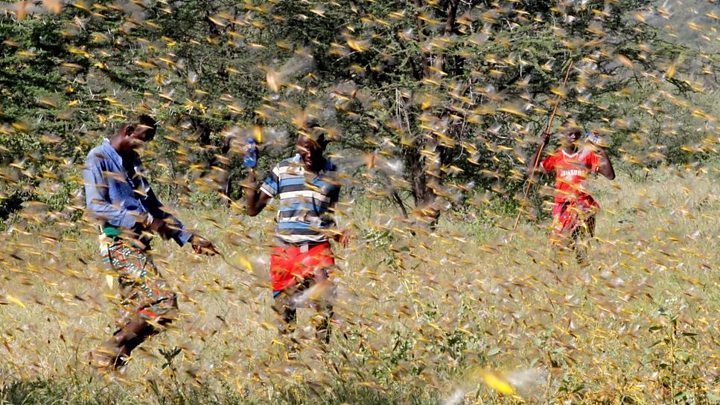 How East Africa is battling devastating locust swarms
There are now fears that the locusts - already in the hundreds of billions - will multiply further.
How East Africa is battling devastating locust swarms
There are now fears that the locusts - already in the hundreds of billions - will multiply further.
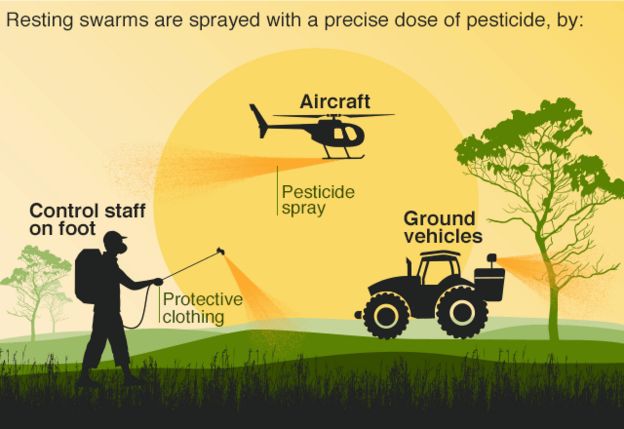 Agriculture Minister Onyoti Adigo Nyikuac said the government was training people to spray.
"Also we need chemicals for spraying and also sprayers. You will also need cars to move while spraying and then later if it becomes worse, we will need aircraft," he said, AFP reports.
About 60% of South Sudan's population is facing food insecurity - and destruction of harvests by locusts could lead to a drop in nutrition levels in children, rights group Save the Children warns.
Even without the locusts, the charity expects that more than 1.3 million children aged under five will suffer from acute malnutrition this year.
The FAO says the insects, which eat their own body weight in food every day, are breeding so fast that numbers could grow 500 times by June.
The UN body last week called on the international community to provide nearly $76m (£58m) to fund the spraying of the affected areas with insecticide.
Somalia has declared a national emergency in response to the crisis.
The Ethiopian government has called for "immediate action" to deal with the problem affecting four of the country's nine states.
Agriculture Minister Onyoti Adigo Nyikuac said the government was training people to spray.
"Also we need chemicals for spraying and also sprayers. You will also need cars to move while spraying and then later if it becomes worse, we will need aircraft," he said, AFP reports.
About 60% of South Sudan's population is facing food insecurity - and destruction of harvests by locusts could lead to a drop in nutrition levels in children, rights group Save the Children warns.
Even without the locusts, the charity expects that more than 1.3 million children aged under five will suffer from acute malnutrition this year.
The FAO says the insects, which eat their own body weight in food every day, are breeding so fast that numbers could grow 500 times by June.
The UN body last week called on the international community to provide nearly $76m (£58m) to fund the spraying of the affected areas with insecticide.
Somalia has declared a national emergency in response to the crisis.
The Ethiopian government has called for "immediate action" to deal with the problem affecting four of the country's nine states.
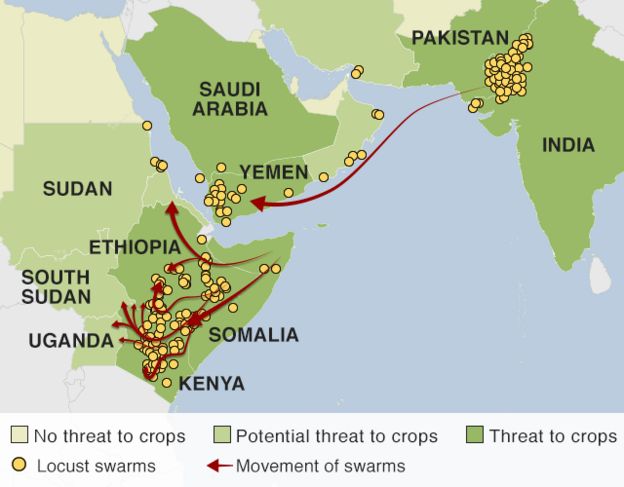 Kenya has deployed aircrafts to spray pesticides in several regions and its Agriculture Minister Peter Munya said on Monday that the invasion was "under control".
Meanwhile, Uganda has deployed soldiers to the northern regions to spray pesticides in the affected areas.
The locust swarms entered Africa from Yemen three months ago.
Kenya has deployed aircrafts to spray pesticides in several regions and its Agriculture Minister Peter Munya said on Monday that the invasion was "under control".
Meanwhile, Uganda has deployed soldiers to the northern regions to spray pesticides in the affected areas.
The locust swarms entered Africa from Yemen three months ago.
How East Africa is battling devastating locust swarms
There are now fears that the locusts - already in the hundreds of billions - will multiply further.
'Reconnaissance mission'
The Food and Agriculture Organization (FAO) said about 2,000 adult insects had entered South Sudan via Uganda into the southern county of Magwi. "These are deep yellow, which means that they will be here mostly looking at areas in which they will lay eggs," the AFP news agency quotes FAO South Sudan representative Meshack Malo as saying.
Agriculture Minister Onyoti Adigo Nyikuac said the government was training people to spray.
"Also we need chemicals for spraying and also sprayers. You will also need cars to move while spraying and then later if it becomes worse, we will need aircraft," he said, AFP reports.
About 60% of South Sudan's population is facing food insecurity - and destruction of harvests by locusts could lead to a drop in nutrition levels in children, rights group Save the Children warns.
Even without the locusts, the charity expects that more than 1.3 million children aged under five will suffer from acute malnutrition this year.
The FAO says the insects, which eat their own body weight in food every day, are breeding so fast that numbers could grow 500 times by June.
The UN body last week called on the international community to provide nearly $76m (£58m) to fund the spraying of the affected areas with insecticide.
Somalia has declared a national emergency in response to the crisis.
The Ethiopian government has called for "immediate action" to deal with the problem affecting four of the country's nine states.
Kenya has deployed aircrafts to spray pesticides in several regions and its Agriculture Minister Peter Munya said on Monday that the invasion was "under control".
Meanwhile, Uganda has deployed soldiers to the northern regions to spray pesticides in the affected areas.
The locust swarms entered Africa from Yemen three months ago.DISCLAIMER: The Views, Comments, Opinions, Contributions and Statements made by Readers and Contributors on this platform do not necessarily represent the views or policy of Multimedia Group Limited.
DISCLAIMER: The Views, Comments, Opinions, Contributions and Statements made by Readers and Contributors on this platform do not necessarily represent the views or policy of Multimedia Group Limited.
Latest Stories
-
NDC threatens sanctions over oversized campaign posters, gives aspirants 5 days to comply
15 minutes -
Star Oil paid GH¢2.7bn in taxes, levies in nine months of 2026
29 minutes -
Samson’s Take: The rule of law is cheaper before the bulldozer
30 minutes -
GRA blames system failure for delay in issuing receipt over passenger’s customs duty
51 minutes -
Livestream: Newsfile discusses World Cup visa scandal, beach demolitions, education strikes, BRICS bid
55 minutes -
NC-PTAs welcomes end of teachers’ strike, urges parents to prepare children for Monday
1 hour -
Government procures over 2,000 transformers as Ghana’s electricity access hits 89.13% – Energy Minister
2 hours -
UTAG-UG threatens strike on October 19 over unpaid allowance
2 hours -
Let The Constitution direct Chieftaincy to deliver “All Development Is Local”
3 hours -
John Jinapor outlines renewable energy, nuclear power priorities for 2027
3 hours -
Ghana explores centre of excellence for hearing, communication and cochlear implant care
4 hours -
Schizophrenia-related disorders lead mental health cases recorded in Ghana
5 hours -
Dutch authorities enlist Ghana in hunt for fugitive drug lord Bolle Jos
5 hours -
Ghana housing finance conference adopts communiqué to improve affordable housing access
9 hours -
Special Initiatives Minister urges Wa Technical Institute to enrol more girls as EU-backed solar training lab opens
10 hours