

Audio By Carbonatix
Many Ghanaians will experience hunger and malnutrition by 2030 due to anticipated drop in national fish production, Professor Berchie Asiedu, the Dean, School of Natural Resources, University of Energy and Natural Resources (UENR) has hinted.
He said the nation’s fish consumption was expected to reach 888,096 tonnes by 2030; however, total fish production was anticipated to constitute only about 43 per cent of the total fish requirement.
“This clearly shows that demand for fish consumption is expected to outweigh the national supply,” Prof Asiedu explained.
At the current growth rate, per capita fish consumption is predicted to decline from 28 kg in 2018 to 23.9 kg in 2030, Prof Asiedu, stated saying, “fish consumption would increase, but people would be eating less fish.”
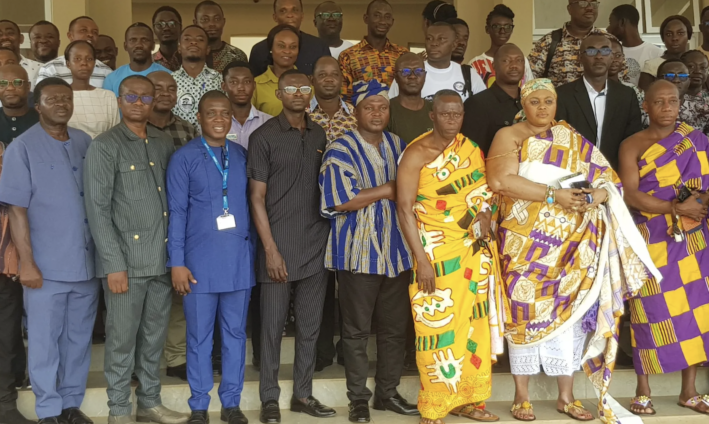
Prof Asiedu made this known when speaking on a research update session, organised by the School of Natural Resources of the University in Sunyani on the theme “Managing our Natural Resources: Academia-Industry Partnership for Sustainable National Development.”
The session was attended by natural resources experts.
Prof Asiedu explained that as the cheapest and most consumed animal protein (60 percent) in the country, fish demand had increased rapidly over the past few years, growing from 960,000 tonnes in 2010 to 1.1 million tonnes in 2020.
Within the same period, per capita fish consumption increased from 24.2 kg to 27.9 kg at a rate of 1.6 percent per annum.
Following the gaps in the trends of production and consumption, Prof Asiedu called for an urgent need for policies to accelerate aqua-culture development in the country.
He also underlined the importance of ensuring general improvement in the fisheries management practices, as well as exploration of adaptive strategies and thereby improve the adaptive capacity of fishers to climate change.
Later in an interview, Mr. Hanson Kodzo Dzamefe, the Bono Regional Director of the Fisheries Commission, expressed concern about the nation’s over-reliance on marine fishes, and called for private sector collaboration to develop the nation’s aqua-culture sector.
He said aquaculture had huge potential for job creation and food security, saying the inland fishing value chain could create millions of jobs if investments were put into the sector.
Mr Dzamefe said aquaculture remained a lucrative business, and therefore, called on the unemployed youth and graduates to engage in commercial fish production to better their lots and advance national food security too.
Latest Stories
-
Only 30% of Ghanaian teachers satisfied with their jobs — CAPCOE data reveals
7 seconds -
Communities affected by construction of Akosombo Dam urge government to speed up compensation process
22 minutes -
World Cup visa scandal: Sports Ministry not shielding anyone – Sports Minister’s special aide
42 minutes -
World Cup visa scandal: Over 30 people misrepresented as GTA board members to US Embassy – Vincent Assafuah alleges
44 minutes -
Fire destroys wooden structure near Yesu Mo Villa at Bush Road
45 minutes -
NDC threatens sanctions over oversized campaign posters, gives aspirants 5 days to comply
2 hours -
Star Oil paid GH¢2.7bn in taxes, levies in nine months of 2026
2 hours -
Samson’s Take: The rule of law is cheaper before the bulldozer
2 hours -
GRA blames system failure for delay in issuing receipt over passenger’s customs duty
2 hours -
Livestream: Newsfile discusses World Cup visa scandal, beach demolitions, education strikes, BRICS bid
2 hours -
NC-PTAs welcomes end of teachers’ strike, urges parents to prepare children for Monday
2 hours -
Government procures over 2,000 transformers as Ghana’s electricity access hits 89.13% – Energy Minister
3 hours -
UTAG-UG threatens strike on October 19 over unpaid allowance
3 hours -
Let The Constitution direct Chieftaincy to deliver “All Development Is Local”
4 hours -
John Jinapor outlines renewable energy, nuclear power priorities for 2027
5 hours