

Audio By Carbonatix
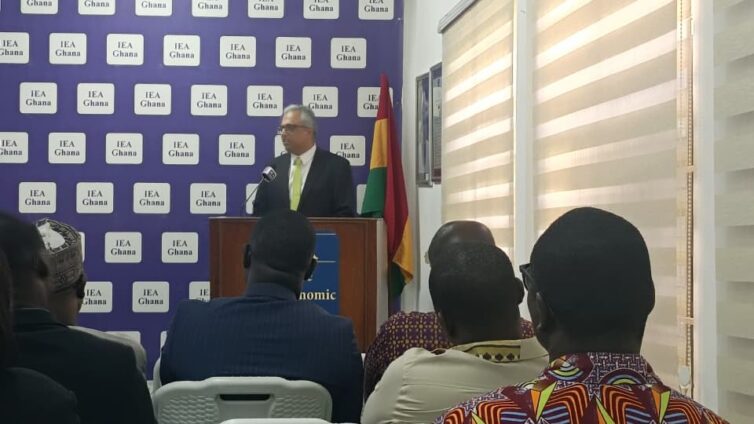
An economist at Aston University, Dr. Sajid Chaudhry, says cuts in the Bank of Ghana’s policy rate will have a limited impact on economic growth unless commercial banks also reduce lending rates.
He said lower lending rates were necessary to stimulate economic activity but expressed concern over the slow transmission of policy rate cuts by commercial banks.
Dr. Chaudhry, who is also an International Fellow of the Institute of Economic Affairs, made the remarks at a forum on interest rates and economic development in Ghana.
According to him, the effectiveness of monetary easing depends largely on its ability to lower borrowing costs and increase private-sector credit.
“Monetary easing can support growth in Ghana, but only if it is transmitted through lower lending costs, stronger private-sector credit, stable exchange rates, and healthier bank balance sheets,” he said.
Dr. Chaudhry explained that an analysis of data from 2002 to 2024 showed that reductions in lending rates were associated with higher Gross Domestic Product (GDP) growth, while high interest rates and inflation weakened economic performance.

He noted that commercial banks had been slow to adjust lending rates downward, maintaining wide net interest margins due to non-performing loans, exchange-rate instability, and broader macroeconomic uncertainty.
“Policy should therefore combine monetary easing with measures that strengthen credit intermediation and bank balance sheets,” he said, while commending the Bank of Ghana for lowering rates in line with declining inflation.
Dr. Chaudhry recommended that the Central Bank adopt regulatory measures to encourage faster transmission of policy rate cuts to borrowers and improve deposit rates when monetary policy tightens.
“The central bank can use some kind of regulatory measures to persuade banks to translate monetary policy rate cuts into lower lending rates,” he stated.
Responding to questions from the Ghana News Agency, Dr. Chaudhry urged commercial banks to strengthen loan screening and monitoring systems, while encouraging businesses to improve productivity and repay loans on time.
“When banks have high levels of bad loans, they are less willing and able to pass lower policy rates through to cheaper lending, which weakens the impact of monetary easing on growth,” he said.
He also urged government to maintain macroeconomic stability through stable exchange rates, controlled inflation, prudent spending, and a sound banking sector to support lower lending rates and economic growth.
Latest Stories
-
Muntaka vows not to compromise in prosecuting drug suspects despite political pressure
34 minutes -
Cannabis traffickers using ambulances and bullion vans – Interior Minister
39 minutes -
Over 90% of people displaced by Savannah conflict back home – Muntaka
45 minutes -
LA28: Desmond Ofei invites 32 Black Meteors players for Libya clash
56 minutes -
ECG to undertake maintenance work in parts of Accra from October 12 to 16
60 minutes -
Ablakwa: Ghana’s Embassies, High Commissions to support World Assemblies of God Congress
1 hour -
Joyce Bawah Mogtari cites infrastructure, healthcare reforms as evidence of Mahama’s development agenda
1 hour -
Ghana had no single gadget to detect narcotics when we took office – Muntaka
1 hour -
GES to consult stakeholders on academic calendar adjustments
1 hour -
Mahama reaffirms commitment to equitable development across Ghana
1 hour -
Youth employment must remain central to Ghana’s economic reset – Joyce Bawah Mogtari
1 hour -
Ethnic conflicts, land disputes and illicit drugs remain major security concerns – Muntaka
2 hours -
Mahama Ayariga visits Kumasi Central Market fire scene to assess damage
2 hours -
Ghana has 48 legitimate entry points but over 300 illegal crossing points – Interior Minister
2 hours -
Ghana is much safer now than in 2025 – Muntaka
2 hours