

Audio By Carbonatix
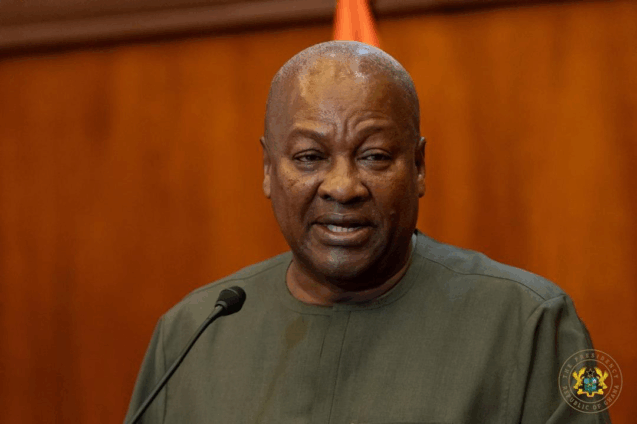
President John Mahama continues to command a strong public mandate, recording a 67 per cent job approval rating, according to the December 2025 National Tracking Poll conducted by Global InfoAnalytics.
The approval rating, which has remained unchanged from the previous quarter, reflects sustained public confidence in the President’s leadership as the year draws to a close. The poll shows that President Mahama’s support cuts across all regions of the country, including areas traditionally aligned with the opposition.
While approval is highest among National Democratic Congress (NDC) supporters at 93 per cent, he also records a notable 69 per cent approval rating among floating voters. In contrast, 28 per cent of New Patriotic Party (NPP) supporters approve of his performance. Overall disapproval stands at 24 per cent, marking only a marginal increase of 2 per cent.
Beyond presidential approval, the poll paints a picture of a nation that remains broadly optimistic about its future. Conducted among 13,495 voters across all 16 regions and 83 constituencies, the survey found that 66 per cent of Ghanaians believe the country is heading in the right direction, a figure that has remained stable since the previous quarter.
Optimism is evident across the country, with majorities in every region expressing confidence in Ghana’s trajectory. The Upper West Region recorded the highest confidence level at 81 per cent, followed closely by the Savannah Region at 79 per cent. Even in the Ashanti Region, long considered an opposition stronghold, 45 per cent of voters believe the country is on the right path.
However, the poll reveals sharp partisan divisions beneath this optimism. While 91 per cent of NDC supporters believe Ghana is moving in the right direction, 61 per cent of NPP supporters think otherwise. Floating voters, often decisive in elections, largely align with the optimistic view, with 68% saying the country is on course.
Economic performance appears to be a key driver of the government’s popularity. The 2026 Budget, presented by Finance Minister Dr. Cassiel Ato Forson, received a positive response, with 66 per cent of voters expressing satisfaction. Only 18 per cent were dissatisfied, while 16 per cent remained neutral.
This economic confidence is reflected in citizens’ lived experiences. A majority of voters (56 per cent) reported an improvement in their standard of living over the past year. While 27 per cent said their situation remained unchanged, and 12 per cent reported a decline, expectations for the future remain high, with 70 per cent believing their standard of living will improve further in 2026.
On governance, perceptions also showed improvement. For the first time, 60 per cent of respondents said the government is doing enough to fight corruption, up from 58 per cent in the previous quarter. Additionally, 56 per cent believe the state of corruption is improving, compared to 17 per cent who think it has worsened.
Efforts to combat illegal mining, commonly known as galamsey, also received cautious approval. Nationally, 56 per cent of voters believe the government is doing enough to address the issue, while 47 per cent do not think the situation has worsened under the current administration. Even in mining communities, 43 per cent shared the view that conditions have not deteriorated.
The poll further reveals a strong public appetite for constitutional and governance reforms. A majority of respondents supported several recommendations from the Constitutional Review Commission, including extending the presidential term to five years (57 per cent), preventing Members of Parliament from serving as ministers (58 per cent), and allowing for the direct election of Metropolitan, Municipal and District Chief Executives (63 per cent). There was also support for lowering the presidential age requirement (55 per cent), abolishing the death penalty (58 per cent), and limiting political campaigns to 120 days before elections (56 per cent).
Demographic changes are also reshaping Ghana’s political landscape. Gen Z and Millennial voters now make up nearly 78 per cent of the electorate, driving a growing demand for youthful leadership. Overall, 64 per cent of voters expressed a preference for younger leaders.
Party affiliation trends show gradual shifts. The NDC leads with 41 per cent, despite a slight dip, while NPP affiliation declined for the third consecutive period to 26 per cent. Floating voters increased marginally to 19 per cent. Educational breakdowns reveal that the NDC holds a significant advantage among tertiary-educated voters, while the NPP performs strongest among voters with no formal education, where the margin narrows considerably.
Latest Stories
-
Struggling Real suffer title blow with Girona draw
2 hours -
Mahama nominates Pamela Graham as Auditor-General
3 hours -
The five big sticking points in US-Iran talks
3 hours -
Melania Trump’s speech propels Epstein crisis back to forefront
4 hours -
What everyone should know about C-sections
4 hours -
Gunmen kill at least four people at Afghanistan picnic spot
5 hours -
Health Ministry engages Ga Mantse ahead of Free Primary Healthcare launch
5 hours -
We can tackle multiple priorities – Sam George defends Anti-LGBTQ Bill push
5 hours -
Statement: Ghana Chamber of Mines’ Response to Claims in Joe Jackson’s “Ananse Stories about the Economy of Ghana”
5 hours -
GES opens 2026 teacher recruitment for licensed B.Ed graduates
5 hours -
Ghana must value skilled trades, build resilient learners — Ibn Chambas
6 hours -
Ghana must rethink education around relevance, resilience and responsibility — Ibn Chambas
6 hours -
Prince Harry faces defamation lawsuit from charity he co-founded
6 hours -
South Korea deploys thermal cameras to track escaped zoo wolf
6 hours -
Calls for royal meeting with Epstein survivors grow ahead of US visit
6 hours