

Audio By Carbonatix
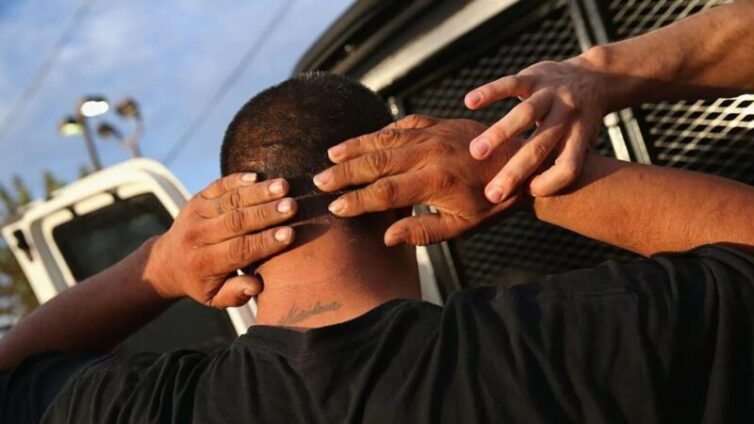
The Trump administration has ramped up arrests of undocumented migrants in major cities around the US, detaining thousands of people including criminals and those without criminal histories alike.
Since the president took office on 20 January, there have been raids in cities including Chicago, New York, Denver and Los Angeles.
In some communities, the arrests have prompted some migrants to skip work or keep their children home from school.
On Tuesday, White House Press Secretary Karoline Leavitt said that while arrests of criminals will be prioritised, nobody in the country illegally is "off the table".
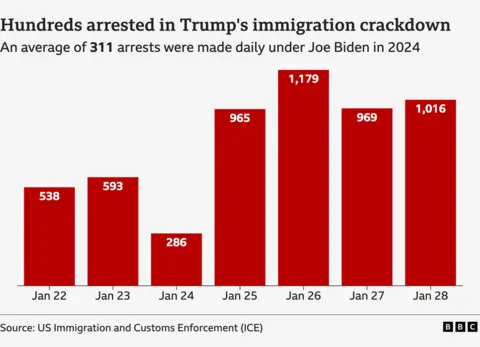
More than 3,500 undocumented migrants have been arrested since Trump returned to the White House, including just over 1,000 on Tuesday, 969 on Monday and 1,179 on Sunday, according to daily statistics published by Immigration and Customs Enforcement (ICE).
By comparison, an average of 310 were made during the 2024 fiscal year, when former President Joe Biden was in office, according to the agency.
Immigration officials have described these raids as "targeted enforcement operations" that have resulted in the arrest of violent gang members and dangerous suspects, and have deputised agents from other federal law enforcement agencies to help step up arrests.
"I haven't seen anything remotely like this, and it's just the first few days of the presidency," said Gina Amato Lough, the California-based director attorney for the Immigrants Right Project, a division of a law firm, Public Counsel. "Nothing of this magnitude."
She said the "stated intention is to create shock and awe".
"It's working," she said. "It's also creating terror in the community."
The White House and ICE have publicised some of these arrests, showing pictures of the suspects and providing details of their countries of origin and crimes, which have included sex crimes, assaults and drug trafficking offences.
But the White House has made it clear that any undocumented migrant caught up in these raids - whether criminal or not - is subject to arrest and deportation, even though simply being in the US illegally is a civil matter.
Earlier this week, White House Press Secretary Karoline Leavitt claimed that "all of them" are criminals.
"They illegally broke our nation's laws, and, therefore, are criminals are far as this administration goes," she told reporters on Tuesday.
The arrests have already had a chilling effect on many immigrant communities across the US.
Ms Lough, for example, said that undocumented clients have expressed a fear about going to any government agency - even to get a driver's licence - or seeking medical attention in hospitals.
"We're hearing people are terrified, and we're getting calls left and right," said Michael Lukens, the executive director of the Amica Center for Immigrant Rights, an organisation which provides free legal representation to undocumented migrants detained by authorities.
"People are scared to go to work, or to send their kids to schools," he said, adding the Trump administration has blocked his organisation's efforts to enter detention facilities to meet with detainees.
"That's exactly what the White House wants - to instil fear in people and make them leave," he said. "That's not something we've ever seen."
Among those who have expressed fear is Gabriela, a Bolivian migrant who entered the US over 20 years ago, hiding under a pile of corn stalks in the boot of a smuggler's case on the journey.
Now a housekeeper in Maryland, Gabriela was initially unconcerned by Trump's election victory, believing that he would only target criminals and that many migrants would benefit from an improved economy.
But nine days into the administration, she says she's grown fearful, along with many of her neighbours, after seeing that ICE had conducted operations in nearby communities.
"Lots of people in my building have stopped sending their children to schools. Nobody is even going to church now," she told the BBC. "We're tuning into mass online."
Gabriela said she's begun packing her belongings in the hopes that, if arrested and deported, acquaintances might be able to ship them back to Bolivia.
Another undocumented migrant, a Mexican national named Carlos who lives in New York City, told the BBC concerns over possible arrests have driven some underground.
"We heard that ICE came to a building not far from me," said Carlos, whose son is a US citizen born in New York.
Like Gabriela, Carlos was initially cautiously optimistic about Trump's electoral win and thought he would indirectly benefit from Trump's promises to boost the economy and lower inflation.
"It's scary. I've been avoiding being out on the street more than I need to," he added. "I don't have a problem with criminals being arrested. But we keep hearing that other people - workers - are also being taken away."
Both Gabriela and Carlos asked to be identified only by their first names, fearing retribution or attention from authorities.
It is unclear how many of those arrested have criminal histories and how many are what have been what the first Trump administration termed "collateral" arrests.
NBC has reported that on 26 January, only 52% of those taken into custody were considered "criminal arrests", citing administration officials .
The BBC has contacted the White House for comment on the figures.
When asked about the number at a press briefing on Tuesday, Ms Leavitt said only that anyone who "broke our nation's laws" is a criminal.
The raids by ICE form part of a larger effort by the Trump administration to clamp down on undocumented migration into the US, which has also included declaring an emergency at the southern border and expanded processes that allow for rapid expulsions.
On Thursday, Trump signed the so-called Laken Riley act into law, requiring undocumented immigrants who are arrested for theft or violent crimes to be held in jail pending trial.
The bill, named after Laken Riley - a Georgia nursing student murdered last year by a Venezuelan man, was approved by Congress last week, an early legislative win for the the administration.
At the signing, Trump said the government would move to set up a 30,000-person facility for undocumented detainees, doubling the government's holding capacity and taking the US "one step further to eliminating the scourge of migrant crime".
Latest Stories
-
Black Queens players stranded in UAE over Israel-Iran conflict
13 minutes -
James Owusu declares bid for NPP–USA chairman, pledges renewal and unity
37 minutes -
Trump threatens strong force if Iran continues to retaliate
52 minutes -
Lekzy DeComic gears up for Easter comedy special ‘A Fool in April’
2 hours -
Iran declares 40 days of national mourning after Ayatollah Ali Khamenei’s death
3 hours -
Family of Maamobi shooting victim makes desperate plea for Presidential intervention
4 hours -
Middle East turmoil threatens to derail Ghana’s single-digit gains
5 hours -
Free-scoring Semenyo takes burden off Haaland
5 hours -
Explainer: Why did the US attack Iran?
6 hours -
Peaky Blinders to The Bride!: 10 of the best films to watch in March
6 hours -
Crude oil price crosses $91 as Strait of Hormuz blockade chokes 22% of global supply
7 hours -
Dr. Hilla Limann Technical University records 17% admission surge; launches region’s first cosmetology laboratory
7 hours -
Over 50 students hospitalised after horror crash ends sports tournament
8 hours -
Accra–Dubai flights cancelled as Middle East tensions deepen
8 hours -
See the areas that will be affected by ECG’s planned maintenance from March 1-5
9 hours