

Audio By Carbonatix
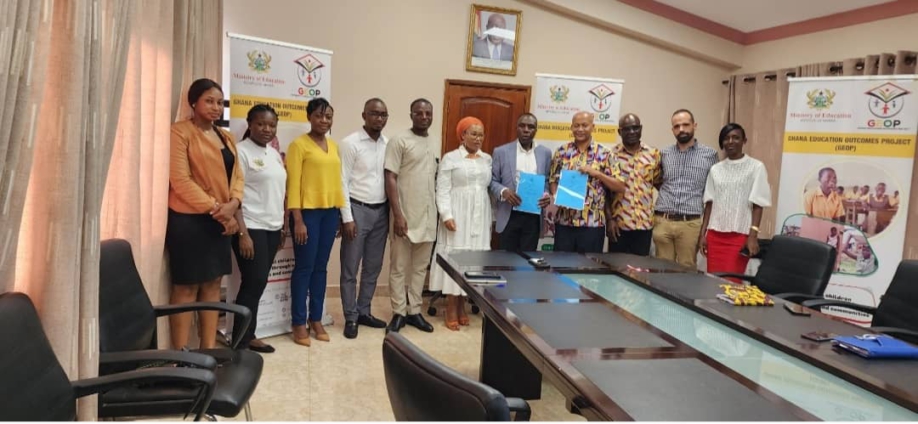
The Education Ministry (MOE) through the Ghana Education Outcomes Project (GEOP) on Wednesday signed a contract with three Service Providers (educational advocacy Non-Governmental Organizations) to bring 70,000 out-of-school children back to school.
The three service providers; Street Child UK, Plan International and School for Life Education Outcomes Project, are being funded by the Education Ministry in collaboration with its development partners with a grant facility of US 25.5 million from the Global Partnership for Results-Based Approaches (GPRBA) as additional funding for the Ghana Accountability for Learning Outcomes Project (GALOP).
Mr Divine Ayidzoe, Acting Chief Director, signed on behalf of the Education Ministry while the leadership of the three service providers signed for their institutions.
The tenets of the contract expect the service providers to help bring improvement in the quality of education in low-performing basic schools in the country, build the human capital index (amount of capital knowledge children have by the age of 18) of children by letting them acquire basic numeracy and literacy skills.
Again, the contract requires the service providers to put to help improve learning outcomes for the targeted population by re-integrating out-of-school children (OOSC) into mainstream beneficiary schools, strengthening the use of resources efficiently, introducing new capacity-building systems for teachers or facilitators in beneficiary schools and improving retention in the beneficiary schools over a period of two years.
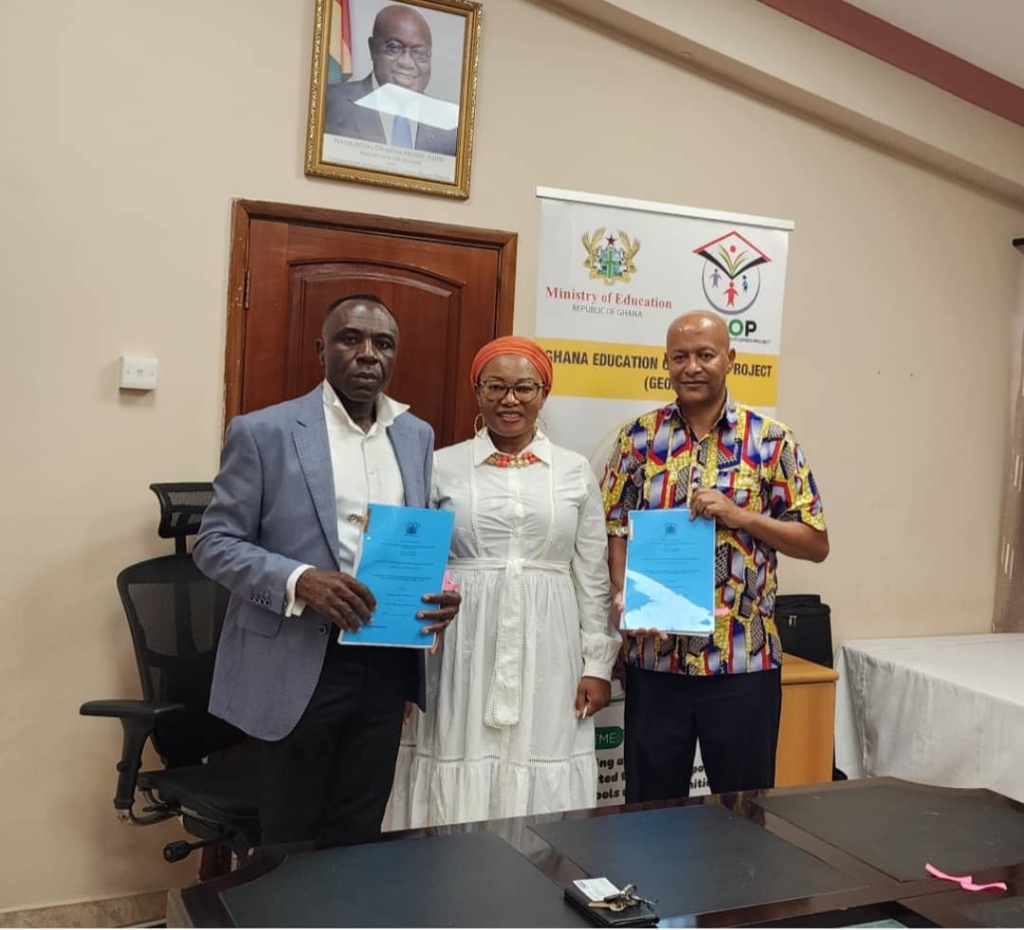
The Ag. Chief Director indicated that the project which is additional funding for the Ghana Accountability for Learning Outcomes Project has the theme, “Getting all children educated through support to schools and communities”.
He was upbeat that with good collaboration among the Ministry, the service providers and other stakeholders, many children, especially those who are out of school would go back to school to benefit from education for their own good as well as shape their dreams so they contribute towards the development of the nation.
The Ag. Chief Director pledged to create an enabling environment for the service providers and any other stakeholder in the education space to contribute towards improving education in the country.
He urged the service providers to bring all their expertise to bear to help bring improvement into the education sector as well as improve enrollment in schools through various innovations.
Project aim
The GEOP is aimed at helping improve the quality of education in selected low-performing basic schools and strengthen education sector equity and accountability in Ghana.
The project has two broad components namely the Rural Component and the Urban Component with the Rural Component targeting 60,000 out-of-school children (OOSC) in rural Ghana, specifically from selected districts in the Northern, North East, Savannah, Bono, and Oti Regions with a high prevalence of OOSC.
The Urban Component on the other hand targets 10,000 out-of-school children (OOSC) and street children in the Greater Accra and Kumasi Metropolitan Areas.
Under this component, OOSC will be trained using the nine months of Complementary Basic Education, CBE modules to help learners acquire foundational skills in literacy and numeracy.
After the nine months of CBE training, OOSC will have two options which are to either choose to be re-integrated into the mainstream schools or they will be enrolled into informal skill sets training by certified master craftsmen leading to the acquisition of the National Proficiency 1 & 11 Certificates.
Service Providers role
The service providers are expected to pre-finance the project by using their experiences and innovation in dealing with out-of-school children to bring them back to school after which KPMG, a consulting firm tasked to evaluate the project would validate the state of the results from the service providers before they are paid.
Using the Results-Based Approach would ensure that any service provider who does not get the needed results would lose his investment since the institution would not be paid for whatever job it has done.
This approach would compel them to use the best strategies and innovative approaches towards getting the best outcomes for the project.
Mr Zakaria Sulemana, Ghana Country Representative, Street Child UK, pledged to work hard with all stakeholders towards attaining the target of the project and called on all stakeholders to come together towards achieving the goals set by the project.
Latest Stories
-
Ghana begins review of 1999 National Land Policy, targets new framework by 2027
17 minutes -
Tiptoe Lane’s tech takeover: The story behind Ghana’s booming informal phone market
2 hours -
Abanga vows to use social media to counter NDC messaging ahead of 2028 elections
2 hours -
Okai Mintah seeks Sabah Zita Benson’s support for NDC National Youth Organiser bid
2 hours -
Okai Mintah vows to strengthen NDC campaign machinery ahead of 2028
2 hours -
Mother of four and Jasikan teacher among new Telecel M’ahitti Promo winners
2 hours -
International Youth Shakers Conclave 2026 set to bring global young leaders to London
2 hours -
Gov’t is committed to addressing teachers’ conditions of service, deprived-area allowance – Education Minister
2 hours -
GoldBod’s structure encouraging galamsey – Afenyo-Markin
2 hours -
Tullow starts selling Jubilee, TEN crude to Ghanaian refineries
2 hours -
Local Government Service authorises rationalisation, redistribution of staff
2 hours -
PURC assures consumers of working to ensure quality services in Northern Region
2 hours -
Ghana develops US$4.28bn water financing framework
2 hours -
Christian Council calls for protection of mission schools’ religious identity
3 hours -
Mahama holds discussions with India’s External Affairs Minister
3 hours