

Audio By Carbonatix
The recent directive by the Ministry of Education that Ghanaian languages should be used as the medium of instruction in all basic schools (KG-JHS) is neither theoretically grounded nor empirically justified. This position is supported by both historical and research-based evidence.
Ghana’s language-in-education policy has evolved through several phases. The 1951 Accelerated Development Plan established the mother tongue as the medium of instruction for the first three years of schooling, followed by English thereafter. This principle was reaffirmed in the 1961 Education Act and the 1974 Dzobo reforms, which emphasised that children learn best through a language they understand. The 2002 English-only policy disrupted this progression and proved counterproductive, as comprehension and early literacy declined sharply.
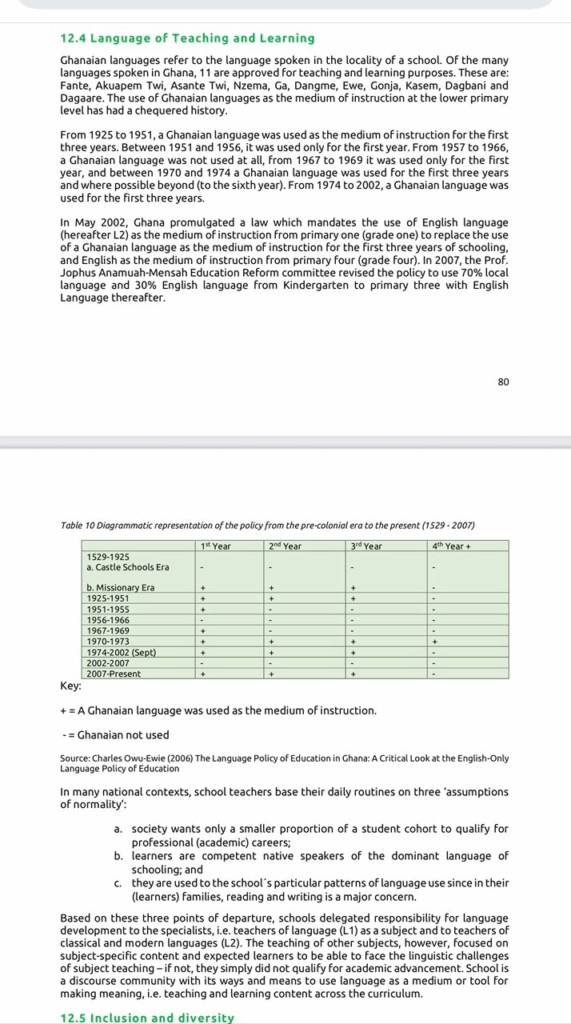
The 2007 Education Reform Committee, chaired by Professor Jophus Anamuah-Mensah, corrected this by introducing the 70 to 30 bilingual model. This model prescribed seventy per cent Ghanaian language and thirty per cent English from Kindergarten to Primary Three, with English becoming the principal medium from Primary Four. This design is not sacrosanct because of who proposed it, but because it is theoretically coherent and empirically validated for two reasons.
First, it provides a gradual and structured transition that allows learners to develop literacy and conceptual understanding through the language they know best while building competence in English, the language of higher education and global participation.
Second, Ghanaian languages have not yet developed the terminological precision required for certain technical and abstract academic concepts such as “exponent,” “denominator,” or “photosynthesis,” which makes full mother-tongue instruction beyond the early grades pedagogically impractical. Primary Four, therefore, serves as the pedagogical bridge through which learners shift from mother-tongue-based comprehension to English-medium learning without linguistic disorientation.
The theoretical foundations of this bilingual model are robust. Vygotsky’s sociocultural theory (1978) views language as the primary tool of cognitive mediation, while Cummins’ interdependence hypothesis (1979) demonstrates that proficiency in the first language supports academic competence in the second. Constructivist theory (Piaget, 1954) emphasises that learners build new knowledge upon existing linguistic and cultural foundations, and Bernstein’s code theory (1971) highlights how home language use in school bridges sociolinguistic inequality. Collectively, these perspectives affirm the cognitive and social rationale for bilingual instruction in early education.
Empirical evidence from Ghana and other countries reinforces this theoretical base. Studies by Owu-Ewie (2006) and recent evaluations such as the USAID Early Grade Reading Programme (2014–2019) and the National Literacy Acceleration Programme (2009–2014) confirm that bilingual classrooms produce stronger literacy and comprehension outcomes.
Pupils who begin learning in their mother tongue while being gradually introduced to English perform better in literacy and numeracy than those taught solely in English. International research from Kenya (Piper et al., 2018), Ethiopia (Heugh, 2011), and Gambia (Trudell, 2025) provides similar evidence that children who receive early education in their first language transition more successfully into English-medium learning in later years.
The Ministry’s new directive to extend mother-tongue instruction throughout the entire basic education cycle, including Junior High School, contradicts these theoretical and empirical foundations. Such a shift would create a serious discontinuity at the Senior High School level, where English remains the sole medium of instruction, resulting in what researchers describe as linguistic shock, a cognitive and emotional disruption that hinders learning and confidence. It would also demand extensive retraining of teachers and redevelopment of instructional materials, for which Ghana’s education system is presently unprepared.
If the Ministry insists on such a shift, it must issue a formal policy document that clearly outlines the underlying rationale, research base, and implementation roadmap. Evidence-informed policymaking requires coherence between theory, data, and institutional capacity. The current bilingual framework, with Kindergarten to Primary Three as the mother-tongue-dominant phase and Primary Four as the transition bridge, remains the most theoretically defensible, empirically validated, and contextually sustainable model for Ghana’s multilingual education system.
******
The writer is a lecturer at the University of Education, Winneba & Former Director-General of the National Council for Curriculum & Assessment.
Latest Stories
-
Ghana’s economy now resilient enough to withstand external shocks – Mahama
3 minutes -
Cocoa price adjustment painful but necessary to sustain sector – COCOBOD CEO
10 minutes -
No single African country will be treated in a manner that is preferential or advantageous – Patrice Motsepe
28 minutes -
Removal of GH₵1 levy won’t automatically lower pump prices – Arko Nokoe
42 minutes -
Decision to strip Senegal of AFCON title reflects independence of institutions – CAF President
46 minutes -
Energy Committee Vice Chair assures Ghanaians on stability amid fuel prices
1 hour -
Mahama hails 48 Engineer Regiment after successful disaster recovery mission in Jamaica
1 hour -
Rising crude prices expose flaws in ‘One Ghana Cedi’ levy – NPP MP
1 hour -
TechServe Employability Programme launched to deploy females in ICT into startups
2 hours -
Parliament passes Security and Intelligence Agencies Bill, renames NIB to BNI
2 hours -
Ghana’s fuel supply secure, but prices remain uncertain – Bulk Oil Distributors
2 hours -
Adu Boahene’s case: I’m not aware of theft or missing GH¢49m – Prosecution witness tells court
2 hours -
Ghana Deposit Protection Amendment Bill 2025 passed
3 hours -
Minority Leader warns of neglect in agriculture amid focus on gold for reserves
3 hours -
Minority alleges ‘state capture’ in mining sector, points to Ibrahim Mahama’s influence
3 hours