

Audio By Carbonatix
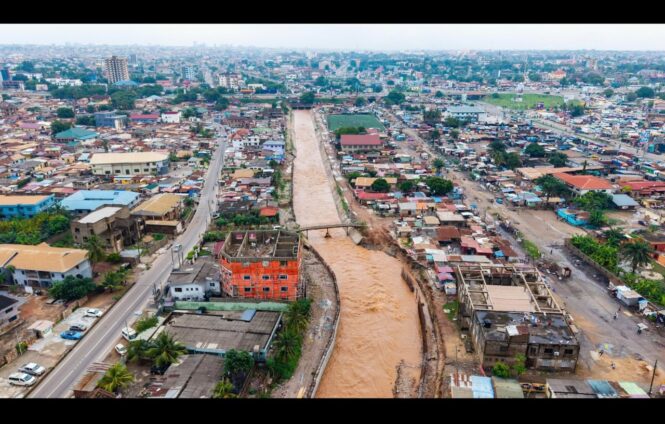
For decades, Accra has stood as Ghana's political, commercial and diplomatic capital. It has driven national growth, attracted investment and projected Ghana's image to the world. Yet today, the city that has served the nation so well is becoming increasingly vulnerable to one of the defining challenges of the twenty-first century—climate change.
Every rainy season tells the same story.
Heavy rainfall overwhelms drainage systems. Roads become rivers. Homes disappear beneath floodwaters. Businesses shut their doors. Thousands of vehicles are damaged. Public infrastructure is destroyed. Families lose their savings and, in some cases, their loved ones. Government diverts scarce resources from development to emergency response and reconstruction.
Once the floodwaters recede, Ghana prepares for the next rainy season.
This has become one of the nation's most expensive recurring disasters.
The question confronting the nation now is whether Ghana should continue concentrating the Presidency, Parliament, ministries, national security institutions, courts, financial headquarters and other strategic national assets in one of the country's most climate-exposed metropolitan areas.
According to World Bank-supported flood resilience assessments, more than US$3 billion worth of economic assets in the Greater Accra Region are exposed to flood risk. Those assets include transport infrastructure, commercial buildings, industries, hospitals, schools, utilities, government facilities and residential developments.
Climate projections indicate increasing rainfall intensity across West Africa. Combined with rapid urbanization, blocked drainage systems, loss of wetlands and rising sea levels, every year places greater volumes of public and private investment at risk.
Flooding has now shift from an environmental issue to become an economic issue and a national security threat issue.
Every major flood interrupts transport, manufacturing, banking, retail trade, telecommunications, healthcare and education. Businesses lose stock. Factories suspend production. Supply chains break down. Workers lose productive hours. Insurance claims increase. Banks face declining collateral values. Investors become increasingly cautious as climate risk begins influencing commercial property values and future investment decisions.
The government also pays a heavy price.
Billions of cedis that should finance industrialisation, education, healthcare, housing and job creation are repeatedly redirected to emergency relief, reconstruction of roads, rehabilitation of drainage systems and replacement of damaged infrastructure.
Meanwhile, ordinary Ghanaians absorb the greatest losses.
Years of savings disappear overnight. Small businesses collapse. Informal traders lose inventory with little or no insurance protection. Families are pushed back into poverty, while entire communities struggle to recover after every major flood.
The cost of rebuilding yesterday grows larger every year.
Ghana therefore needs more than improved drains.
It needs a new national resilience strategy.
One option deserving serious consideration is the gradual relocation of Ghana's administrative capital to a safer inland location while allowing Accra to continue serving as the nation's commercial, financial, maritime and diplomatic capital.
A National Capital Corridor
Rather than building an isolated capital city, Ghana has an opportunity to create one of Africa's most transformative national development projects.
The proposed Accra–Kumasi Expressway Corridor could become the backbone of a National Capital Corridor—a modern, climate-resilient administrative and economic spine linking Ghana's two largest economic regions.
A Corridor Shaped by Geography, Not Chance
One of the greatest strengths of the proposed Accra–Kumasi Expressway Corridor is its natural topography. Unlike the low-lying coastal plain around Accra, the corridor gradually rises inland onto higher and more stable terrain, providing a natural foundation for climate-resilient urban development.
The approximate elevation profile illustrates this advantage:
- Accra: 20–60 metres above mean sea level
- Adeiso: 60 metres
- Asamankese: 147 metres
- Akyem Oda: 132 metres
- Ofoase: 220–260 metres
- Lake Bosomtwe: 150 metres
- Kumasi: 250 metres
The corridor climbs steadily from the Atlantic coast through the forested uplands of the Eastern Region, briefly dips within the Birim Basin around Akyem Oda, and then rises onto the elevated Ashanti Plateau toward Kumasi.
This natural elevation offers Ghana a unique strategic advantage. Future government districts, national institutions, residential communities and critical infrastructure can be developed on higher ground that is generally less exposed to coastal flooding and tidal influences. The terrain also provides greater opportunities for gravity-assisted drainage, integrated water management and long-term climate adaptation.
Instead of concentrating future national investments within increasingly vulnerable low-lying coastal zones, Ghana can strategically guide new development toward higher inland terrain while preserving Accra as the nation's commercial and maritime gateway.
The corridor also provides sufficient space for carefully planned industrial parks, logistics hubs, universities, research centres, affordable housing, hospitals, renewable energy parks and government precincts without the severe land constraints now facing metropolitan Accra.
Learning from Global Development Corridors
Ghana would not be the first nation to use a strategic transport corridor as the foundation for long-term national development.
The corridor connecting Dubai and Abu Dhabi in the United Arab Emirates has become one of the world's most successful economic development axes, integrating highways, logistics, ports, airports, industrial zones, financial centres, residential communities and world-class infrastructure. Although the United Arab Emirates was not built along a single road, this corridor demonstrates how sustained investment in transport infrastructure can stimulate coordinated urban growth, attract global investment and strengthen national competitiveness.
Ghana has a similar opportunity.
The Accra–Kumasi Expressway Corridor could become Ghana's own National Development Corridor. Instead of permitting unplanned ribbon development, it could be master-planned with parallel arterial roads, high-speed rail, government precincts, smart cities, universities, research institutions, industrial parks, logistics hubs, renewable energy systems, digital infrastructure, hospitals, affordable housing and protected green belts.
The expressway itself would remain a protected national transport route, while parallel arterial roads would connect ministries, businesses, residential communities and public institutions. Fibre-optic networks, electricity transmission, water pipelines and future public transport systems could all be integrated into one coordinated national infrastructure corridor.
Such a vision would accomplish far more than relocating government.
It would reshape Ghana's economic geography.
It would stimulate billions of dollars in public and private investment.
It would create hundreds of thousands of skilled jobs.
It would reduce pressure on Accra while promoting balanced national development.
Most importantly, it would create a climate-resilient administrative capital designed for the next century instead of continuously repairing one designed for the last.
Countries such as Brazil, Nigeria and Indonesia have demonstrated that relocating an administrative capital can strengthen governance while supporting regional development.
Ghana now has an opportunity to go even further—not simply by relocating government, but by building a National Capital Corridor that could become the backbone of the country's economic transformation for generations.
Economic experts will argue that relocation is expensive and they are correct.
But the most pressing question regarding this is:
How much will Ghana spend over the next fifty years rebuilding flood-damaged roads, replacing destroyed infrastructure, compensating disaster victims, rehabilitating drainage systems and absorbing repeated economic disruption?
At what point does rebuilding become more expensive than strategic national planning?
History teaches that resilient nations do not wait for disasters to dictate policy.
They anticipate risk, plan boldly and invest for future generations.
Ghana has reached that moment.
This is not a proposal to abandon Accra.
It is a proposal to protect Ghana's future.
Accra will remain Ghana's commercial gateway and financial powerhouse.
But the nation's administrative future should be built where climate resilience, smart infrastructure and long-term sustainability can be guaranteed.
The rains will continue. Climate change will continue. Economic losses will continue.
The regarding question now is whether Ghana will continue rebuilding yesterday's capital—or begin building tomorrow's.
The time to begin that national conversation is now.
Latest Stories
-
Ghana explores centre of excellence for hearing, communication and cochlear implant care
41 minutes -
Schizophrenia-related disorders lead mental health cases recorded in Ghana
1 hour -
Dutch authorities enlist Ghana in hunt for fugitive drug lord Bolle Jos
1 hour -
Ghana housing finance conference adopts communiqué to improve affordable housing access
6 hours -
Special Initiatives Minister urges Wa Technical Institute to enrol more girls as EU-backed solar training lab opens
6 hours -
In the matter of my first year at the Bar
6 hours -
ActionAid Ghana calls for an end to child marriage, greater investment in girls’ rights
7 hours -
Newsfile to tackle World Cup visa scandal, beach demolitions, education strikes, BRICS bid
7 hours -
UK-Ghana Trade & Investment Summit: Trade Resource Centre to help businesses maximise UK-Ghana trade opportunities
7 hours -
Embassy of Denmark celebrates World Maritime Day
7 hours -
Linking LEAP to productive inclusion could cut extreme poverty by 2030 – UNICEF
8 hours -
Trade Ministry backs use of creative arts to rehabilitate prison inmates
9 hours -
Negotiations with government to continue despite strike suspension – GNAT
9 hours -
‘Ghana cannot afford to waste public resources; every cedi has a job’ – Ato Forson
9 hours -
Ghana expects economic boost as World Assemblies of God Congress brings 10,000 delegates to Accra
9 hours