


Audio By Carbonatix
The Nelson Mandela Foundation has asked the courts to ban "gratuitous displays" of the apartheid-era South African flag.
The foundation argues public displays of the flag amounts to "hate speech, unfair discrimination and harassment".
The flag, it added, was a celebration of the crime against humanity committed by the white minority regime against millions of South Africans.
But some have reacted angrily, saying it would limit freedom of expression.
The foundation, which was set up to continue the legacy of Mr Mandela following his tenure as South Africa's first black president, filed the application with the Equality Court in Johannesburg on Tuesday.
In a statement released the next day, it revealed it had been prompted to act after the flag was on show during the "Black Monday" protests against white farm murders last October.
During debates following the march, the foundation said, it became clear "some South Africans do not fully appreciate that apartheid was a crime against humanity... and that gratuitous displays of apartheid symbols, such as the old flag, are a celebration of that crime and a humiliation of its victims".
What is the flag?
The orange, white and blue flag was brought in in 1928, and came to represent white-minority rule during the apartheid era.
It was based on the Dutch Prince's flag, and included smaller flags of the Orange Free State, South African Republic and the British Union Jack - all reminders of the country's colonial past.
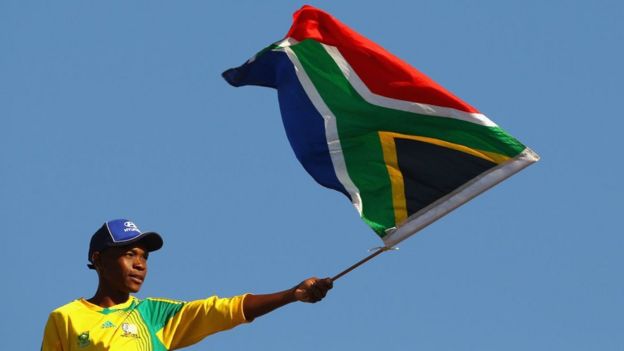
This has been the flag of South Africa since 1994
It was finally replaced in 1994 by one which sought to represent the entire "Rainbow Nation", as South Africa came to be called.
It was later revealed to have been personally approved by Mr Mandela and the current President, Cyril Ramaphosa.
So why do some people still fly it?
According to the Nelson Mandela Foundation's news release, Afriforum - which focuses on the rights of South Africa's Afrikaans population - said they understood the flag "offends dome people".
However, it argued it should not be banned as it was part of history.
Others on social media have said banning the flag would impinge on their freedom of expression.
Would it be a total ban?
No, the foundation is not calling for it to be wiped from history.
The flag would still be allowed in "museums, documentaries and cathartic creative works", it said.
Latest Stories
-
Mobile Money Merchants are driving fraud
8 minutes -
Alban Bagbin declines minority’s motion to investigate sale of gold reserves at BoG
8 minutes -
NACOC leadership tours drug testing centres in Accra
10 minutes -
OSP’s power to prosecute without AG’s authorisation unconstitutional – AG files at Supreme Court
13 minutes -
Seven African referees selected for World Cup 2026 as Ndala, Issa Sy miss out
30 minutes -
Why diaspora investors are using Accra real estate to hedge against global uncertainty in 2026
53 minutes -
GWL urges public support to stem water thefts
55 minutes -
Fire guts 2-storey apartment at Ashaley Botwe
56 minutes -
Come down and account, it’s a constitutional requirement – Martin Kpebu to Ofori-Atta
1 hour -
The power of the private courtyard: How regalia is redefining resort-style living in Accra
1 hour -
Beyond roads and bridges: Understanding the true role of your MP
1 hour -
UK says Russia ran submarine operation over cables and pipelines
1 hour -
NPRA recovers GH¢27m in 2025, 30% of defaulted pension contributions
1 hour -
Power fluctuations slash Ashanti region water production by 959,000 cubic metres in March
1 hour -
Beyond the festivities: Gomoa must turn visibility into development
2 hours