

Audio By Carbonatix
The first nest of Asian giant hornets found in the US has successfully been destroyed by scientists.
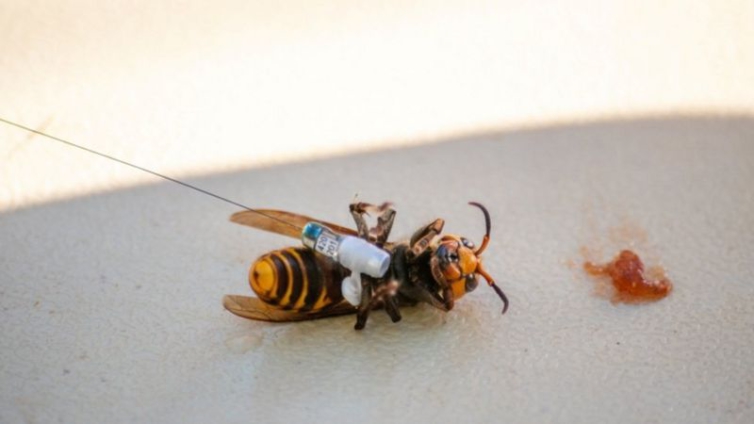
The nest, in the state of Washington, was found by putting tracker devices on the hornets and it was sucked out of a tree using a vacuum hose.
The invasive species insects, known as "murder hornets", have a powerful sting and can spit venom.
After weeks of searching, crews from Washington State's Agriculture Department destroyed the first nest of so-called murder hornets found in the U.S. The large invasive hornets can leave painful stings, but pose a bigger threat to honeybees than humans. https://t.co/L8wJWF6rSx
— The Associated Press (@AP) October 24, 2020
They target honeybees, which pollinate crops, and can destroy a colony in just a matter of hours.
The nest in Washington was found when entomologists, scientists that study insects, used dental gloss to tie tracking devices to three hornets.
The nest of around 200 insects was then discovered in the city of Blaine close to the Canadian border.
On Saturday, a crew of scientists wearing protective suits vacuumed the insects from the tree, which will now be cut down to remove any further nests.
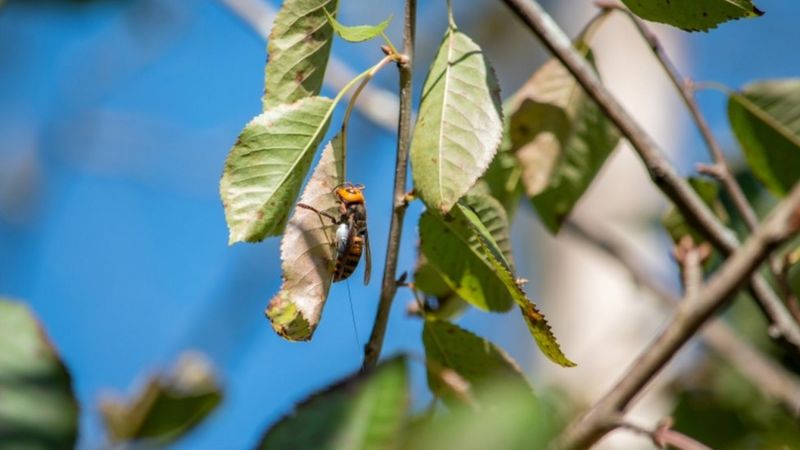
Asian giant hornets are the among the world's largest wasps - the queens can reach over 5cm (2in) long.
Their venomous sting can penetrate humans' protective clothing but the number of people they kill each year is low - about 40 annually in Asia, according to the Smithsonian museum in Washington D.C.
Normally their natural habitat is in areas of Asia from China to Japan, but in 2019 there were several sightings of single "murder hornets" in North America.
A nest was destroyed in Vancouver Island in Canada in December last year.
Globally, conservationists are deeply concerned about falling insect populations. But it can be permissible to kill some insects if they are an invasive species - one that is not native to an area and preys on other insects there.
Honeybees are under threat due to loss of food after habitat destruction, pesticides, and disease.
When an Asian giant hornet enters a honeybee colony, it begins a "slaughter phrase" in which it kills bee after bee and can destroy the colony in a few hours.
Latest Stories
-
Iran–US conflict pushes fertilizer prices higher, raising food security risks in 2026
2 minutes -
Iran using children in security roles in war, reports and witnesses say
5 minutes -
Evalue-Ajomoro-Gwira MP pledges to safeguard peace in Lower Axim and Nsein
8 minutes -
Global collaboration in focus as Malaysia courts Ghanaian top business executives
16 minutes -
Bondaye Residents accuse Heath Goldfields of unsafe mining and broken promises
20 minutes -
Evalue Ajomoro Gwira MP calls for calm amid Lower Axim and Nsein chieftaincy tensions
29 minutes -
I know the President listens and he will – Franklin Cudjoe
49 minutes -
Former AG Godfred Dame demands retraction from Kwakye Ofosu over galamsey claims
49 minutes -
All Big Push contractors paid, projects on track – Roads Minister
1 hour -
Photos: Mahama meets CSOs on accountability, anti-corruption and governance
1 hour -
Big Push prioritises precision, quality and value – Roads Minister Agbodza
1 hour -
Big Push agenda targets local contractor development – Agbodza
1 hour -
Between memory and partnership: Ghana’s moral test on reparatory justice
1 hour -
“OSP has always lacked the opportunity to speak” – Samuel Appiah-Darko
1 hour -
Local experts unlock pension capital as Ci Gaba Fund raises GH¢380m to finance SMEs
1 hour