


Audio By Carbonatix
North Korea appears to be building new ballistic missiles despite recent warming ties with the Trump administration and pledges to denuclearise, reports say.
Unnamed US officials told the Washington Post that spy satellites had spotted continuing activity at a site that has produced ballistic missiles.
Reuters quotes an official as saying it is unclear how far the work has gone.
Donald Trump met North Korea's Kim Jong-un in Singapore in June.
After the first meeting between sitting leaders from the two countries, the two men pledged to work towards denuclearisation. Mr Trump later said North Korea was "no longer a nuclear threat".
But Mr Trump was criticised at home for making concessions without securing any firm commitment from Mr Kim to end the nuclear and missile programmes.
These are not the first reports that North Korea may be continuing its weapons programme, casting doubt on the real impact of the summit in Singapore.
What do the latest reports say?
On Monday, the Washington Post newspaper quoted officials as saying North Korea appeared to be building one or two new liquid-fuelled intercontinental ballistic missiles (ICBMs) at the Sanumdong facility near the capital, Pyongyang.
The factory is known to have produced the Hwasong-15, the first North Korean ICBM capable of reaching the US.
However, a US official told news agency Reuters that a liquid-fuelled ICBM didn't "pose nearly the threat that a solid-fuelled one would because they take so long to fuel".
Reuters also added that satellite imaging showed vehicles moving in and out of the facility, but not the extent of any missile construction.
What are experts saying about this?
Satellite imagery of the Sanumdong facility shows that the site is "active", Jeffrey Lewis, a nuclear expert at the Middlebury Institute of International Studies (MIIS) told the Washington Post.
"[The facility] is not dead, by any stretch of the imagination," said Mr Lewis. "We see shipping containers and vehicles coming and going. This is a facility where they build ICBMs and space-launch vehicles."
To be clear, we could not confirm all parts of the leak. 1/https://t.co/bo2fC5l1Vq
— Melissa Hanham (@mhanham) July 31, 2018
Another North Korean expert from MIIS, Melissa Hanham, told the BBC that the facility had "regular traffic in and out of the building", adding that this "traffic pattern" on the site stayed "about the same through the Panmunjom and Singapore meetings".
This indicated that there had not been a complete stop in activity during the summit talks.
She also noted that large "brightly coloured containers" also showed up in satellite imagery, saying that "containers similar to these have appeared during previous ICBM inspections by Mr Kim."
Ms Hanham added that while that experts at MIIS could not "find a way to confirm the [intelligence] leak", the information has matched evidence from satellite imagery.
What was agreed on in the Singapore summit?
North Korea has carried out a total of six nuclear tests, the most recent of which took place in September last year. It has in the past two years quickly advanced its nuclear programme.
But at their landmark meeting in Singapore, Mr Trump and Mr Kim agreed to work towards the "complete denuclearisation of the Korean Peninsula".
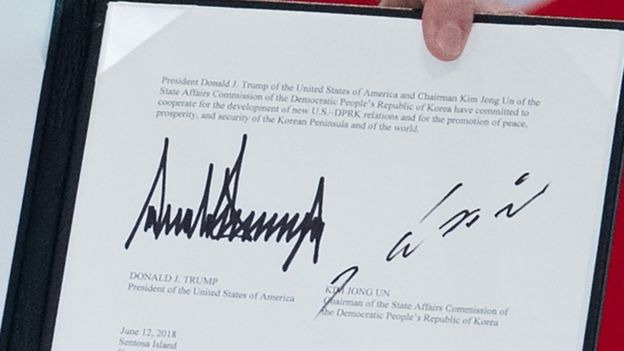
The pair signed a document pledging they would work towards new relations
It's been unclear what both sides mean by "complete denuclearisation", and no further details have been released about when or how Pyongyang would renounce its nuclear weapons nor how the process would be verified.
Experts have also cast doubt on whether Pyongyang has been genuine in its apparent commitment to "denuclearise".
Last week, it appeared North Korea had begun dismantling part of a key rocket launch site, but according to recent reports based on US intelligence leaks, Pyongyang might still secretly be continuing its nuclear weapons programme.
Reports had indicated that North Korea was upgrading its only official nuclear enrichment site, and was stepping up enrichment at other secret sites.
Last week, US Secretary of State Mike Pompeo was forced to admit that North Korea was continuing to produce nuclear fissile material, though he insisted that "progress is happening".
Latest Stories
-
BoG Governor urges unified national action to reform gold sector and halt economic losses
3 minutes -
Wendy Shay wins Best Female Artiste Western Africa at 2025 AFRIMA
4 minutes -
NPP Karaga delegates endorse Bawumia massively as hundreds turn up to receive him
10 minutes -
Sarkodie wasn’t aware Ebo Noah would be at 2025 Rapperholic – DJ Mensah
12 minutes -
Passenger arrivals at airport drop marginally in 9-months of 2025, but container traffic at habours up 20.6% – BoG
12 minutes -
Water crisis in Teshie enclave worsens as desalination plant remains shut over debts
20 minutes -
Implications of US withdrawal from Global Climate Treaties for Ghana and Africa
21 minutes -
KATH forced to detain patients over unpaid bills amid rising cost pressures
25 minutes -
Underground Mining Alliance awards GH¢504m in scholarships to 57 students, apprentices in Ahafo Region
27 minutes -
Construction sector activities declined by 4% in quarter 3, 2025 – BoG
28 minutes -
Prince Amoako Jnr set to wear iconic No.10 jersey at FC Nordsjaelland
31 minutes -
Deposit mobilisation strategy strengthens NIB PLC’s financial performance
32 minutes -
Manufacturing sector activities improved in 9-months of 2025; direct taxes collected increased by 18%
36 minutes -
2026 U-17 WWC: Black Maidens to face Togo in first round of qualifiers
45 minutes -
We have been keen on monitoring loan performance – Opportunity International CEO
49 minutes