

Audio By Carbonatix
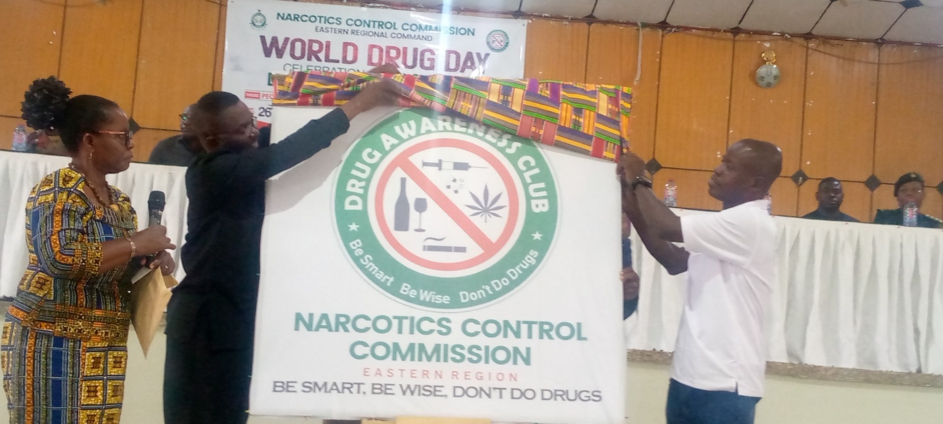
The Narcotics Control Commission in the Eastern Region has launched a drug awareness club and a book for schools in the region to help students understand more about the adverse effects of drug use on the body.
Senior Narcotic Control Officer and the Eastern Regional Commander of the Narcotics Control Commission, Mr. Felix Sarfo Yeboah addressed the event and said that the club would operate in both basic and senior high schools.
The objective is to educate students about the need to stop stigmatising individuals with substance use disorders and to instead strengthen the substance abuse prevention campaign.
In addition, the book will serve as a guide for school-based facilitators who will lead the club in educating students about substance abuse, a move that is anticipated to foster the growth of resourcefulness and autonomy.
Mr. Yeboah gave highlights of the contents of the book which included guiding individuals to set goals, figuring out what to do with their life, dealing with resistance, learning life skills, drugs, and communicating.
Abusing drugs means taking them in large amounts or in ways that hurt you or other people, while certain drugs make the brain feel good.
Ms. Patricia Birago Gyamfi, the Eastern Regional Coordinator for Girl Child Education at the Ghana Education Service, Mr. John A. Donkor, the Chief Director at the Eastern Regional Coordinating Council, and Mr. Yeboah introduced the drug awareness club, with the theme "Be smart, be wise, don't do drugs."
Ms. Gyamfi said that she thought the number of people who use drugs was going up and that it was scary that many young people had mental health issues.
She stressed how important it was to teach the people more about drug use and keep kids from using drugs, which is bad for national growth.
She also talked about how important it was to raise good leaders for the social and economic growth of the country.
The Eastern Regional Coordinator for Girl Child Education at the Ghana Education Service said that stigmatisation was another thing that made it hard for people with drug use problems to get health care and other kinds of help because it hurt their self-esteem and made them feel ashamed.
Latest Stories
-
Edmond Boateng takes up secretary role at Honorary Consular Corps of Ghana
3 hours -
Gambia appoints British barrister to prosecute gruesome Jammeh-era crimes
4 hours -
Girl group Flo on entering into their ‘bombastic, confident, strong’ era
4 hours -
Germany suspends military approval for long stays abroad for men under 45
4 hours -
Liverpool face uphill Champions League task after PSG thrashing in Paris
4 hours -
‘Ketamine Queen’ sentenced to 15 years in Matthew Perry overdose death
4 hours -
Nigeria begins mass trial of 500 terrorism suspects
4 hours -
Atletico Madrid stun 10-man Barcelona to seize Champions League semi-final advantage
5 hours -
Black Stars coach to be announced by next week – Sports Minister
5 hours -
Chiefs, queen mothers and principal elders of Odau group denounce ‘rebellious Etweresohene’, pledges allegiance to Okyenhene
5 hours -
KNUST library dress code sparks online backlash over strict rules
5 hours -
Cultural Diplomacy in Action: Ghanaian youth leaders present symbolic smock to U.S. Chargé d’Affaires
5 hours -
Ghana Card payment activation under review – NIA breaks silence on financial integration
6 hours -
Ofori-Atta’s ICE release on bail positive; he poses no risk – Amanda Clinton
6 hours -
Ken Ofori-Atta’s passport seized after bail, set to reappear in US Court on April 27
6 hours