

Audio By Carbonatix
Getting water from the ground is capital intensive and laborious.
Climate change has also worsened the reliability of these groundwater systems.
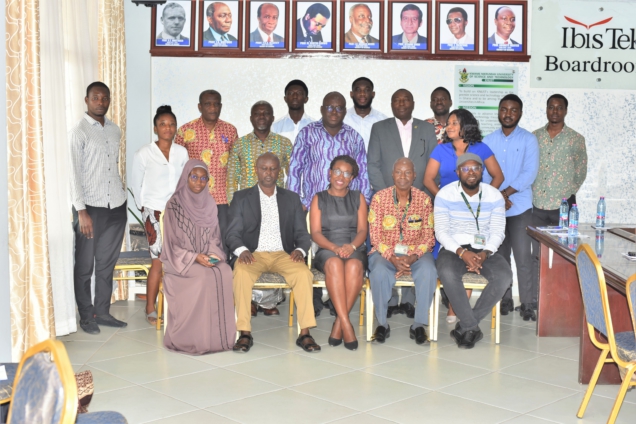
The Kwame Nkrumah University of Science and Technology (KNUST), is therefore employing artificial intelligence to predict water availability in the ground.
The project is dubbed Rapid Assessment of Groundwater Availability (RAGA).
According to the Principal investigator, Dr. Cyril Boateng of the Department of Physics, the project will build an AI-based system for groundwater which can be accessed by the public through their smartphones and computers.
“We seek to develop an innovative web-based artificial intelligence driven open-source framework to predict groundwater availability in Ghana.
“We intend to achieve this aim by building a database of spatio-temporal hydrogeological, and climate variables; developing AI algorithms and workflows for integration of varied data sources and prediction of groundwater availability and developing an open-source web-based application for rapid groundwater availability assessment to be used by stakeholders and the general populace,” he explained.
Partners in the 1-year project include, Departments of Physics, Meteorology and Climate Science, Computer Science and Geological Engineering of KNUST. Also involved are the Water Resources Commission and the CSIR-Water Research Institute.
Provost of the College of Science, Prof. Leonard Amekudzi is happy the project will build the profile of early-career researchers and foster research collaboration.
“The project is seeing the College of Science collaborating with the College of Engineering, CSIR among others. The project team is mainly made up of early-career researchers and it’ll therefore build their capacities,” he said.
Prof. Amekudzi added: “The project will contribute to KNUST’s agenda of carrying out impactful research since water accessibility has become critical in the face of the illegal mining menace.”
The project is part of the Responsible Artificial Intelligence Network for Climate Action in Africa (RAINCA) Hub.
The hub is funded by the Canadian International Development Center (IDRC) through three institutions, namely the West African Science Service Center on Climate Change and Adapted Land Use (WASCAL), the Regional Universities Forum for Capacity Building in Agriculture (RUFORUM), and AKADEMIYA2063.
Latest Stories
-
Mahama’s push for visa-free Africa reflects Nkrumah’s Pan-African vision – Rashid Tanko-Computer
5 minutes -
Redefining sweetness: Why our celebrations must heal, not harm
6 minutes -
IMANI urges Mahama to reaffirm his 2014 directive on competitive state insurance placements
7 minutes -
Maiden Katon Praise comes off at Accra Sports Stadium on April 17
19 minutes -
Families flock to Luv FM Easter party at Rattray park in Kumasi
35 minutes -
Rural health worker laments overwhelming burden at CHPS compounds
55 minutes -
Katon Meet to stream Accra stadium Katon Praise Concert worldwide
57 minutes -
Gov’t considers exploring local raw materials to stabilise production costs of sachet water prices
1 hour -
Mahama in Paris: Turning Diplomacy into Delivery
1 hour -
Middle East crisis shows Ghana needs to diversify energy sources – Energy expert
2 hours -
Government of Ghana Internal Revenue Generation cannot fund Big Push in Four Years
2 hours -
EPCG Moderator urges leaders to serve with courage and humility in Easter message
3 hours -
The Cobra at the gate: When good intentions overrun the system
3 hours -
Easter service disrupted in Nyanyano as suspected land guards storm church event
3 hours -
Price surge exposing NDC gov’ts dishonesty -Titus Glover
3 hours