

Audio By Carbonatix
France's ambassador has remained in Niger despite being given a 48-hour deadline to leave the country last Friday, French President Emmanuel Macron confirmed in a defiant speech.
Ambassador Sylvain Itte had been ordered to go amid rapidly deteriorating bilateral ties.
But hours after the coup leaders' deadline had passed, the president said he "applauds" Mr Itte for staying put.
The junta overthrew Niger's elected president last month.
In a major foreign policy speech to ambassadors gathered in Paris as well as others listening remotely, Mr Macron said: "France and its diplomats have faced particularly difficult situations in some countries in recent months, from Sudan, where France has been exemplary, to Niger at this very moment.
"I applaud your colleague and your colleagues who are listening from their posts."
Niger's President Mohamed Bazoum was toppled on 26 July in a coup that has been condemned by France and many of Niger's neighbours, including the West African regional bloc Ecowas.
Ambassador Itte had refused to meet Niger's new leaders after the coup, the junta said on Friday, as it announced the French ambassador had 48 hours to leave.
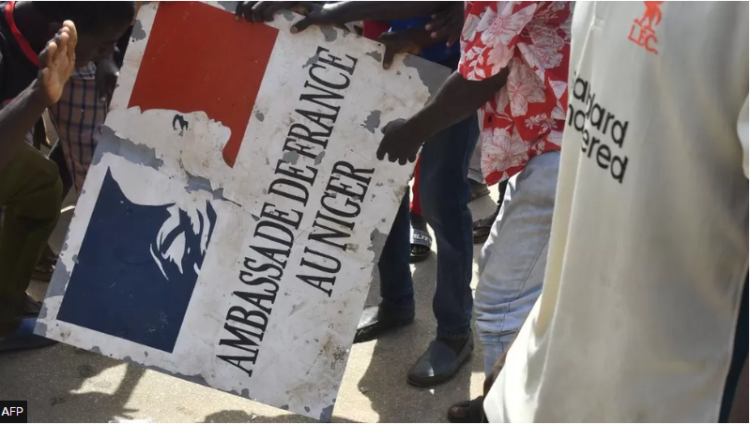
Thousands of Nigeriens in favour of the coup demonstrated on Sunday near the French military base in the capital, Niamey.
Some held signs demanding the departure of French troops, while footage posted on social media appears to show local Muslim imams leading prayers outside the base.
In Monday's speech, Mr Macron defended France's military presence in Niger, stating that without intervention from Paris, the country would "no longer exist" with its "existing borders".
Neighbours Mali and Burkina Faso would also have suffered the same fate without France, Mr Macron said.
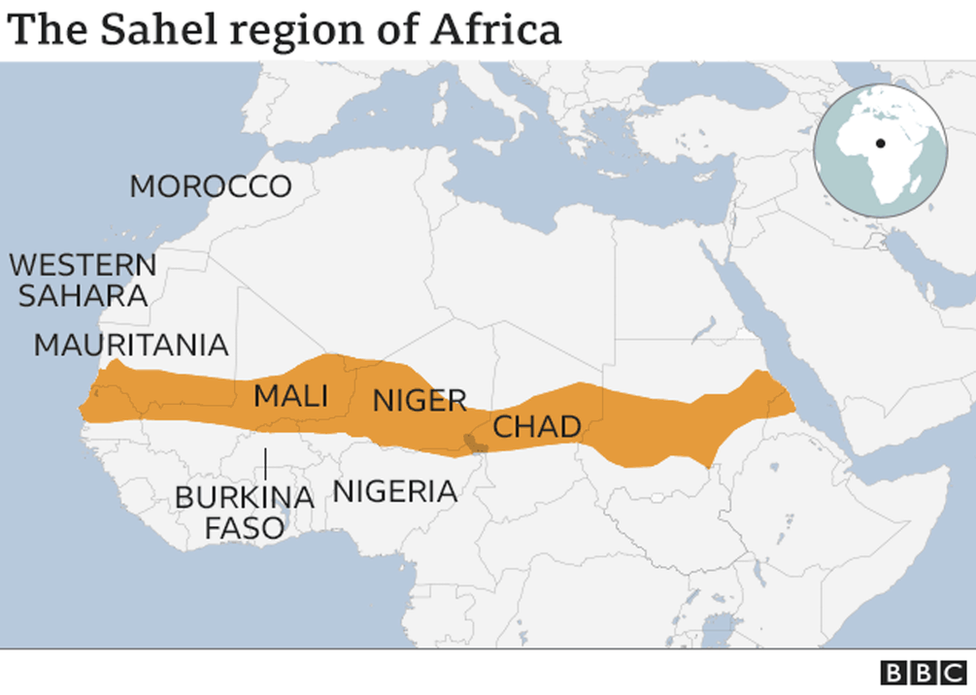
France carried out a decade-long operation to fight Islamic insurgents in Niger, Mali, Burkina Faso, Chad and Mauritania - all former French colonies - up until last year.
At its high point, around 5,500 French soldiers were stationed in the African countries.
However, anti-French sentiment and protests in the region intensified recently, with some opponents complaining France's intervention was a modern form of colonialism.
Others noted that the troops have not been able to overcome the threat from jihadists, whose deadly attacks on communities continue.
Amid this insecurity, soldiers in Mali, Burkina Faso and more recently Niger launched coups, saying a change of leadership was necessary to tackle the jihadists.
Mali's military government has called on the Russian mercenary group Wagner to help fight the Islamist militants. It is suspected that the mercenaries could be active in the wider region.
Latest Stories
-
Accra Athletics Open Championships conclude with strong performances ahead of African Championships
46 seconds -
Ghana to begin camping with 12 athletes after Accra Open Championships – Bawa Fuseni
22 minutes -
Anthony Joshua declines showdown with Tyson Fury but admits they ‘probably’ clash next
35 minutes -
Tyson Fury dominates Makhmudov, calls out Joshua next
55 minutes -
I have supported highway authority financially to fix roads in my constituency – A Plus
2 hours -
US, Iran fail to reach peace agreement after marathon talks in Pakistan
2 hours -
ECG kicks off Phase Two of transformer upgrades at Lashibi; brief outages expected
3 hours -
Port crises loom as 11,000 drivers threaten four-day strike
4 hours -
A source of excellence across generations – Vice President Opoku-Agyemang lauds Mfantsipim
5 hours -
(Photos) Mfantsipim School launches historic 150th anniversary
5 hours -
Knights and Ladies of Marshall group backs Catholic Bishops’ stance on anti-LGBTQ+
6 hours -
Bright Simons writes: All the Filla in the Ibrahim Mahama/E&P – Gold Fields Saga
6 hours -
Monetise Idiocy In Ghana
7 hours -
The Ghanaian prophet and the mysterious death of his scottish wife Charmain Speirs
7 hours -
Nearly 400 sentenced in Nigeria for links to militant Islamists
8 hours